 Français
 English
Rb (Phospho Thr252) rabbit pAb
AO-06-ES20170-50

| ELK.No | ES20170 |
| Product name | Rb (Phospho Thr252) rabbit pAb |
| Reactivity | Human;Mouse;Rat |
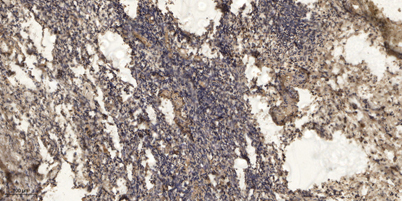
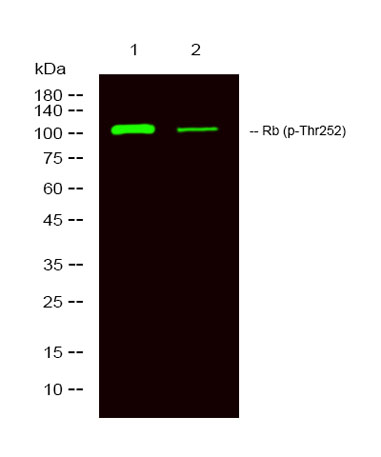
| Applications | WB;ELISA;IHC |
| Other name | Retinoblastoma-associated protein (p105-Rb;pRb;Rb;pp110) |
| Size | 50μL |
| Unit price ($) | 148 |
| Human gene ID | 5925 |
| Human Swiss-Prot | P06400 |
| Source | Rabbit |
| Isotype | IgG |
| Target | Rb |
| Fields | >>Endocrine resistance;>>Cell cycle;>>Cellular senescence;>>Cushing syndrome;>>Hepatitis C;>>Hepatitis B;>>Human cytomegalovirus infection;>>Human papillomavirus infection;>>Human T-cell leukemia virus 1 infection;>>Kaposi sarcoma-associated herpesvirus infection;>>Epstein-Barr virus infection;>>Pathways in cancer;>>Viral carcinogenesis;>>Chemical carcinogenesis - receptor activation;>>Pancreatic cancer;>>Glioma;>>Prostate cancer;>>Melanoma;>>Bladder cancer;>>Chronic myeloid leukemia;>>Small cell lung cancer;>>Non-small cell lung cancer;>>Breast cancer;>>Hepatocellular carcinoma;>>Gastric cancer |
| Gene name | RB1 |
| Protein name | Rb (Phospho Thr252) |
| Human gene link | View Human Gene |
| Human Swiss link | View Human Swiss-Prot |
| Mouse gene ID | 19645 |
| Mouse gene link | View Mouse Gene |
| Mouse Swiss-Prot | P13405 |
| Mouse Swiss link | View Mouse Swiss-Prot |
| Rat gene ID | 24708 |
| Rat gene link | View Rat Gene |
| Rat Swiss-Prot | P33568 |
| Rat Swiss link | View Rat Swiss-Prot |
| Immunogen | Synthesized peptide derived from human Rb (Phospho Thr252) |
| Specificity | This antibody detects endogenous levels of Human,Mouse,Rat Rb (Phospho Thr252) |
| Formulation | Liquid in PBS containing 50% glycerol, 0.5% BSA and 0.02% sodium azide. |
| Clonality | Polyclonal |
| Dilution | WB 1:500-2000;IHC-p 1:50-300; ELISA 2000-20000 |
| Purification | The antibody was affinity-purified from rabbit serum by affinity-chromatography using specific immunogen. |
| Concentration | 1 mg/ml |
| Storage stability | -20°C/1 year |
| Molecular Weight (Da) | |
| Observed band (KD) | 106kD |
| Background | disease:Defects in RB1 are a cause of bladder cancer [MIM:109800].,disease:Defects in RB1 are a cause of osteogenic sarcoma [MIM:259500].,disease:Defects in RB1 are the cause of childhood cancer retinoblastoma (RB) [MIM:180200]. RB is a congenital malignant tumor that arises from the nuclear layers of the retina. It occurs in about 1:20'000 live births and represents about 2% of childhood malignancies. It is bilateral in about 30% of cases. Although most RB appear sporadically, about 20% are transmitted as an autosomal dominant trait with incomplete penetrance. The diagnosis is usually made before the age of 2 years when strabismus or a gray to yellow reflex from pupil ("cat eye") is investigated.,function:Key regulator of entry into cell division that acts as a tumor suppressor. Acts as a transcription repressor of E2F1 target genes. The underphosphorylated, active form of RB1 interacts with E2F1 and represses its transcription activity, leading to cell cycle arrest. Directly involved in heterochromatin formation by maintaining overall chromatin structure and, in particular, that of constitutive heterochromatin by stabilizing histone methylation. Recruits and targets histone methyltransferases SUV39H1, SUV420H1 and SUV420H2, leading to epigenetic transcriptional repression. Controls histone H4 'Lys-20' trimethylation. Inhibits the intrinsic kinase activity of TAF1. In case of viral infections, interactions with SV40 large T antigen, HPV E7 protein or adenovirus E1A protein induce the disassembly of RB1-E2F1 complex thereby disrupting RB1's activity.,online information:RB1 mutation db,online information:Retinoblastoma protein entry,PTM:Phosphorylated in G1, thereby releasing E2F1 which is then able to activate cell growth. Dephosphorylated at the late M phase. SV40 large T antigen, HPV E7 and adenovirus E1A bind to the underphosphorylated, active form of pRb.,similarity:Belongs to the retinoblastoma protein (RB) family.,subunit:Interacts with ATAD5 (By similarity). The hypophosphorylated form interacts with and sequesters the E2F1 transcription factor. The unphosphorylated form interacts with ARID3B, KDM5A, SUV39H1, MJD2A/JHDM3A and THOC1. Interacts with the N-terminal domain of TAF1. Interacts with AATF, DNMT1, LIN9, LMNA, SUV420H1, SUV420H2, PELP1 and TMPO-alpha. May interact with NDC80. Interacts with EID1 and UBR4. Interacts with ARID4A and KDM5B. Interacts with E4F1. Interacts with adenovirus E1A protein, HPV E7 protein and SV40 large T antigen.,tissue specificity:Expressed in the retina., |
| Function | cell cycle checkpoint, G1/S transition of mitotic cell cycle, regulation of transcription of G1/S-phase of mitotic cell cycle,negative regulation of transcription from RNA polymerase II promoter, mitotic cell cycle, M phase, regulation of cell growth, immune system development, regulation of myeloid leukocyte differentiation, positive regulation of myeloid leukocyte differentiation, chromatin organization, chromatin remodeling, transcription, regulation of transcription, DNA-dependent, regulation of transcription from RNA polymerase II promoter, negative regulation of protein kinase activity,cell cycle, cell cycle arrest, regulation of S phase of mitotic cell cycle, intracellular signaling cascade, regulation of mitotic cell cycle, negative regulation of cell proliferation, regulation of cell size, negative regulation of biosynthetic process, positive regulation of biosynthetic process, |
| Subcellular location | Nucleus . During keratinocyte differentiation, acetylation by KAT2B/PCAF is required for nuclear localization. . |
| Expression | Expressed in the retina. Expressed in foreskin keratinocytes (at protein level) (PubMed:20940255). |

Use collapsible tabs for more detailed information that will help customers make a purchasing decision.
Ex: Shipping and return policies, size guides, and other common questions.