 Français
 English
14-3-3σ (Phospho Ser186) rabbit pAb
AO-06-ES20196-50

| ELK.No | ES20196 |
| Product name | 14-3-3σ (Phospho Ser186) rabbit pAb |
| Reactivity | Human;Mouse |
| Applications | WB; ELISA |
| Other name | 14-3-3 protein sigma (Epithelial cell marker protein 1;Stratifin) |
| Size | 50μL |
| Unit price ($) | 148 |
| Human gene ID | 2810 |
| Human Swiss-Prot | P31947 |
| Source | Rabbit |
| Isotype | IgG |
| Target | 14-3-3σ |
| Fields | >>Cell cycle;>>p53 signaling pathway;>>Aldosterone-regulated sodium reabsorption |
| Gene name | SFN HME1 |
| Protein name | 14-3-3σ (Phospho Ser186) |
| Human gene link | View Human Gene |
| Human Swiss link | View Human Swiss-Prot |
| Mouse gene ID | 55948 |
| Mouse gene link | View Mouse Gene |
| Mouse Swiss-Prot | O70456 |
| Mouse Swiss link | View Mouse Swiss-Prot |
| Rat gene ID | |
| Rat gene link | |
| Rat Swiss-Prot | |
| Rat Swiss link | |
| Immunogen | Synthesized peptide derived from human 14-3-3σ (Phospho Ser186) |
| Specificity | This antibody detects endogenous levels of Human,Mouse 14-3-3σ (Phospho Ser186) |
| Formulation | Liquid in PBS containing 50% glycerol, 0.5% BSA and 0.02% sodium azide. |
| Clonality | Polyclonal |
| Dilution | WB 1:1000-2000 ELISA 1:5000-20000 |
| Purification | The antibody was affinity-purified from rabbit serum by affinity-chromatography using specific immunogen. |
| Concentration | 1 mg/ml |
| Storage stability | -20°C/1 year |
| Molecular Weight (Da) | |
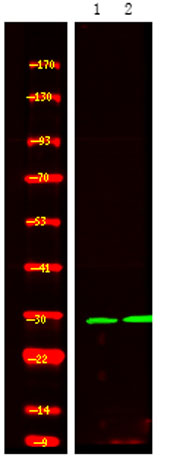
| Observed band (KD) | 30kD |
| Background | function:Adapter protein implicated in the regulation of a large spectrum of both general and specialized signaling pathway. Binds to a large number of partners, usually by recognition of a phosphoserine or phosphothreonine motif. Binding generally results in the modulation of the activity of the binding partner. When bound to KRT17, regulates protein synthesis and epithelial cell growth by stimulating Akt/mTOR pathway.,function:p53-regulated inhibitor of G2/M progression.,similarity:Belongs to the 14-3-3 family.,subcellular location:May be secreted by a non-classical secretory pathway.,subunit:Homodimer. Interacts with KRT17 (By similarity). Found in a complex with XPO7, EIF4A1, ARHGAP1, VPS26A, VPS29, VPS35 and SFN.,tissue specificity:Present mainly in tissues enriched in stratified squamous keratinising epithelium., |
| Function | function:Adapter protein implicated in the regulation of a large spectrum of both general and specialized signaling pathway. Binds to a large number of partners, usually by recognition of a phosphoserine or phosphothreonine motif. Binding generally results in the modulation of the activity of the binding partner. When bound to KRT17, regulates protein synthesis and epithelial cell growth by stimulating Akt/mTOR pathway.,function:p53-regulated inhibitor of G2/M progression.,similarity:Belongs to the 14-3-3 family.,subcellular location:May be secreted by a non-classical secretory pathway.,subunit:Homodimer. Interacts with KRT17 (By similarity). Found in a complex with XPO7, EIF4A1, ARHGAP1, VPS26A, VPS29, VPS35 and SFN.,tissue specificity:Present mainly in tissues enriched in stratified squamous keratinising epithelium., |
| Subcellular location | Cytoplasm. Nucleus . Secreted. May be secreted by a non-classical secretory pathway. |
| Expression | Present mainly in tissues enriched in stratified squamous keratinizing epithelium. |

Use collapsible tabs for more detailed information that will help customers make a purchasing decision.
Ex: Shipping and return policies, size guides, and other common questions.