 Français
 English

| ELK.No | ES2127 |
| Product name | Cytokeratin 17 rabbit pAb |
| Reactivity | Human;Mouse;Rat |
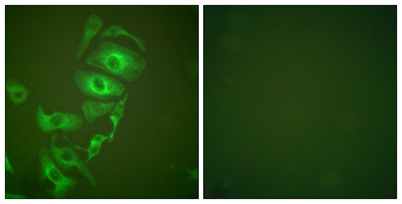
| Applications | WB;IHC;IF;ELISA |
| Other name | KRT17; Keratin; type I cytoskeletal 17; 39.1; Cytokeratin-17; CK-17; Keratin-17; K17 |
| Size | 50μL |
| Unit price ($) | 148 |
| Human gene ID | 3872 |
| Human Swiss-Prot | Q04695 |
| Source | Rabbit |
| Isotype | IgG |
| Target | Cytokeratin 17 |
| Fields | >>Estrogen signaling pathway;>>Staphylococcus aureus infection |
| Gene name | KRT17 |
| Protein name | Keratin type I cytoskeletal 17 |
| Human gene link | View Human Gene |
| Human Swiss link | View Human Swiss-Prot |
| Mouse gene ID | 16667 |
| Mouse gene link | View Mouse Gene |
| Mouse Swiss-Prot | Q9QWL7 |
| Mouse Swiss link | View Mouse Swiss-Prot |
| Rat gene ID | 287702 |
| Rat gene link | View Rat Gene |
| Rat Swiss-Prot | Q6IFU8 |
| Rat Swiss link | View Rat Swiss-Prot |
| Immunogen | The antiserum was produced against synthesized peptide derived from human Keratin 17. AA range:381-430 |
| Specificity | Cytokeratin 17 Polyclonal Antibody detects endogenous levels of Cytokeratin 17 protein. |
| Formulation | Liquid in PBS containing 50% glycerol, 0.5% BSA and 0.02% sodium azide. |
| Clonality | Polyclonal |
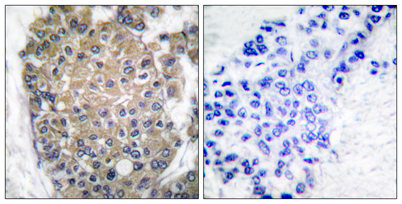
| Dilution | Western Blot: 1/500 - 1/2000. Immunohistochemistry: 1/100 - 1/300. Immunofluorescence: 1/200 - 1/1000. ELISA: 1/20000. Not yet tested in other applications. |
| Purification | The antibody was affinity-purified from rabbit antiserum by affinity-chromatography using epitope-specific immunogen. |
| Concentration | 1 mg/ml |
| Storage stability | -20°C/1 year |
| Molecular Weight (Da) | |
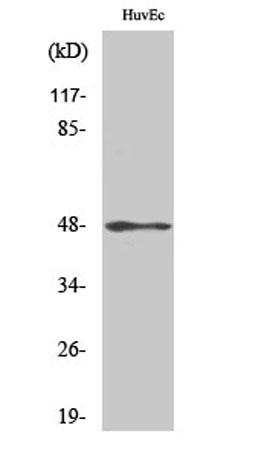
| Observed band (KD) | 48kD |
| Background | This gene encodes the type I intermediate filament chain keratin 17, expressed in nail bed, hair follicle, sebaceous glands, and other epidermal appendages. Mutations in this gene lead to Jackson-Lawler type pachyonychia congenita and steatocystoma multiplex. [provided by RefSeq, Aug 2008], |
| Function | disease:Defects in KRT17 are a cause of pachyonychia congenita type 2 (PC2) [MIM:167210]; also known as pachyonychia congenita Jackson-Lawler type. PC2 is an autosomal dominant ectodermal dysplasia characterized by hypertrophic nail dystrophy resulting in onchyogryposis (thickening and increase in curvature of the nail), palmoplantar keratoderma and hyperhidrosis, follicular hyperkeratosis, multiple epidermal cysts, absent/sparse eyebrow and body hair, and by the presence of natal teeth.,disease:Defects in KRT17 are a cause of steatocystoma multiplex (SM) [MIM:184500]. SM is a disease characterized by round or oval cystic tumors widely distributed on the back, anterior trunk, arms, scrotum, and thighs.,disease:KRT16 and KRT17 are coexpressed only in pathological situations such as metaplasias and carcinomas of the uterine cervix and in psoriasis vulgaris.,function:May play a role in the |
| Subcellular location | Cytoplasm . |
| Expression | Expressed in the outer root sheath and medulla region of hair follicle specifically from eyebrow and beard, digital pulp, nail matrix and nail bed epithelium, mucosal stratified squamous epithelia and in basal cells of oral epithelium, palmoplantar epidermis and sweat and mammary glands. Also expressed in myoepithelium of prostate, basal layer of urinary bladder, cambial cells of sebaceous gland and in exocervix (at protein level). |

Use collapsible tabs for more detailed information that will help customers make a purchasing decision.
Ex: Shipping and return policies, size guides, and other common questions.