 Français
 English

| ELK.No | ES2216 |
| Product name | EAAT1 rabbit pAb |
| Reactivity | Human;Rat;Mouse; |
| Applications | WB;ELISA |
| Other name | SLC1A3; EAAT1; GLAST; GLAST1; Excitatory amino acid transporter 1; Sodium-dependent glutamate/aspartate transporter 1; GLAST-1; Solute carrier family 1 member 3 |
| Size | 50μL |
| Unit price ($) | 148 |
| Human gene ID | 6507 |
| Human Swiss-Prot | P43003 |
| Source | Rabbit |
| Isotype | IgG |
| Target | EAAT1 |
| Fields | >>Synaptic vesicle cycle;>>Glutamatergic synapse;>>Huntington disease |
| Gene name | SLC1A3 |
| Protein name | Excitatory amino acid transporter 1 |
| Human gene link | View Human Gene |
| Human Swiss link | View Human Swiss-Prot |
| Mouse gene ID | |
| Mouse gene link | |
| Mouse Swiss-Prot | P56564 |
| Mouse Swiss link | View Mouse Swiss-Prot |
| Rat gene ID | |
| Rat gene link | |
| Rat Swiss-Prot | |
| Rat Swiss link | |
| Immunogen | The antiserum was produced against synthesized peptide derived from human EAAT1. AA range:492-541 |
| Specificity | EAAT1 Polyclonal Antibody detects endogenous levels of EAAT1 protein. |
| Formulation | Liquid in PBS containing 50% glycerol, 0.5% BSA and 0.02% sodium azide. |
| Clonality | Polyclonal |
| Dilution | Western Blot: 1/500 - 1/2000. ELISA: 1/10000. Not yet tested in other applications. |
| Purification | The antibody was affinity-purified from rabbit antiserum by affinity-chromatography using epitope-specific immunogen. |
| Concentration | 1 mg/ml |
| Storage stability | -20°C/1 year |
| Molecular Weight (Da) | |
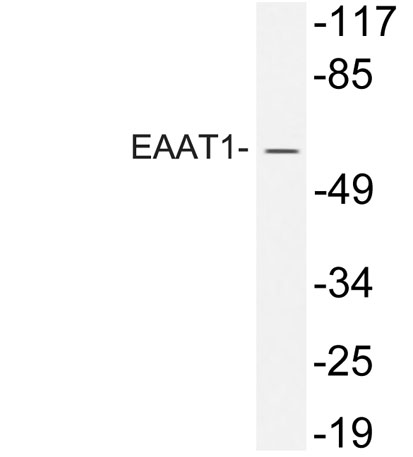
| Observed band (KD) | 65kD |
| Background | This gene encodes a member of a member of a high affinity glutamate transporter family. This gene functions in the termination of excitatory neurotransmission in central nervous system. Mutations are associated with episodic ataxia, Type 6. Alternative splicing results in multiple transcript variants.[provided by RefSeq, Feb 2014], |
| Function | disease:Defects in SLC1A3 are the cause of episodic ataxia type 6 (EA6) [MIM:612656]. EA6 is characterized by episodic ataxia, seizures, migraine and alternating hemiplegia.,function:Transports L-glutamate and also L- and D-aspartate. Essential for terminating the postsynaptic action of glutamate by rapidly removing released glutamate from the synaptic cleft. Acts as a symport by cotransporting sodium.,PTM:Glycosylated.,similarity:Belongs to the sodium:dicarboxylate (SDF) symporter (TC 2.A.23) family.,tissue specificity:Highly expressed in cerebellum, but also found in frontal cortex, hippocampus and basal ganglia., |
| Subcellular location | Cell membrane ; Multi-pass membrane protein . |
| Expression | Detected in brain (PubMed:8218410, PubMed:7521911, PubMed:8123008). Detected at very much lower levels in heart, lung, placenta and skeletal muscle (PubMed:7521911, PubMed:8123008). Highly expressed in cerebellum, but also found in frontal cortex, hippocampus and basal ganglia (PubMed:7521911). |


Use collapsible tabs for more detailed information that will help customers make a purchasing decision.
Ex: Shipping and return policies, size guides, and other common questions.