 Français
 English

| ELK.No | ES2268 |
| Product name | EP4 rabbit pAb |
| Reactivity | Human;Rat;Mouse; |
| Applications | WB;IF;ELISA |
| Other name | PTGER4; PTGER2; Prostaglandin E2 receptor EP4 subtype; PGE receptor EP4 subtype; PGE2 receptor EP4 subtype; Prostanoid EP4 receptor |
| Size | 50μL |
| Unit price ($) | 148 |
| Human gene ID | 5734 |
| Human Swiss-Prot | P35408 |
| Source | Rabbit |
| Isotype | IgG |
| Target | EP4 |
| Fields | >>Neuroactive ligand-receptor interaction;>>Inflammatory mediator regulation of TRP channels;>>Renin secretion;>>Human cytomegalovirus infection;>>Human papillomavirus infection;>>Pathways in cancer |
| Gene name | PTGER4 |
| Protein name | Prostaglandin E2 receptor EP4 subtype |
| Human gene link | View Human Gene |
| Human Swiss link | View Human Swiss-Prot |
| Mouse gene ID | |
| Mouse gene link | |
| Mouse Swiss-Prot | P32240 |
| Mouse Swiss link | View Mouse Swiss-Prot |
| Rat gene ID | |
| Rat gene link | |
| Rat Swiss-Prot | |
| Rat Swiss link | |
| Immunogen | The antiserum was produced against synthesized peptide derived from human PE2R4. AA range:321-370 |
| Specificity | EP4 Polyclonal Antibody detects endogenous levels of EP4 protein. |
| Formulation | Liquid in PBS containing 50% glycerol, 0.5% BSA and 0.02% sodium azide. |
| Clonality | Polyclonal |
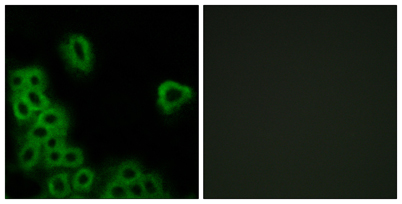
| Dilution | Western Blot: 1/500 - 1/2000. Immunofluorescence: 1/200 - 1/1000. ELISA: 1/20000. Not yet tested in other applications. |
| Purification | The antibody was affinity-purified from rabbit antiserum by affinity-chromatography using epitope-specific immunogen. |
| Concentration | 1 mg/ml |
| Storage stability | -20°C/1 year |
| Molecular Weight (Da) | |
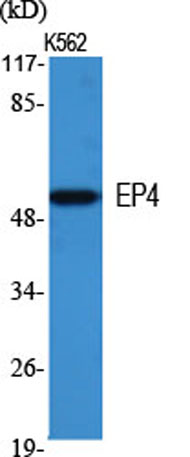
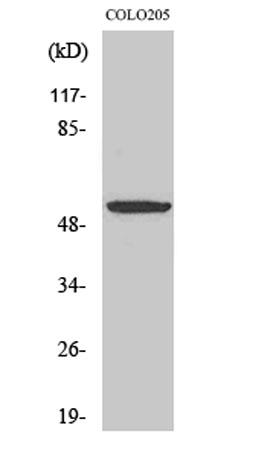
| Observed band (KD) | 55kD |
| Background | The protein encoded by this gene is a member of the G-protein coupled receptor family. This protein is one of four receptors identified for prostaglandin E2 (PGE2). This receptor can activate T-cell factor signaling. It has been shown to mediate PGE2 induced expression of early growth response 1 (EGR1), regulate the level and stability of cyclooxygenase-2 mRNA, and lead to the phosphorylation of glycogen synthase kinase-3. Knockout studies in mice suggest that this receptor may be involved in the neonatal adaptation of circulatory system, osteoporosis, as well as initiation of skin immune responses. [provided by RefSeq, Jul 2008], |
| Function | caution:Was originally designated as the EP2 subtype.,function:Receptor for prostaglandin E2 (PGE2). The activity of this receptor is mediated by G(s) proteins that stimulate adenylate cyclase. Has a relaxing effect on smooth muscle. May play an important role in regulating renal hemodynamics, intestinal epithelial transport, adrenal aldosterone secretion, and uterine function.,similarity:Belongs to the G-protein coupled receptor 1 family.,subunit:Interacts with FEM1A.,tissue specificity:High in intestine and in peripheral blood mononuclear cells; low in lung, kidney, thymus, uterus, vasculature and brain. Not found in liver, heart, retina oe skeletal muscle., |
| Subcellular location | Cell membrane; Multi-pass membrane protein. |
| Expression | High in intestine and in peripheral blood mononuclear cells; low in lung, kidney, thymus, uterus, vasculature and brain. Not found in liver, heart, retina oe skeletal muscle. |

Use collapsible tabs for more detailed information that will help customers make a purchasing decision.
Ex: Shipping and return policies, size guides, and other common questions.