 Français
 English

| ELK.No | ES2280 |
| Product name | Ephrin-B1 rabbit pAb |
| Reactivity | Human;Mouse;Rat;Monkey |
| Applications | WB;ELISA |
| Other name | EFNB1; EFL3; EPLG2; LERK2; Ephrin-B1; EFL-3; ELK ligand; ELK-L; EPH-related receptor tyrosine kinase ligand 2; LERK-2 |
| Size | 100μL |
| Unit price ($) | 248 |
| Human gene ID | 1947 |
| Human Swiss-Prot | P98172 |
| Source | Rabbit |
| Isotype | IgG |
| Target | Ephrin-B1 |
| Fields | >>Axon guidance |
| Gene name | EFNB1 |
| Protein name | Ephrin-B1 |
| Human gene link | View Human Gene |
| Human Swiss link | View Human Swiss-Prot |
| Mouse gene ID | 13641 |
| Mouse gene link | View Mouse Gene |
| Mouse Swiss-Prot | P52795 |
| Mouse Swiss link | View Mouse Swiss-Prot |
| Rat gene ID | |
| Rat gene link | |
| Rat Swiss-Prot | P52796 |
| Rat Swiss link | View Rat Swiss-Prot |
| Immunogen | The antiserum was produced against synthesized peptide derived from human EFNB1. AA range:283-332 |
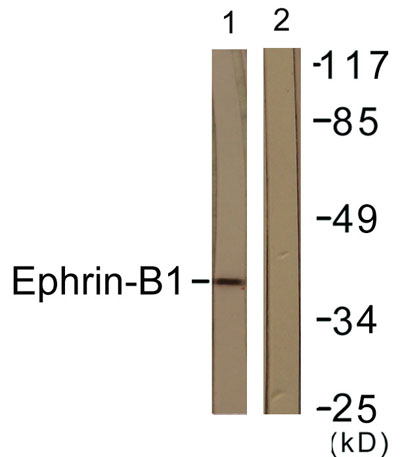
| Specificity | Ephrin-B1 Polyclonal Antibody detects endogenous levels of Ephrin-B1 protein. |
| Formulation | Liquid in PBS containing 50% glycerol, 0.5% BSA and 0.02% sodium azide. |
| Clonality | Polyclonal |
| Dilution | Western Blot: 1/500 - 1/2000. ELISA: 1/40000. Not yet tested in other applications. |
| Purification | The antibody was affinity-purified from rabbit antiserum by affinity-chromatography using epitope-specific immunogen. |
| Concentration | 1 mg/ml |
| Storage stability | -20°C/1 year |
| Molecular Weight (Da) | |
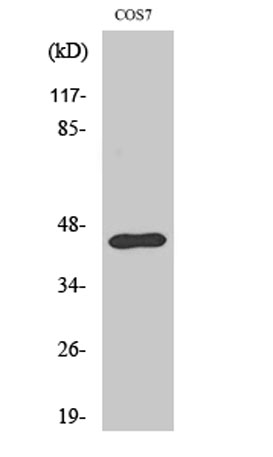
| Observed band (KD) | 38kD |
| Background | The protein encoded by this gene is a type I membrane protein and a ligand of Eph-related receptor tyrosine kinases. It may play a role in cell adhesion and function in the development or maintenance of the nervous system. [provided by RefSeq, Jul 2008], |
| Function | disease:Defects in EFNB1 are a cause of craniofrontonasal syndrome (CFNS) [MIM:304110]; also known as craniofrontonasal dysplasia (CFND). CFNS is an X-linked inherited syndrome characterized by hypertelorism, coronal synostosis with brachycephaly, downslanting palpebral fissures, clefting of the nasal tip, joint anomalies, longitudinally grooved fingernails and other digital anomalies.,function:Binds to the receptor tyrosine kinases EPHB1 and EPHA1. Binds to, and induce the collapse of, commissural axons/growth cones in vitro. May play a role in constraining the orientation of longitudinally projecting axons.,induction:By TNF-alpha.,PTM:Inducible phosphorylation of tyrosine residues in the cytoplasmic domain.,similarity:Belongs to the ephrin family.,subunit:Interacts with GRIP1 and GRIP2.,tissue specificity:Heart, placenta, lung, liver, skeletal muscle, kidney, pancreas., |
| Subcellular location | Cell membrane ; Single-pass type I membrane protein . Membrane raft . May recruit GRIP1 and GRIP2 to membrane raft domains. .; [Ephrin-B1 C-terminal fragment]: Cell membrane ; Single-pass type I membrane protein .; [Ephrin-B1 intracellular domain]: Nucleus . Colocalizes with ZHX2 in the nucleus. . |
| Expression | Widely expressed (PubMed:8070404, PubMed:7973638). Detected in both neuronal and non-neuronal tissues (PubMed:8070404, PubMed:7973638). Seems to have particularly strong expression in retina, sciatic nerve, heart and spinal cord (PubMed:7973638). |

Use collapsible tabs for more detailed information that will help customers make a purchasing decision.
Ex: Shipping and return policies, size guides, and other common questions.