 Français
 English

| ELK.No | ES2344 |
| Product name | Fibulin-5 rabbit pAb |
| Reactivity | Human;Mouse;Rat |
| Applications | WB;ELISA |
| Other name | FBLN5; DANCE; Fibulin-5; FIBL-5; Developmental arteries and neural crest EGF-like protein; Dance; Urine p50 protein; UP50 |
| Size | 50μL |
| Unit price ($) | 148 |
| Human gene ID | 10516 |
| Human Swiss-Prot | Q9UBX5 |
| Source | Rabbit |
| Isotype | IgG |
| Target | Fibulin-5 |
| Fields | |
| Gene name | FBLN5 |
| Protein name | Fibulin-5 |
| Human gene link | View Human Gene |
| Human Swiss link | View Human Swiss-Prot |
| Mouse gene ID | 23876 |
| Mouse gene link | View Mouse Gene |
| Mouse Swiss-Prot | Q9WVH9 |
| Mouse Swiss link | View Mouse Swiss-Prot |
| Rat gene ID | 29158 |
| Rat gene link | View Rat Gene |
| Rat Swiss-Prot | Q9WVH8 |
| Rat Swiss link | View Rat Swiss-Prot |
| Immunogen | The antiserum was produced against synthesized peptide derived from human FBLN5. AA range:171-220 |
| Specificity | Fibulin-5 Polyclonal Antibody detects endogenous levels of Fibulin-5 protein. |
| Formulation | Liquid in PBS containing 50% glycerol, 0.5% BSA and 0.02% sodium azide. |
| Clonality | Polyclonal |
| Dilution | Western Blot: 1/500 - 1/2000. ELISA: 1/5000. Not yet tested in other applications. |
| Purification | The antibody was affinity-purified from rabbit antiserum by affinity-chromatography using epitope-specific immunogen. |
| Concentration | 1 mg/ml |
| Storage stability | -20°C/1 year |
| Molecular Weight (Da) | |
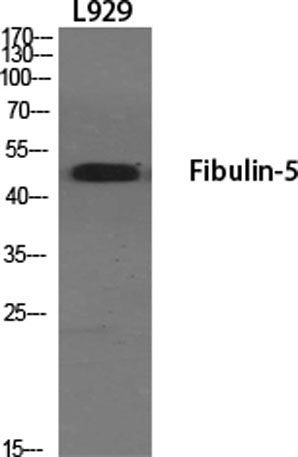
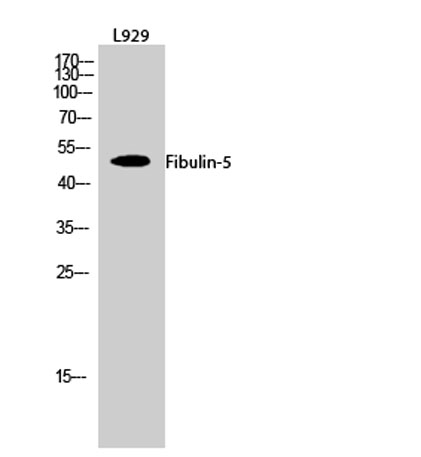
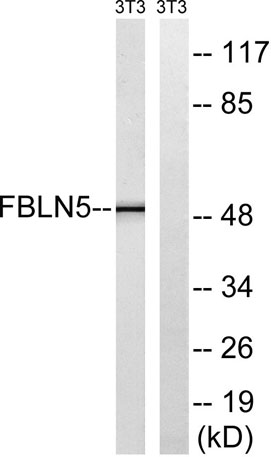
| Observed band (KD) | 50kD |
| Background | The protein encoded by this gene is a secreted, extracellular matrix protein containing an Arg-Gly-Asp (RGD) motif and calcium-binding EGF-like domains. It promotes adhesion of endothelial cells through interaction of integrins and the RGD motif. It is prominently expressed in developing arteries but less so in adult vessels. However, its expression is reinduced in balloon-injured vessels and atherosclerotic lesions, notably in intimal vascular smooth muscle cells and endothelial cells. Therefore, the protein encoded by this gene may play a role in vascular development and remodeling. Defects in this gene are a cause of autosomal dominant cutis laxa, autosomal recessive cutis laxa type I (CL type I), and age-related macular degeneration type 3 (ARMD3). [provided by RefSeq, Jul 2008], |
| Function | disease:Defects in FBLN5 are a cause of autosomal dominant cutis laxa [MIM:123700]. Hereditary cutis laxa refers to a heterogeneous group of connective tissue disorders characterized by cutaneous abnormalities and variable systemic manifestations. The most constant clinical feature is loose skin, sagging over the face and trunk. Hereditary cutis laxa is inherited in both autosomal dominant and autosomal recessive modes. Autosomal dominant cutis laxa is a relatively benign inherited and acquired connective tissue disorder.,disease:Defects in FBLN5 are a cause of autosomal recessive cutis laxa type I (CL type I) [MIM:219100]. CL type I shows the most severe phenotype and has the poorest prognosis. In addition to the skin, internal organs enriched in elastic fibers, such as the lung and arteries, are affected.,disease:Defects in FBLN5 are the cause of age-related macular degeneration type 3 |
| Subcellular location | Secreted . Secreted, extracellular space, extracellular matrix . co-localizes with ELN in elastic fibers. . |
| Expression | Expressed in skin fibroblasts (at protein level)(PubMed:17035250). Expressed predominantly in heart, ovary, and colon but also in kidney, pancreas, testis, lung and placenta. Not detectable in brain, liver, thymus, prostate, or peripheral blood leukocytes (PubMed:10428823). |

Use collapsible tabs for more detailed information that will help customers make a purchasing decision.
Ex: Shipping and return policies, size guides, and other common questions.