 Français
 English

| ELK.No | ES2407 |
| Product name | GCG rabbit pAb |
| Reactivity | Human;Mouse;Rat;Monkey |
| Applications | WB;IHC;IF;ELISA |
| Other name | GCG; Glucagon |
| Size | 50μL |
| Unit price ($) | 148 |
| Human gene ID | 2641 |
| Human Swiss-Prot | P01275 |
| Source | Rabbit |
| Isotype | IgG |
| Target | Glucagon |
| Fields | >>cAMP signaling pathway;>>Neuroactive ligand-receptor interaction;>>Thermogenesis;>>Insulin secretion;>>Glucagon signaling pathway |
| Gene name | GCG |
| Protein name | Glucagon |
| Human gene link | View Human Gene |
| Human Swiss link | View Human Swiss-Prot |
| Mouse gene ID | 14526 |
| Mouse gene link | View Mouse Gene |
| Mouse Swiss-Prot | P55095 |
| Mouse Swiss link | View Mouse Swiss-Prot |
| Rat gene ID | |
| Rat gene link | |
| Rat Swiss-Prot | P06883 |
| Rat Swiss link | View Rat Swiss-Prot |
| Immunogen | The antiserum was produced against synthesized peptide derived from human Glucagon. AA range:61-110 |
| Specificity | GCG Polyclonal Antibody detects endogenous levels of GCG protein. |
| Formulation | Liquid in PBS containing 50% glycerol, 0.5% BSA and 0.02% sodium azide. |
| Clonality | Polyclonal |
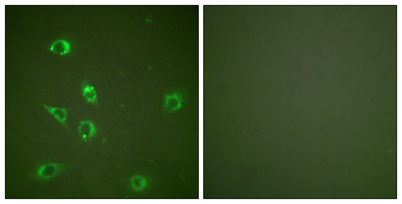
| Dilution | Western Blot: 1/500 - 1/2000. Immunohistochemistry: 1/100 - 1/300. Immunofluorescence: 1/200 - 1/1000. ELISA: 1/40000. Not yet tested in other applications. |
| Purification | The antibody was affinity-purified from rabbit antiserum by affinity-chromatography using epitope-specific immunogen. |
| Concentration | 1 mg/ml |
| Storage stability | -20°C/1 year |
| Molecular Weight (Da) | |
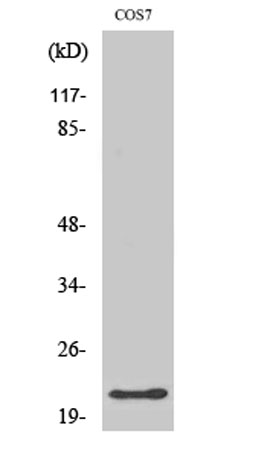
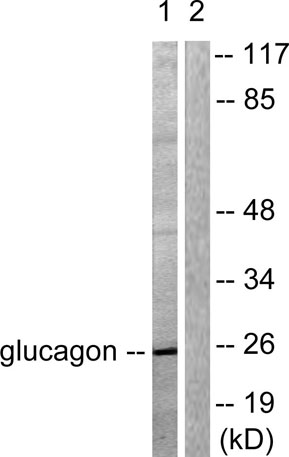
| Observed band (KD) | 25kD |
| Background | The protein encoded by this gene is actually a preproprotein that is cleaved into four distinct mature peptides. One of these, glucagon, is a pancreatic hormone that counteracts the glucose-lowering action of insulin by stimulating glycogenolysis and gluconeogenesis. Glucagon is a ligand for a specific G-protein linked receptor whose signalling pathway controls cell proliferation. Two of the other peptides are secreted from gut endocrine cells and promote nutrient absorption through distinct mechanisms. Finally, the fourth peptide is similar to glicentin, an active enteroglucagon. [provided by RefSeq, Jul 2008], |
| Function | function:Glicentin may modulate gastric acid secretion and the gastro-pyloro-duodenal activity. May play an important role in intestinal mucosal growth in the early period of life.,function:GLP-1 is a potent stimulator of glucose-dependent insulin release. Play important roles on gastric motility and the suppression of plasma glucagon levels. May be involved in the suppression of satiety and stimulation of glucose disposal in peripheral tissues, independent of the actions of insulin. Have growth-promoting activities on intestinal epithelium. May also regulate the hypothalamic pituitary axis (HPA) via effects on LH, TSH, CRH, oxytocin, and vasopressin secretion. Increases islet mass through stimulation of islet neogenesis and pancreatic beta cell proliferaton. Inhibits beta cell apoptosis.,function:GLP-2 stimulates intestinal growth and up-regulates villus height in the small intestine, c |
| Subcellular location | Secreted .; [Glucagon-like peptide 1]: Secreted . |
| Expression | [Glucagon]: Secreted in the A cells of the islets of Langerhans. ; [Glucagon-like peptide 1]: Secreted in the A cells of the islets of Langerhans (PubMed:22037645). Secreted from enteroendocrine L cells throughout the gastrointestinal tract (PubMed:22037645). Also secreted in selected neurons in the brain. ; [Glucagon-like peptide 2]: Secreted from enteroendocrine cells throughout the gastrointestinal tract. Also secreted in selected neurons in the brain.; [Glicentin]: Secreted from enteroendocrine cells throughout the gastrointestinal tract.; [Oxyntomodulin]: Secreted from enteroendocrine cells throughout the gastrointestinal tract. |

Use collapsible tabs for more detailed information that will help customers make a purchasing decision.
Ex: Shipping and return policies, size guides, and other common questions.