 Français
 English
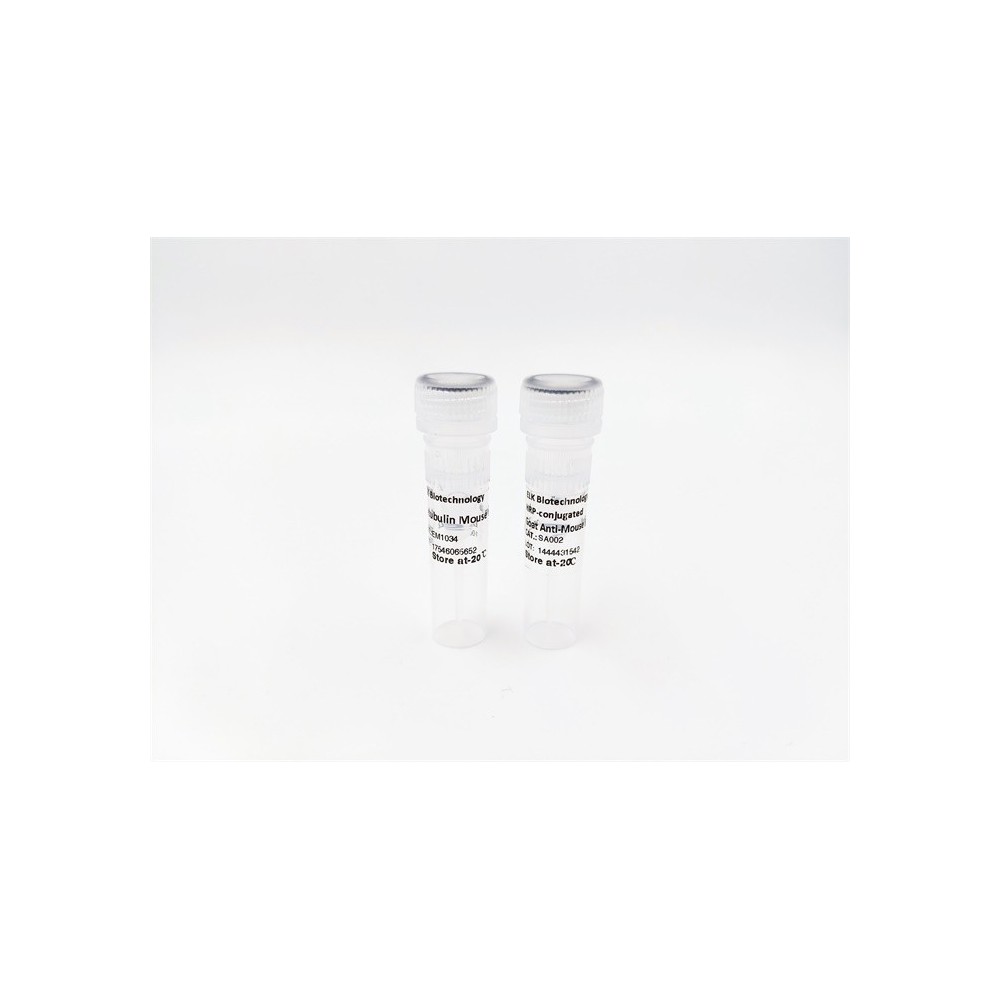

| ELK.No | ES2418 |
| Product name | GDF-15 rabbit pAb |
| Reactivity | Human;Rat;Mouse; |
| Applications | WB;ELISA |
| Other name | GDF15; MIC1; PDF; PLAB; PTGFB; Growth/differentiation factor 15; GDF-15; Macrophage inhibitory cytokine 1; MIC-1; NSAID-activated gene 1 protein; NAG-1; NSAID-regulated gene 1 protein; NRG-1; Placental TGF-beta; Placental bone morphogenetic |
| Size | 50μL |
| Unit price ($) | 148 |
| Human gene ID | 9518 |
| Human Swiss-Prot | Q99988 |
| Source | Rabbit |
| Isotype | IgG |
| Target | GDF-15 |
| Fields | >>Cytokine-cytokine receptor interaction |
| Gene name | GDF15 |
| Protein name | Growth/differentiation factor 15 |
| Human gene link | View Human Gene |
| Human Swiss link | View Human Swiss-Prot |
| Mouse gene ID | |
| Mouse gene link | |
| Mouse Swiss-Prot | Q9Z0J7 |
| Mouse Swiss link | View Mouse Swiss-Prot |
| Rat gene ID | |
| Rat gene link | |
| Rat Swiss-Prot | |
| Rat Swiss link | |
| Immunogen | The antiserum was produced against synthesized peptide derived from human GDF15. AA range:31-80 |
| Specificity | GDF-15 Polyclonal Antibody detects endogenous levels of GDF-15 protein. |
| Formulation | Liquid in PBS containing 50% glycerol, 0.5% BSA and 0.02% sodium azide. |
| Clonality | Polyclonal |
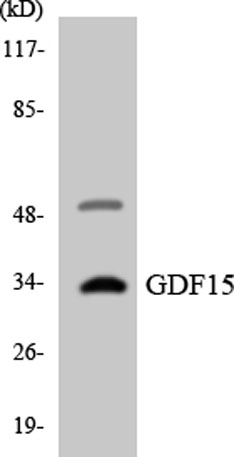
| Dilution | Western Blot: 1/500 - 1/2000. ELISA: 1/40000. Not yet tested in other applications. |
| Purification | The antibody was affinity-purified from rabbit antiserum by affinity-chromatography using epitope-specific immunogen. |
| Concentration | 1 mg/ml |
| Storage stability | -20°C/1 year |
| Molecular Weight (Da) | |
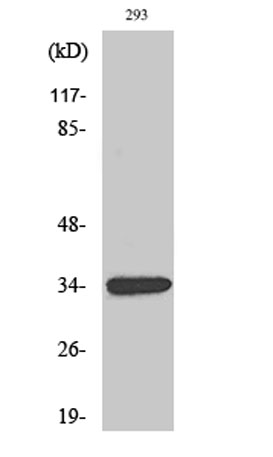
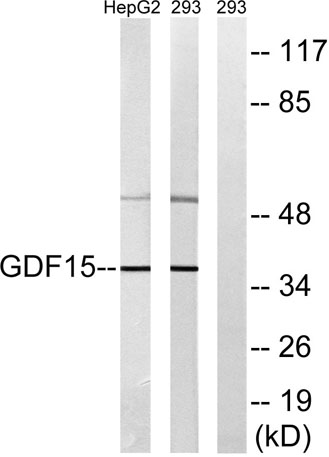
| Observed band (KD) | 37kD |
| Background | growth differentiation factor 15(GDF15) Homo sapiens This gene encodes a secreted ligand of the TGF-beta (transforming growth factor-beta) superfamily of proteins. Ligands of this family bind various TGF-beta receptors leading to recruitment and activation of SMAD family transcription factors that regulate gene expression. The encoded preproprotein is proteolytically processed to generate each subunit of the disulfide-linked homodimer. The protein is expressed in a broad range of cell types, acts as a pleiotropic cytokine and is involved in the stress response program of cells after cellular injury. Increased protein levels are associated with disease states such as tissue hypoxia, inflammation, acute injury and oxidative stress. [provided by RefSeq, Aug 2016], |
| Function | similarity:Belongs to the TGF-beta family.,subunit:Homodimer; disulfide-linked.,tissue specificity:Highly expressed in placenta, with lower levels in prostate and colon and some expression in kidney., |
| Subcellular location | Secreted . |
| Expression | Highly expressed in placenta, with lower levels in prostate and colon and some expression in kidney (PubMed:9348093). Detected in plasma (at protein level) (PubMed:28572090, PubMed:29046435). |

Use collapsible tabs for more detailed information that will help customers make a purchasing decision.
Ex: Shipping and return policies, size guides, and other common questions.