 Français
 English

| ELK.No | ES2605 |
| Product name | IKKγ rabbit pAb |
| Reactivity | Human;Rat;Mouse; |
| Applications | WB;IHC;IF;ELISA |
| Other name | IKBKG; FIP3; NEMO; NF-kappa-B essential modulator; NEMO; FIP-3; IkB kinase-associated protein 1; IKKAP1; Inhibitor of nuclear factor kappa-B kinase subunit gamma; I-kappa-B kinase subunit gamma; IKK-gamma; IKKG; IkB kinase subunit gamma; NF |
| Size | 50μL |
| Unit price ($) | 148 |
| Human gene ID | 8517 |
| Human Swiss-Prot | Q9Y6K9 |
| Source | Rabbit |
| Isotype | IgG |
| Target | IKKγ |
| Fields | >>Antifolate resistance;>>MAPK signaling pathway;>>Ras signaling pathway;>>Chemokine signaling pathway;>>NF-kappa B signaling pathway;>>PI3K-Akt signaling pathway;>>Apoptosis;>>Osteoclast differentiation;>>Toll-like receptor signaling pathway;>>NOD-like receptor signaling pathway;>>RIG-I-like receptor signaling pathway;>>Cytosolic DNA-sensing pathway;>>C-type lectin receptor signaling pathway;>>IL-17 signaling pathway;>>Th1 and Th2 cell differentiation;>>Th17 cell differentiation;>>T cell receptor signaling pathway;>>B cell receptor signaling pathway;>>TNF signaling pathway;>>Adipocytokine signaling pathway;>>Alcoholic liver disease;>>Alzheimer disease;>>Epithelial cell signaling in Helicobacter pylori infection;>>Pathogenic Escherichia coli infection;>>Shigellosis;>>Salmonella infection;>>Yersinia infection;>>Chagas disease;>>Toxoplasmosis;>>Hepatitis C;>>Hepatitis B;>>Measles;>>Human cytomegalovirus infection;>>Influenza A;>>Human papillomavirus infection;>>Human T-cell leukemia viru |
| Gene name | IKBKG |
| Protein name | NF-kappa-B essential modulator |
| Human gene link | View Human Gene |
| Human Swiss link | View Human Swiss-Prot |
| Mouse gene ID | |
| Mouse gene link | |
| Mouse Swiss-Prot | O88522 |
| Mouse Swiss link | View Mouse Swiss-Prot |
| Rat gene ID | |
| Rat gene link | |
| Rat Swiss-Prot | |
| Rat Swiss link | |
| Immunogen | The antiserum was produced against synthesized peptide derived from human IKK-gamma. AA range:51-100 |
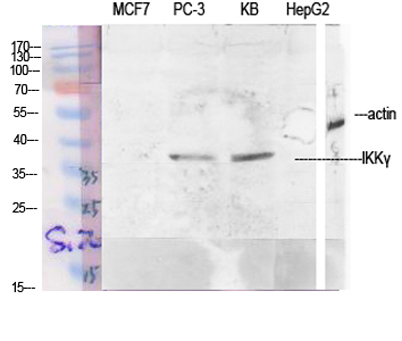
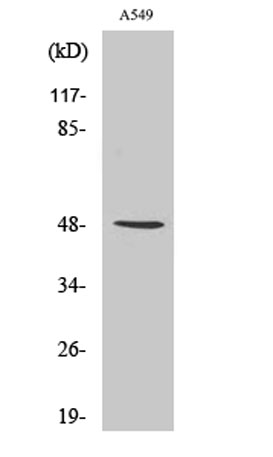
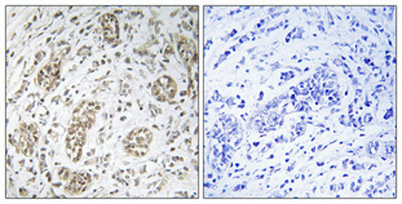
| Specificity | IKKγ Polyclonal Antibody detects endogenous levels of IKKγ protein. |
| Formulation | Liquid in PBS containing 50% glycerol, 0.5% BSA and 0.02% sodium azide. |
| Clonality | Polyclonal |
| Dilution | Western Blot: 1/500 - 1/2000. Immunohistochemistry: 1/100 - 1/300. Immunofluorescence: 1/200 - 1/1000. ELISA: 1/20000. Not yet tested in other applications. |
| Purification | The antibody was affinity-purified from rabbit antiserum by affinity-chromatography using epitope-specific immunogen. |
| Concentration | 1 mg/ml |
| Storage stability | -20°C/1 year |
| Molecular Weight (Da) | |
| Observed band (KD) | 43kD |
| Background | This gene encodes the regulatory subunit of the inhibitor of kappaB kinase (IKK) complex, which activates NF-kappaB resulting in activation of genes involved in inflammation, immunity, cell survival, and other pathways. Mutations in this gene result in incontinentia pigmenti, hypohidrotic ectodermal dysplasia, and several other types of immunodeficiencies. A pseudogene highly similar to this locus is located in an adjacent region of the X chromosome. [provided by RefSeq, Mar 2016], |
| Function | caution:The sequence shown here is derived from an Ensembl automatic analysis pipeline and should be considered as preliminary data.,disease:Defects in IKBKG are a cause of immunodeficiency without anhidrotic ectodermal dysplasia [MIM:300584]; also called isolated immunodeficiency or pure immunodeficiency. Patients manifest immunodeficiency not associated with other abnormalities, and resulting in increased infection susceptibility. Patients suffer from multiple episodes of infectious diseases.,disease:Defects in IKBKG are the cause of ectodermal dysplasia anhidrotic with immunodeficiency X-linked (EDAXID) [MIM:300291]; also known as hypohidrotic ectodermal dysplasia with immunodeficiency (HED-ID). Ectodermal dysplasia defines a heterogeneous group of disorders due to abnormal development of two or more ectodermal structures. EDAXID is characterized by absence of sweat glands, sparse sca |
| Subcellular location | Cytoplasm . Nucleus . Sumoylated NEMO accumulates in the nucleus in response to genotoxic stress. . |
| Expression | Heart, brain, placenta, lung, liver, skeletal muscle, kidney and pancreas. |

Use collapsible tabs for more detailed information that will help customers make a purchasing decision.
Ex: Shipping and return policies, size guides, and other common questions.