 Français
 English

| ELK.No | ES2797 |
| Product name | MLH1 rabbit pAb |
| Reactivity | Human;Mouse;Rat |
| Applications | WB;IHC |
| Other name | MLH1; COCA2; DNA mismatch repair protein Mlh1; MutL protein homolog 1 |
| Size | 100μL |
| Unit price ($) | 248 |
| Human gene ID | 4292 |
| Human Swiss-Prot | P40692 |
| Source | Rabbit |
| Isotype | IgG |
| Target | MLH1 |
| Fields | >>Platinum drug resistance;>>Mismatch repair;>>Fanconi anemia pathway;>>Pathways in cancer;>>Colorectal cancer;>>Endometrial cancer;>>Gastric cancer |
| Gene name | MLH1 |
| Protein name | DNA mismatch repair protein Mlh1 |
| Human gene link | View Human Gene |
| Human Swiss link | View Human Swiss-Prot |
| Mouse gene ID | 17350 |
| Mouse gene link | View Mouse Gene |
| Mouse Swiss-Prot | Q9JK91 |
| Mouse Swiss link | View Mouse Swiss-Prot |
| Rat gene ID | 81685 |
| Rat gene link | View Rat Gene |
| Rat Swiss-Prot | P97679 |
| Rat Swiss link | View Rat Swiss-Prot |
| Immunogen | The antiserum was produced against synthesized peptide derived from human MLH1. AA range:441-490 |
| Specificity | MLH1 Polyclonal Antibody detects endogenous levels of MLH1 protein. |
| Formulation | Liquid in PBS containing 50% glycerol, 0.5% BSA and 0.02% sodium azide. |
| Clonality | Polyclonal |
| Dilution | WB 1:500-2000;IHC-p 1:50-300 |
| Purification | The antibody was affinity-purified from rabbit antiserum by affinity-chromatography using epitope-specific immunogen. |
| Concentration | 1 mg/ml |
| Storage stability | -20°C/1 year |
| Molecular Weight (Da) | |
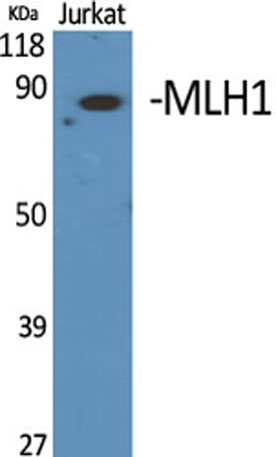
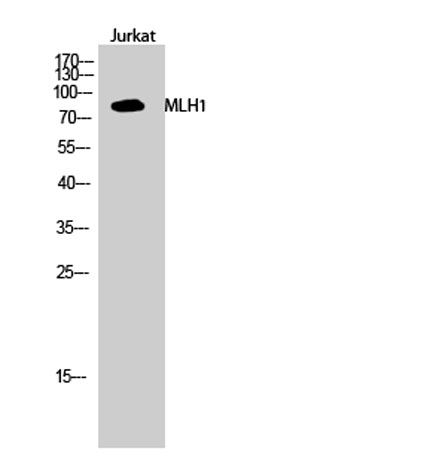
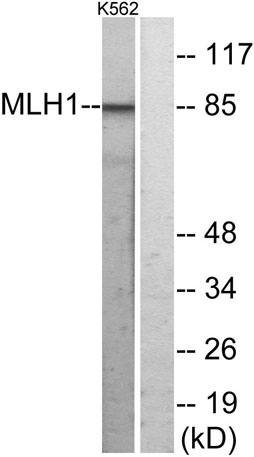
| Observed band (KD) | 85kD |
| Background | This gene was identified as a locus frequently mutated in hereditary nonpolyposis colon cancer (HNPCC). It is a human homolog of the E. coli DNA mismatch repair gene mutL, consistent with the characteristic alterations in microsatellite sequences (RER+phenotype) found in HNPCC. Alternative splicing results in multiple transcript variants encoding distinct isoforms. Additional transcript variants have been described, but their full-length natures have not been determined.[provided by RefSeq, Nov 2009], |
| Function | disease:Defects in MLH1 are a cause of Muir-Torre syndrome (MTS) [MIM:158320]. MTS is a rare autosomal dominant disorder characterized by sebaceous neoplasms and visceral malignancy.,disease:Defects in MLH1 are a cause of susceptibility to endometrial cancer [MIM:608089].,disease:Defects in MLH1 are a cause of Turcot syndrome [MIM:276300]; also called mismatch repair cancer syndrome (MMRCS). Turcot syndrome is an autosomal dominant disorder characterized by malignant tumors of the brain associated with multiple colorectal adenomas. Skin features include sebaceous cysts, hyperpigmented and cafe au lait spots.,disease:Defects in MLH1 are the cause of hereditary non-polyposis colorectal cancer type 2 (HNPCC2) [MIM:609310]. Mutations in more than one gene locus can be involved alone or in combination in the production of the HNPCC phenotype (also called Lynch syndrome). Most families with cl |
| Subcellular location | Nucleus . Chromosome . Recruited to chromatin in a MCM9-dependent manner. . |
| Expression | Colon, lymphocytes, breast, lung, spleen, testis, prostate, thyroid, gall bladder and heart. |

Use collapsible tabs for more detailed information that will help customers make a purchasing decision.
Ex: Shipping and return policies, size guides, and other common questions.