 Français
 English

| ELK.No | ES2880 |
| Product name | Myotubularin rabbit pAb |
| Reactivity | Human;Mouse |
| Applications | WB;IHC |
| Other name | MTM1; CG2; Myotubularin |
| Size | 50μL |
| Unit price ($) | 148 |
| Human gene ID | 4534 |
| Human Swiss-Prot | Q13496 |
| Source | Rabbit |
| Isotype | IgG |
| Target | Myotubularin |
| Fields | >>Inositol phosphate metabolism;>>Metabolic pathways;>>Phosphatidylinositol signaling system |
| Gene name | MTM1 |
| Protein name | Myotubularin |
| Human gene link | View Human Gene |
| Human Swiss link | View Human Swiss-Prot |
| Mouse gene ID | 17772 |
| Mouse gene link | View Mouse Gene |
| Mouse Swiss-Prot | Q9Z2C5 |
| Mouse Swiss link | View Mouse Swiss-Prot |
| Rat gene ID | |
| Rat gene link | |
| Rat Swiss-Prot | |
| Rat Swiss link | |
| Immunogen | The antiserum was produced against synthesized peptide derived from human Myotubularin. AA range:241-290 |
| Specificity | Myotubularin Polyclonal Antibody detects endogenous levels of Myotubularin protein. |
| Formulation | Liquid in PBS containing 50% glycerol, 0.5% BSA and 0.02% sodium azide. |
| Clonality | Polyclonal |
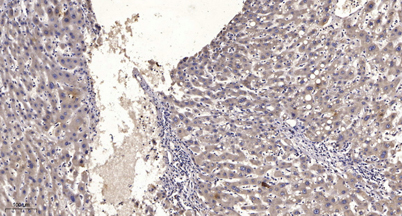
| Dilution | WB 1:500-2000;IHC-p 1:50-300 |
| Purification | The antibody was affinity-purified from rabbit antiserum by affinity-chromatography using epitope-specific immunogen. |
| Concentration | 1 mg/ml |
| Storage stability | -20°C/1 year |
| Molecular Weight (Da) | |
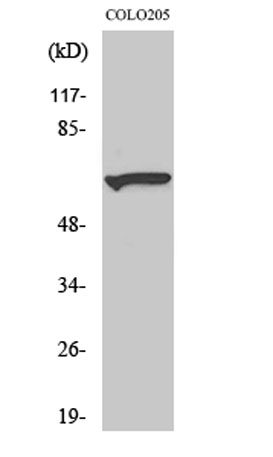
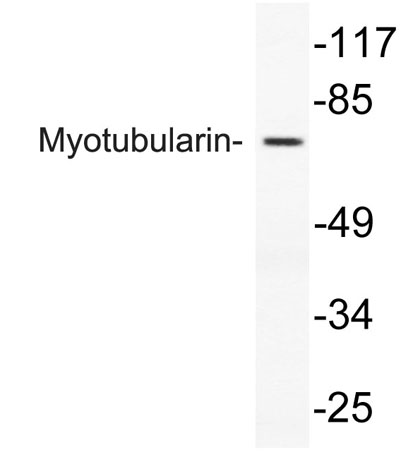
| Observed band (KD) | 70kD |
| Background | This gene encodes a dual-specificity phosphatase that acts on both phosphotyrosine and phosphoserine. It is required for muscle cell differentiation and mutations in this gene have been identified as being responsible for X-linked myotubular myopathy. [provided by RefSeq, Jul 2008], |
| Function | catalytic activity:Protein tyrosine phosphate + H(2)O = protein tyrosine + phosphate.,caution:The sequence shown here is derived from an Ensembl automatic analysis pipeline and should be considered as preliminary data.,disease:Defects in MTM1 are the cause of X-linked centronuclear myopathy X-linked (XCNM) [MIM:310400]; also known as X-linked myotubular myopathy (XLMTM) or myotubular myopathy type 1 (MTM1). Centronuclear myopathies are congenital muscle disorders characterized by progressive muscular weakness and wasting involving mainly limb girdle, trunk, and neck muscles. It may also affect distal muscles. Weakness may be present during childhood or adolescence or may not become evident until the third decade of life. Ptosis is a frequent clinical feature. The most prominent histopathologic features include high frequency of centrally located nuclei in muscle fibers not secondary to r |
| Subcellular location | Cytoplasm . Cell membrane; Peripheral membrane protein . Cell projection, filopodium . Cell projection, ruffle . Late endosome . Cytoplasm, myofibril, sarcomere . Localizes as a dense cytoplasmic network (PubMed:11001925). Also localizes to the plasma membrane, including plasma membrane extensions such as filopodia and ruffles (PubMed:12118066). Predominantly located in the cytoplasm following interaction with MTMR12 (PubMed:12847286). Recruited to the late endosome following EGF stimulation (PubMed:14722070). In skeletal muscles, co-localizes with MTMR12 in the sarcomere (By similarity). . |
| Expression | Epithelium,Platelet,Testis, |

Use collapsible tabs for more detailed information that will help customers make a purchasing decision.
Ex: Shipping and return policies, size guides, and other common questions.