 Français
 English
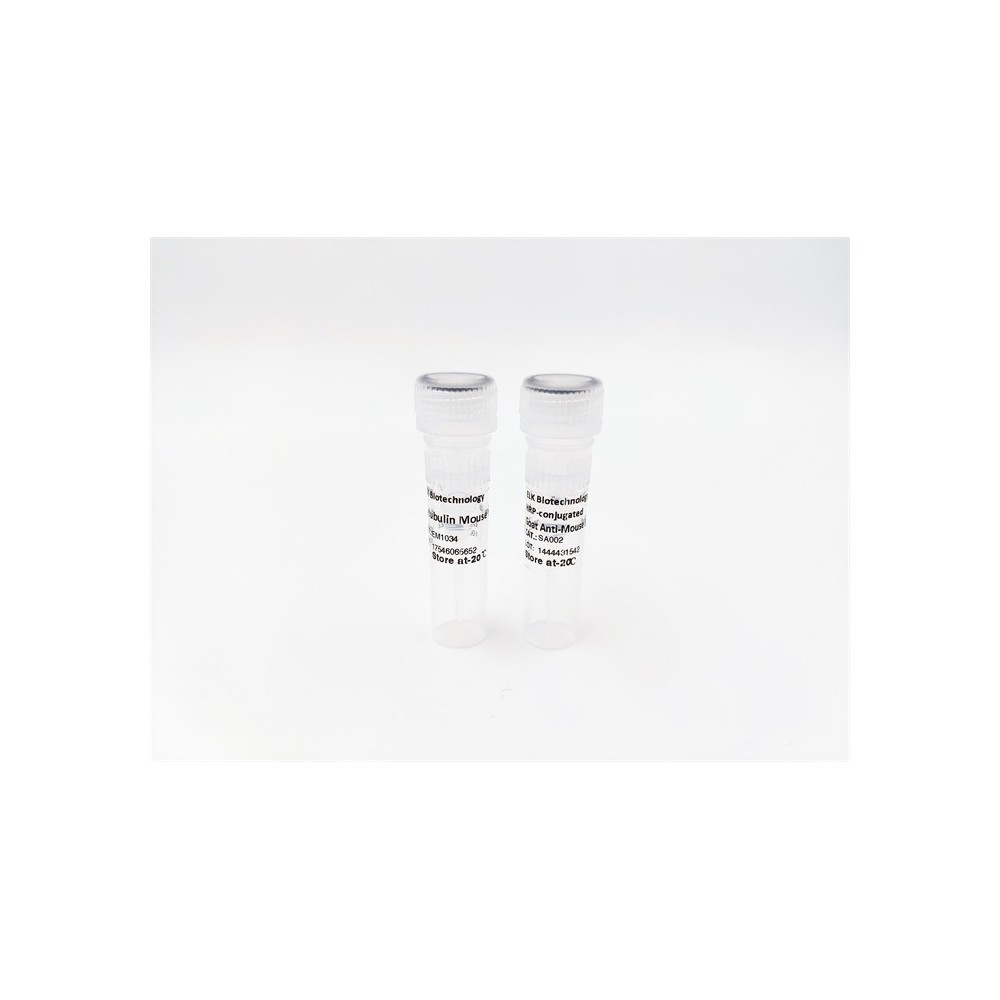

| ELK.No | ES3096 |
| Product name | p140Cap rabbit pAb |
| Reactivity | Human;Mouse;Rat |
| Applications | WB;ELISA |
| Other name | SRCIN1; KIAA1684; P140; SRC kinase signaling inhibitor 1; SNAP-25-interacting protein; SNIP; p130Cas-associated protein; p140Cap |
| Size | 100μL |
| Unit price ($) | 248 |
| Human gene ID | 80725 |
| Human Swiss-Prot | Q9C0H9 |
| Source | Rabbit |
| Isotype | IgG |
| Target | p140Cap |
| Fields | |
| Gene name | SRCIN1 |
| Protein name | SRC kinase signaling inhibitor 1 |
| Human gene link | View Human Gene |
| Human Swiss link | View Human Swiss-Prot |
| Mouse gene ID | 56013 |
| Mouse gene link | View Mouse Gene |
| Mouse Swiss-Prot | Q9QWI6 |
| Mouse Swiss link | View Mouse Swiss-Prot |
| Rat gene ID | 56029 |
| Rat gene link | View Rat Gene |
| Rat Swiss-Prot | Q9QXY2 |
| Rat Swiss link | View Rat Swiss-Prot |
| Immunogen | The antiserum was produced against synthesized peptide derived from human SNIP. AA range:811-860 |
| Specificity | p140Cap Polyclonal Antibody detects endogenous levels of p140Cap protein. |
| Formulation | Liquid in PBS containing 50% glycerol, 0.5% BSA and 0.02% sodium azide. |
| Clonality | Polyclonal |
| Dilution | Western Blot: 1/500 - 1/2000. ELISA: 1/20000. Not yet tested in other applications. |
| Purification | The antibody was affinity-purified from rabbit antiserum by affinity-chromatography using epitope-specific immunogen. |
| Concentration | 1 mg/ml |
| Storage stability | -20°C/1 year |
| Molecular Weight (Da) | |
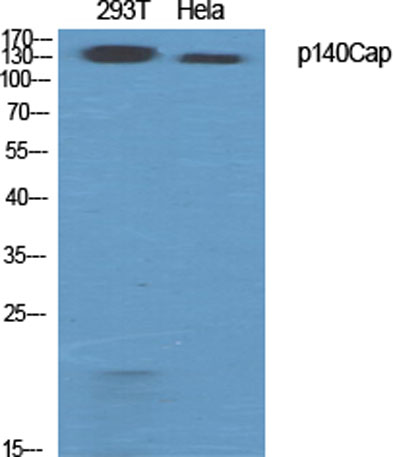
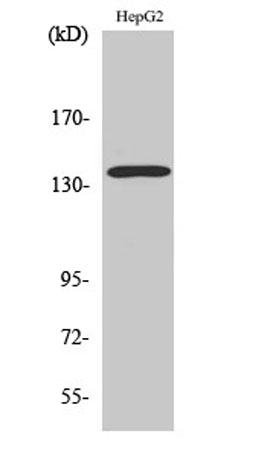
| Observed band (KD) | 112kD |
| Background | function:Delays the onset of cell spreading in the early stages of cell adhesion to fibronectin. Also involved in calcium-dependent exocytosis from PC12 cells.,PTM:Tyrosine-phosphorylated in response to EGF and to cell adhesion to integrin ligands.,similarity:Belongs to the p140Cap family.,subcellular location:Localized to the perinuclear region, lamellopodia, cortical actin and actin stress fibers but not to focal adhesions.,subunit:Interacts with the N-terminal coiled-coil region of SNAP25 (By similarity). Interacts with BCAR1/p130Cas through its C-terminal domain., |
| Function | function:Delays the onset of cell spreading in the early stages of cell adhesion to fibronectin. Also involved in calcium-dependent exocytosis from PC12 cells.,PTM:Tyrosine-phosphorylated in response to EGF and to cell adhesion to integrin ligands.,similarity:Belongs to the p140Cap family.,subcellular location:Localized to the perinuclear region, lamellopodia, cortical actin and actin stress fibers but not to focal adhesions.,subunit:Interacts with the N-terminal coiled-coil region of SNAP25 (By similarity). Interacts with BCAR1/p130Cas through its C-terminal domain., |
| Subcellular location | Cytoplasm . Cytoplasm, cytoskeleton . Cell projection, axon . Cell projection, dendrite . Cell junction, synapse, presynapse . Cell junction, synapse, postsynapse . Cell junction, synapse, postsynaptic density . Localized to the perinuclear region, lamellopodia, cortical actin and actin stress fibers but not to focal adhesions. Strongly expressed in axons and dendrites of the CA1 and CA3 hippocampal regions and of the dentate gyrus. Detected in both presynapses and postsynapses and enriched in postsynaptic density fractions. . |
| Expression | Expressed in some primary breast carcinomas where its presence is significantly associated with increased tumor size. Not detected in normal breast tissue. |

Use collapsible tabs for more detailed information that will help customers make a purchasing decision.
Ex: Shipping and return policies, size guides, and other common questions.