 Français
 English
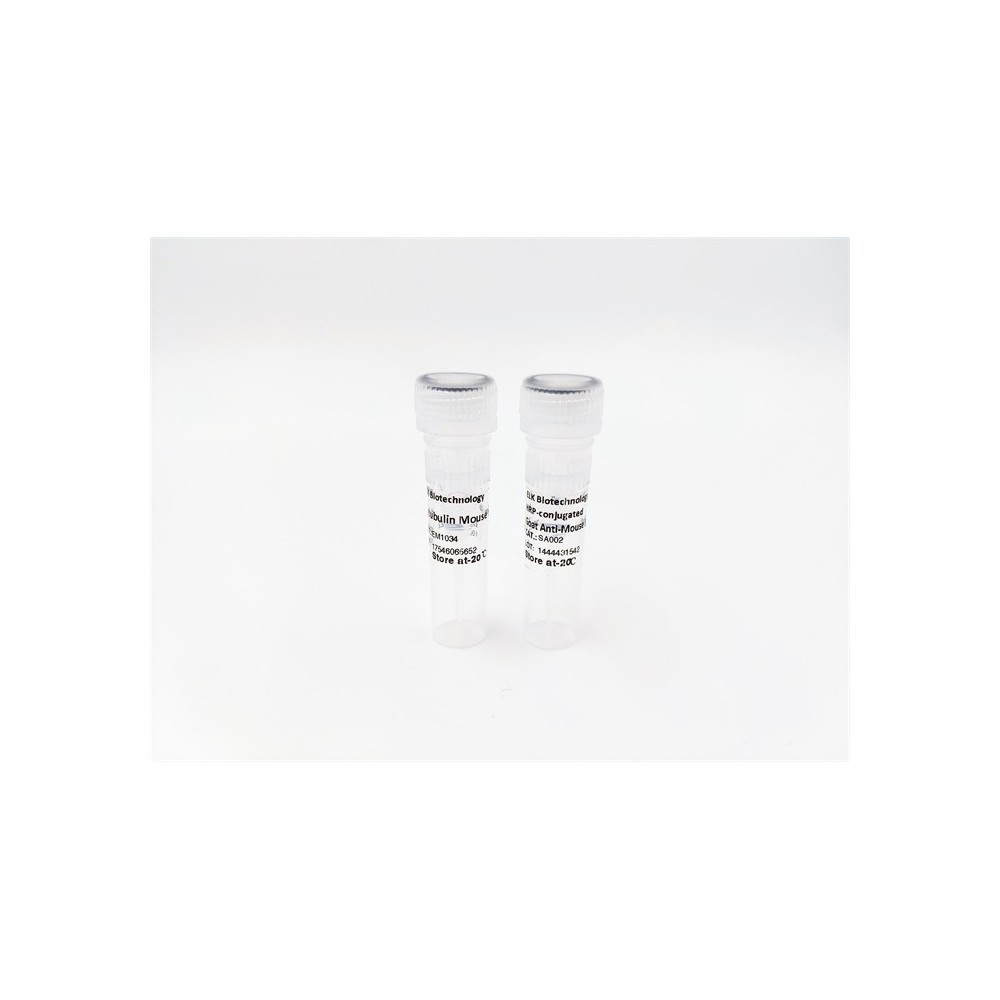

| ELK.No | ES3149 |
| Product name | PARD3A rabbit pAb |
| Reactivity | Human;Mouse;Rat |
| Applications | WB;IHC;IF;ELISA |
| Other name | PARD3; PAR3; PAR3A; Partitioning defective 3 homolog; PAR-3; PARD-3; Atypical PKC isotype-specific-interacting protein; ASIP; CTCL tumor antigen se2-5; PAR3-alpha |
| Size | 50μL |
| Unit price ($) | 148 |
| Human gene ID | 56288 |
| Human Swiss-Prot | Q8TEW0 |
| Source | Rabbit |
| Isotype | IgG |
| Target | PARD3A |
| Fields | >>Rap1 signaling pathway;>>Chemokine signaling pathway;>>Neuroactive ligand-receptor interaction;>>Endocytosis;>>Axon guidance;>>Hippo signaling pathway;>>Adherens junction;>>Tight junction;>>Human papillomavirus infection |
| Gene name | PARD3 |
| Protein name | Partitioning defective 3 homolog |
| Human gene link | View Human Gene |
| Human Swiss link | View Human Swiss-Prot |
| Mouse gene ID | 93742 |
| Mouse gene link | View Mouse Gene |
| Mouse Swiss-Prot | Q99NH2 |
| Mouse Swiss link | View Mouse Swiss-Prot |
| Rat gene ID | 81918 |
| Rat gene link | View Rat Gene |
| Rat Swiss-Prot | Q9Z340 |
| Rat Swiss link | View Rat Swiss-Prot |
| Immunogen | The antiserum was produced against synthesized peptide derived from human PARD3. AA range:1141-1190 |
| Specificity | PARD3A Polyclonal Antibody detects endogenous levels of PARD3A protein. |
| Formulation | Liquid in PBS containing 50% glycerol, 0.5% BSA and 0.02% sodium azide. |
| Clonality | Polyclonal |
| Dilution | Western Blot: 1/500 - 1/2000. Immunohistochemistry: 1/100 - 1/300. Immunofluorescence: 1/200 - 1/1000. ELISA: 1/20000. Not yet tested in other applications. |
| Purification | The antibody was affinity-purified from rabbit antiserum by affinity-chromatography using epitope-specific immunogen. |
| Concentration | 1 mg/ml |
| Storage stability | -20°C/1 year |
| Molecular Weight (Da) | |
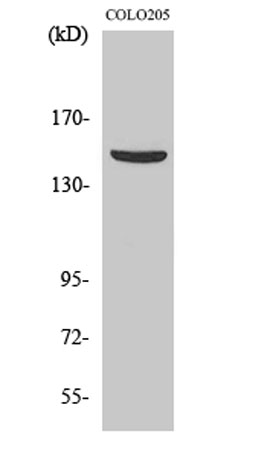
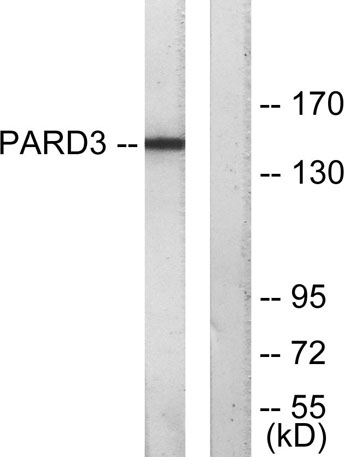
| Observed band (KD) | 151kD |
| Background | This gene encodes a member of the PARD protein family. PARD family members interact with other PARD family members and other proteins; they affect asymmetrical cell division and direct polarized cell growth. Multiple alternatively spliced transcript variants have been described for this gene. [provided by RefSeq, Oct 2011], |
| Function | alternative products:Additional isoforms seem to exist. As a matter of fact, alternatively spliced products seem to fall into two broad groups: one group, which includes the longest continuous ORF but which may also include molecules lacking some middle domains, has a single TM element and is likely to be associated with the plasma membrane. The other group lacks a TM domain and thus its members may be secreted,disease:Defects in PKHD1 are the cause of polycystic kidney disease autosomal recessive (ARPKD) [MIM:263200]. ARPKD is a severe form of polycystic kidney disease affecting the kidneys and the hepatic biliary tract. The clinical spectrum is widely variable, with most cases presenting during infancy. The fetal phenotypic features classically include enlarged and echogenic kidneys, as well as oligohydramnios secondary to a poor urine output. Up to 50% of the affected neonates die sho |
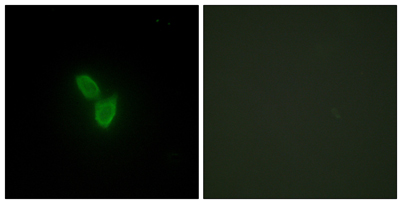
| Subcellular location | Cytoplasm . Endomembrane system . Cell junction . Cell junction, tight junction . Cell junction, adherens junction . Cell membrane . Cytoplasm, cell cortex . Cytoplasm, cytoskeleton . Localized along the cell-cell contact region. Colocalizes with PARD6A and PRKCI at epithelial tight junctions. Colocalizes with the cortical actin that overlays the meiotic spindle during metaphase I and metaphase II. Colocalized with SIRT2 in internode region of myelin sheath (By similarity). Presence of KRIT1, CDH5 and RAP1B is required for its localization to the cell junction. . |
| Expression | Widely expressed. |

Use collapsible tabs for more detailed information that will help customers make a purchasing decision.
Ex: Shipping and return policies, size guides, and other common questions.