 Français
 English

| ELK.No | ES3181 |
| Product name | PFKM rabbit pAb |
| Reactivity | Human;Mouse;Rat |
| Applications | WB;IHC;IF;ELISA |
| Other name | PFKM; PFKX; 6-phosphofructokinase; muscle type; Phosphofructo-1-kinase isozyme A; PFK-A; Phosphofructokinase-M; Phosphofructokinase 1; Phosphohexokinase |
| Size | 100μL |
| Unit price ($) | 248 |
| Human gene ID | 5213 |
| Human Swiss-Prot | P08237 |
| Source | Rabbit |
| Isotype | IgG |
| Target | PFKM |
| Fields | >>Glycolysis / Gluconeogenesis;>>Pentose phosphate pathway;>>Fructose and mannose metabolism;>>Galactose metabolism;>>Metabolic pathways;>>Carbon metabolism;>>Biosynthesis of amino acids;>>RNA degradation;>>HIF-1 signaling pathway;>>AMPK signaling pathway;>>Thyroid hormone signaling pathway;>>Glucagon signaling pathway;>>Central carbon metabolism in cancer |
| Gene name | PFKM |
| Protein name | 6-phosphofructokinase muscle type |
| Human gene link | View Human Gene |
| Human Swiss link | View Human Swiss-Prot |
| Mouse gene ID | 18642 |
| Mouse gene link | View Mouse Gene |
| Mouse Swiss-Prot | P47857 |
| Mouse Swiss link | View Mouse Swiss-Prot |
| Rat gene ID | 65152 |
| Rat gene link | View Rat Gene |
| Rat Swiss-Prot | P47858 |
| Rat Swiss link | View Rat Swiss-Prot |
| Immunogen | The antiserum was produced against synthesized peptide derived from human PFK-1. AA range:320-369 |
| Specificity | PFKM Polyclonal Antibody detects endogenous levels of PFKM protein. |
| Formulation | Liquid in PBS containing 50% glycerol, 0.5% BSA and 0.02% sodium azide. |
| Clonality | Polyclonal |
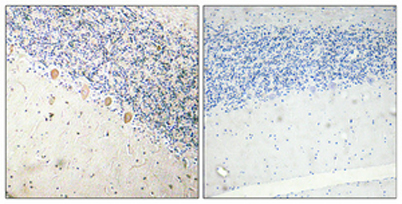
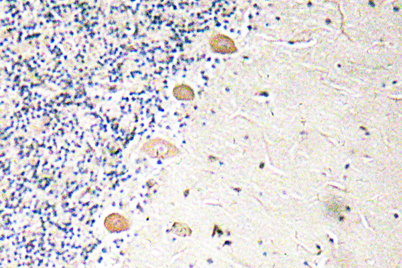
| Dilution | Western Blot: 1/500 - 1/2000. Immunohistochemistry: 1/100 - 1/300. ELISA: 1/10000. Not yet tested in other applications. |
| Purification | The antibody was affinity-purified from rabbit antiserum by affinity-chromatography using epitope-specific immunogen. |
| Concentration | 1 mg/ml |
| Storage stability | -20°C/1 year |
| Molecular Weight (Da) | |
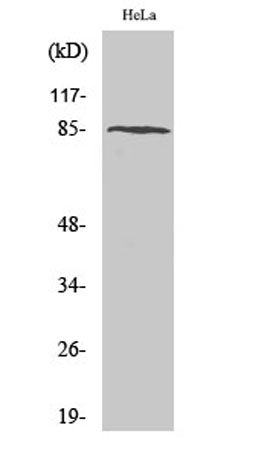
| Observed band (KD) | 85kD |
| Background | Three phosphofructokinase isozymes exist in humans: muscle, liver and platelet. These isozymes function as subunits of the mammalian tetramer phosphofructokinase, which catalyzes the phosphorylation of fructose-6-phosphate to fructose-1,6-bisphosphate. Tetramer composition varies depending on tissue type. This gene encodes the muscle-type isozyme. Mutations in this gene have been associated with glycogen storage disease type VII, also known as Tarui disease. Alternatively spliced transcript variants have been described.[provided by RefSeq, Nov 2009], |
| Function | catalytic activity:ATP + D-fructose 6-phosphate = ADP + D-fructose 1,6-bisphosphate.,cofactor:Magnesium.,disease:Defects in PFKM are the cause of glycogen storage disease type 7 (GSD7) [MIM:232800]; also known as Tarui disease. GSD7 is an autosomal recessive disorder characterized by exercise intolerance with associated nausea and vomiting. Short bursts of intense activity are particularly difficult. Severe muscle cramps and myoglobinuria develop after vigorous exercise. Most patients obtain a "second wind" when the onset of exercise is followed by a brief rest period. In time patients adjust their activity level and are well compensated.,enzyme regulation:Allosteric enzyme activated by ADP, AMP, or fructose bisphosphate and inhibited by ATP or citrate.,miscellaneous:In human PFK exists as a system of 3 types of subunits, PFKM (muscle), PFKL (liver) and PFKP (platelet) isoenzymes.,pathwa |
| Subcellular location | Cytoplasm . |
| Expression | Brain,Liver,Muscle,Skeletal muscle,Thymus, |

Use collapsible tabs for more detailed information that will help customers make a purchasing decision.
Ex: Shipping and return policies, size guides, and other common questions.