 Français
 English

| ELK.No | ES3270 |
| Product name | PSMC6 rabbit pAb |
| Reactivity | Human;Mouse |
| Applications | WB;IHC |
| Other name | PSMC6; SUG2; 26S protease regulatory subunit 10B; 26S proteasome AAA-ATPase subunit RPT4; Proteasome 26S subunit ATPase 6; Proteasome subunit p42 |
| Size | 50μL |
| Unit price ($) | 148 |
| Human gene ID | 5706 |
| Human Swiss-Prot | P62333 |
| Source | Rabbit |
| Isotype | IgG |
| Target | PSMC6 |
| Fields | >>Proteasome;>>Alzheimer disease;>>Parkinson disease;>>Amyotrophic lateral sclerosis;>>Huntington disease;>>Spinocerebellar ataxia;>>Prion disease;>>Pathways of neurodegeneration - multiple diseases;>>Epstein-Barr virus infection |
| Gene name | PSMC6 |
| Protein name | 26S protease regulatory subunit 10B |
| Human gene link | View Human Gene |
| Human Swiss link | View Human Swiss-Prot |
| Mouse gene ID | 67089 |
| Mouse gene link | View Mouse Gene |
| Mouse Swiss-Prot | P62334 |
| Mouse Swiss link | View Mouse Swiss-Prot |
| Rat gene ID | |
| Rat gene link | |
| Rat Swiss-Prot | |
| Rat Swiss link | |
| Immunogen | The antiserum was produced against synthesized peptide derived from human PSMC6. AA range:61-110 |
| Specificity | PSMC6 Polyclonal Antibody detects endogenous levels of PSMC6 protein. |
| Formulation | Liquid in PBS containing 50% glycerol, 0.5% BSA and 0.02% sodium azide. |
| Clonality | Polyclonal |
| Dilution | WB 1:500-2000;IHC-p 1:50-300 |
| Purification | The antibody was affinity-purified from rabbit antiserum by affinity-chromatography using epitope-specific immunogen. |
| Concentration | 1 mg/ml |
| Storage stability | -20°C/1 year |
| Molecular Weight (Da) | |
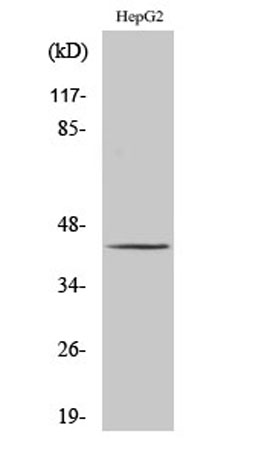
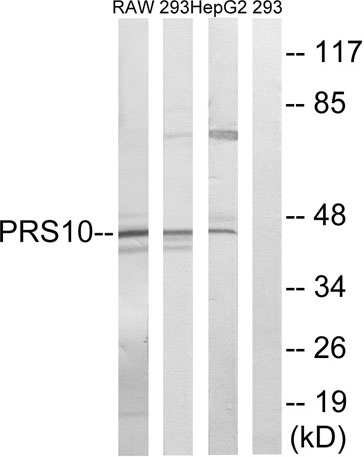
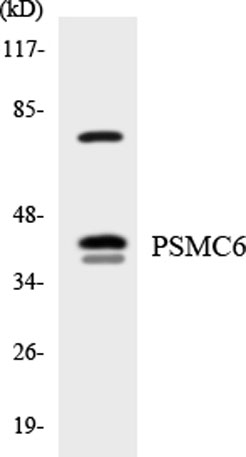
| Observed band (KD) | 44kD |
| Background | proteasome 26S subunit, ATPase 6(PSMC6) Homo sapiens The 26S proteasome is a multicatalytic proteinase complex with a highly ordered structure composed of 2 complexes, a 20S core and a 19S regulator. The 20S core is composed of 4 rings of 28 non-identical subunits; 2 rings are composed of 7 alpha subunits and 2 rings are composed of 7 beta subunits. The 19S regulator is composed of a base, which contains 6 ATPase subunits and 2 non-ATPase subunits, and a lid, which contains up to 10 non-ATPase subunits. Proteasomes are distributed throughout eukaryotic cells at a high concentration and cleave peptides in an ATP/ubiquitin-dependent process in a non-lysosomal pathway. An essential function of a modified proteasome, the immunoproteasome, is the processing of class I MHC peptides. This gene encodes one of the ATPase subunits, a member of the triple-A family of ATPases which have a chaperone-like activity. Pseudogenes have been identified on chrom |
| Function | function:The 26S protease is involved in the ATP-dependent degradation of ubiquitinated proteins. The regulatory (or ATPase) complex confers ATP dependency and substrate specificity to the 26S complex.,similarity:Belongs to the AAA ATPase family.,subunit:Found in the multi-protein complexes: the 26S proteasome (formed from the 20S proteasome and PA700), and the modulator. PA700 consists of 28 subunits arranged to form a cylinder-shaped complex by four stacked rings, each containing seven subunits. Interacts with PAAF1., |
| Subcellular location | Cytoplasm . Nucleus . |
| Expression | Aorta,Urinary bladder, |

Use collapsible tabs for more detailed information that will help customers make a purchasing decision.
Ex: Shipping and return policies, size guides, and other common questions.