 Français
 English

| ELK.No | ES3347 |
| Product name | RGS1 rabbit pAb |
| Reactivity | Human;Mouse;Rat |
| Applications | WB;IHC;IF;ELISA |
| Other name | RGS1; 1R20; BL34; IER1; Regulator of G-protein signaling 1; RGS1; B-cell activation protein BL34; Early response protein 1R20 |
| Size | 50μL |
| Unit price ($) | 148 |
| Human gene ID | 5996 |
| Human Swiss-Prot | Q08116 |
| Source | Rabbit |
| Isotype | IgG |
| Target | RGS1 |
| Fields | |
| Gene name | RGS1 |
| Protein name | Regulator of G-protein signaling 1 |
| Human gene link | View Human Gene |
| Human Swiss link | View Human Swiss-Prot |
| Mouse gene ID | 50778 |
| Mouse gene link | View Mouse Gene |
| Mouse Swiss-Prot | Q9JL25 |
| Mouse Swiss link | View Mouse Swiss-Prot |
| Rat gene ID | 54289 |
| Rat gene link | View Rat Gene |
| Rat Swiss-Prot | P97844 |
| Rat Swiss link | View Rat Swiss-Prot |
| Immunogen | The antiserum was produced against synthesized peptide derived from human RGS1. AA range:118-167 |
| Specificity | RGS1 Polyclonal Antibody detects endogenous levels of RGS1 protein. |
| Formulation | Liquid in PBS containing 50% glycerol, 0.5% BSA and 0.02% sodium azide. |
| Clonality | Polyclonal |
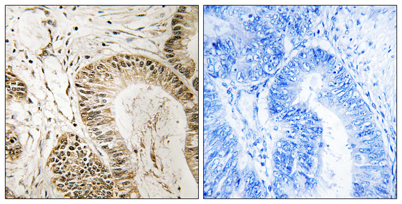
| Dilution | Western Blot: 1/500 - 1/2000. Immunohistochemistry: 1/100 - 1/300. ELISA: 1/20000. Not yet tested in other applications. |
| Purification | The antibody was affinity-purified from rabbit antiserum by affinity-chromatography using epitope-specific immunogen. |
| Concentration | 1 mg/ml |
| Storage stability | -20°C/1 year |
| Molecular Weight (Da) | |
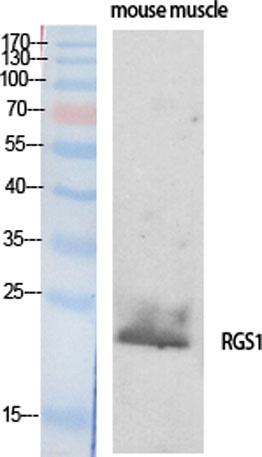
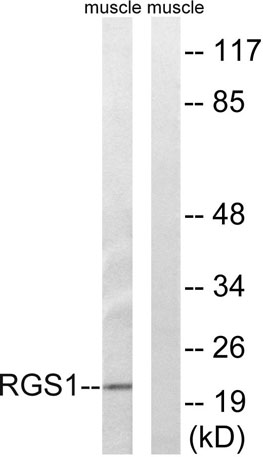
| Observed band (KD) | 22kD |
| Background | This gene encodes a member of the regulator of G-protein signalling family. This protein is located on the cytosolic side of the plasma membrane and contains a conserved, 120 amino acid motif called the RGS domain. The protein attenuates the signalling activity of G-proteins by binding to activated, GTP-bound G alpha subunits and acting as a GTPase activating protein (GAP), increasing the rate of conversion of the GTP to GDP. This hydrolysis allows the G alpha subunits to bind G beta/gamma subunit heterodimers, forming inactive G-protein heterotrimers, thereby terminating the signal. [provided by RefSeq, Jul 2008], |
| Function | function:Inhibits signal transduction by increasing the GTPase activity of G protein alpha subunits thereby driving them into their inactive GDP-bound form. This protein may be involved in the regulation of B-cell activation and proliferation.,induction:In response to several B-cell activation signals.,PTM:Could be phosphorylated. Might be functionally regulated by protein kinase(s).,similarity:Contains 1 RGS domain.,tissue specificity:B-cell specific. Expression is relatively low in B-cells and chronic lymphocytic leukemia B-cells; however, in other types of malignant B-cell such as non-Hodgkin's lymphoma and hairy cell leukemia, expression is constitutively high., |
| Subcellular location | Cell membrane ; Peripheral membrane protein ; Cytoplasmic side . Cytoplasm, cytosol . |
| Expression | Detected in peripheral blood monocytes (PubMed:10480894). Expression is relatively low in B-cells and chronic lymphocytic leukemia B-cells; however, in other types of malignant B-cell such as non-Hodgkin lymphoma and hairy cell leukemia, expression is constitutively high (PubMed:8473738). |

Use collapsible tabs for more detailed information that will help customers make a purchasing decision.
Ex: Shipping and return policies, size guides, and other common questions.