 Français
 English
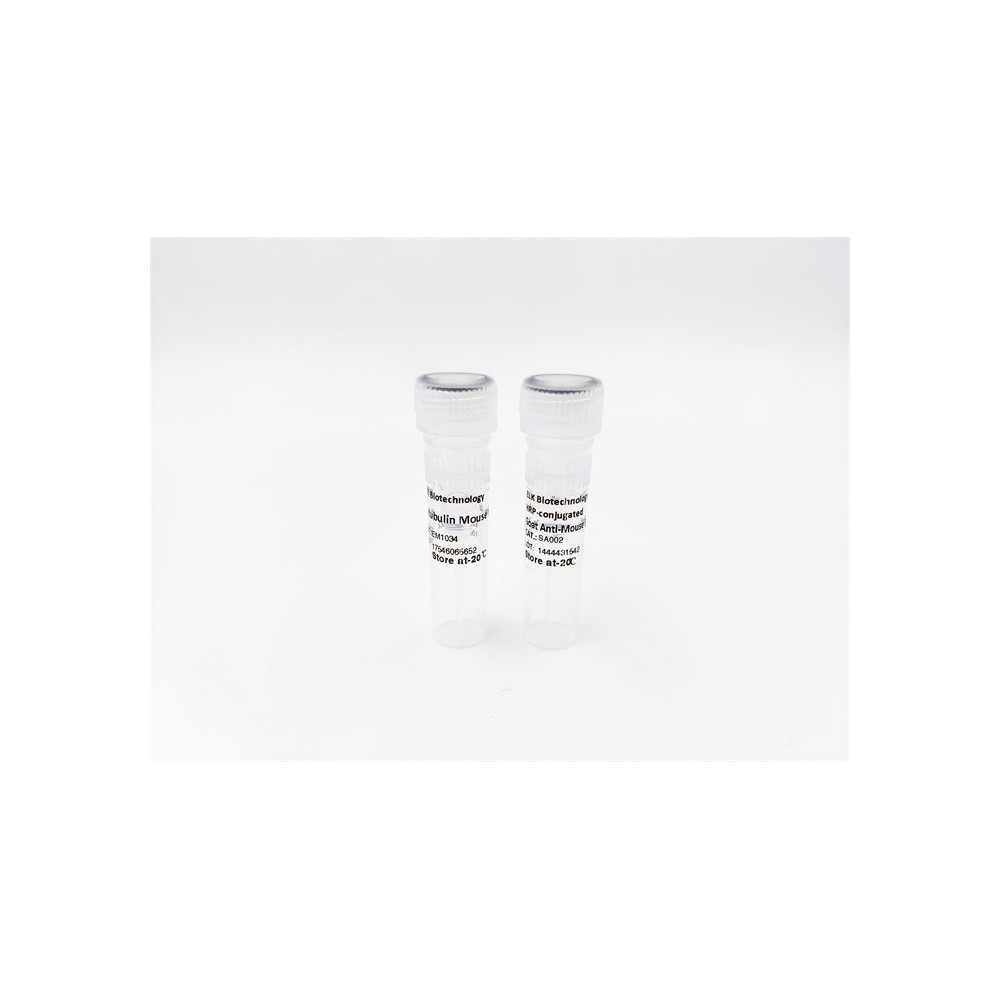

| ELK.No | ES3427 |
| Product name | Septin 8 rabbit pAb |
| Reactivity | Human;Mouse;Rat |
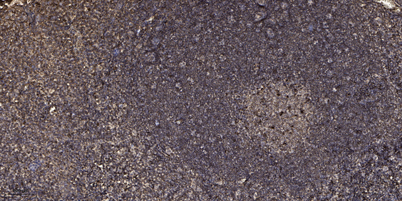
| Applications | WB;ELISA;IHC |
| Other name | SEPT8; KIAA0202; Septin-8 |
| Size | 100μL |
| Unit price ($) | 248 |
| Human gene ID | 23176 |
| Human Swiss-Prot | Q92599 |
| Source | Rabbit |
| Isotype | IgG |
| Target | Septin 8 |
| Fields | >>Bacterial invasion of epithelial cells;>>Shigellosis |
| Gene name | SEPT8 |
| Protein name | Septin-8 |
| Human gene link | View Human Gene |
| Human Swiss link | View Human Swiss-Prot |
| Mouse gene ID | 20362 |
| Mouse gene link | View Mouse Gene |
| Mouse Swiss-Prot | Q8CHH9 |
| Mouse Swiss link | View Mouse Swiss-Prot |
| Rat gene ID | |
| Rat gene link | |
| Rat Swiss-Prot | B0BNF1 |
| Rat Swiss link | View Rat Swiss-Prot |
| Immunogen | The antiserum was produced against synthesized peptide derived from human SEPT8. AA range:170-219 |
| Specificity | Septin 8 Polyclonal Antibody detects endogenous levels of Septin 8 protein. |
| Formulation | Liquid in PBS containing 50% glycerol, 0.5% BSA and 0.02% sodium azide. |
| Clonality | Polyclonal |
| Dilution | WB 1:500-2000;IHC-p 1:50-300; ELISA 2000-20000 |
| Purification | The antibody was affinity-purified from rabbit antiserum by affinity-chromatography using epitope-specific immunogen. |
| Concentration | 1 mg/ml |
| Storage stability | -20°C/1 year |
| Molecular Weight (Da) | |
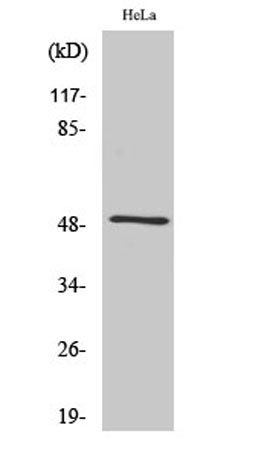
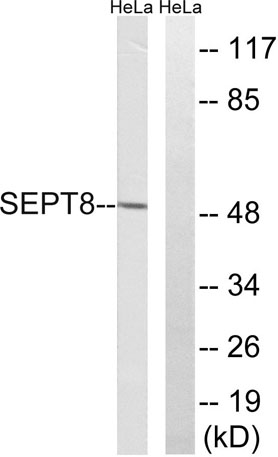
| Observed band (KD) | 50kD |
| Background | septin 8(SEPT8) Homo sapiens This gene is a member of the septin family of nucleotide binding proteins, originally described in yeast as cell division cycle regulatory proteins. Septins are highly conserved in yeast, Drosophila, and mouse, and appear to regulate cytoskeletal organization. Disruption of septin function disturbs cytokinesis and results in large multinucleate or polyploid cells. Multiple alternatively spliced transcript variants encoding different isoforms have been found for this gene. [provided by RefSeq, Jul 2014], |
| Function | similarity:Belongs to the septin family.,subunit:Interacts with SEPT5.,tissue specificity:Expressed in brain, heart and platelets; most abundant in aorta. Isoform 2 is expressed at low levels in specific brain areas, such as occipital pole, frontal lobe, temporal lobe and putamen, whereas isoforms 1 and 3 are highly expressed in these areas. In prostate, testis and ovary, isoform 2 is highly expressed, while isoforms 1 and 3 found at low levels., |
| Subcellular location | Cytoplasm . Cytoplasm, cytoskeleton . Cell junction, synapse . Cell projection, axon . Cytoplasmic vesicle, secretory vesicle, synaptic vesicle membrane . Cell junction, synapse, presynapse . Expressed in axons of immature neurons, localizes to synapses in mature neurons (By similarity). In platelets, found in areas surrounding alpha-granules (PubMed:15116257). . |
| Expression | Widely expressed, including in brain, heart and platelets; most abundant in aorta. Isoform 2 is expressed at low levels in specific brain areas, such as occipital pole, frontal lobe, temporal lobe and putamen. Isoform 1 and 3 are highly expressed in specific brain areas, such as occipital pole, frontal lobe, temporal lobe and putamen. Isoform 2 is highly expressed in prostate, testis and ovary. Isoform 1 and isoform 3 are expressed at low levels in prostate, testis and ovary. |

Use collapsible tabs for more detailed information that will help customers make a purchasing decision.
Ex: Shipping and return policies, size guides, and other common questions.