 Français
 English
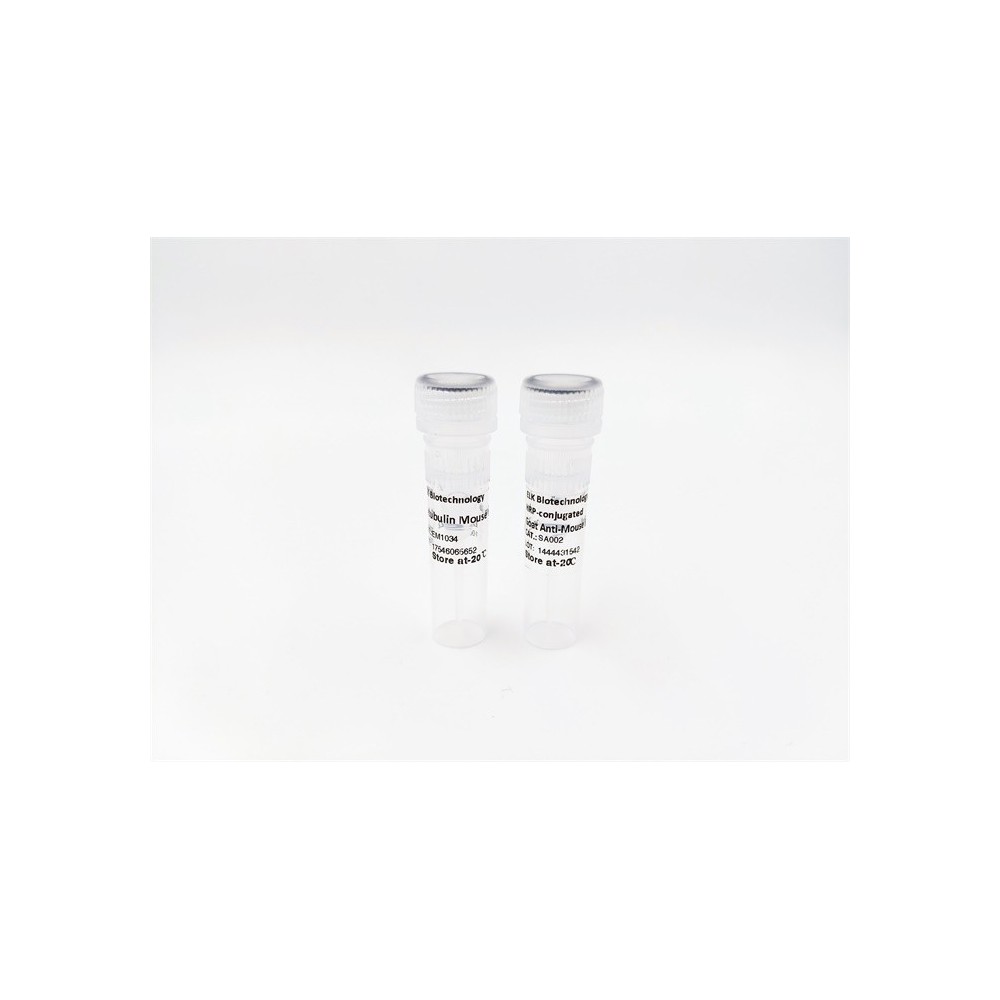

| ELK.No | ES3624 |
| Product name | TNF-β rabbit pAb |
| Reactivity | Human;Mouse;Rat;Monkey |
| Applications | WB;ELISA |
| Other name | LTA; TNFB; TNFSF1; Lymphotoxin-alpha; LT-alpha; TNF-beta; Tumor necrosis factor ligand superfamily member 1 |
| Size | 100μL |
| Unit price ($) | 248 |
| Human gene ID | 4049 |
| Human Swiss-Prot | P01374 |
| Source | Rabbit |
| Isotype | IgG |
| Target | TNFB |
| Fields | >>Cytokine-cytokine receptor interaction;>>Viral protein interaction with cytokine and cytokine receptor;>>NF-kappa B signaling pathway;>>TNF signaling pathway;>>Type I diabetes mellitus;>>Human T-cell leukemia virus 1 infection;>>Herpes simplex virus 1 infection |
| Gene name | LTA |
| Protein name | Lymphotoxin-alpha |
| Human gene link | View Human Gene |
| Human Swiss link | View Human Swiss-Prot |
| Mouse gene ID | 16992 |
| Mouse gene link | View Mouse Gene |
| Mouse Swiss-Prot | P09225 |
| Mouse Swiss link | View Mouse Swiss-Prot |
| Rat gene ID | 25008 |
| Rat gene link | View Rat Gene |
| Rat Swiss-Prot | Q06332 |
| Rat Swiss link | View Rat Swiss-Prot |
| Immunogen | The antiserum was produced against synthesized peptide derived from human TNF-beta. AA range:17-66 |
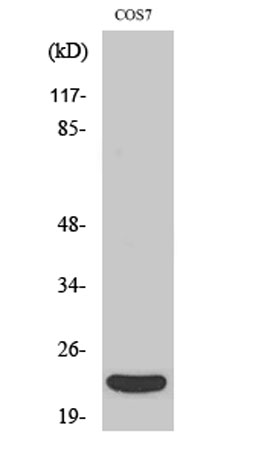
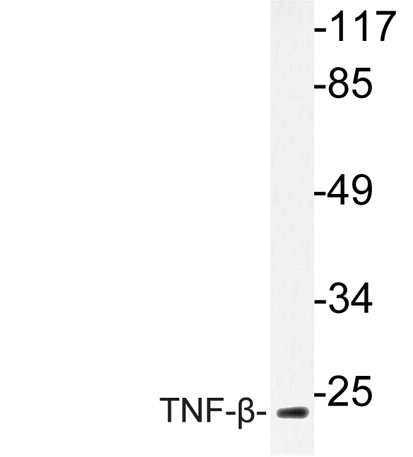
| Specificity | TNF-β Polyclonal Antibody detects endogenous levels of TNF-β protein. |
| Formulation | Liquid in PBS containing 50% glycerol, 0.5% BSA and 0.02% sodium azide. |
| Clonality | Polyclonal |
| Dilution | Western Blot: 1/500 - 1/2000. ELISA: 1/40000. Not yet tested in other applications. |
| Purification | The antibody was affinity-purified from rabbit antiserum by affinity-chromatography using epitope-specific immunogen. |
| Concentration | 1 mg/ml |
| Storage stability | -20°C/1 year |
| Molecular Weight (Da) | |
| Observed band (KD) | 22kD |
| Background | The encoded protein, a member of the tumor necrosis factor family, is a cytokine produced by lymphocytes. The protein is highly inducible, secreted, and forms heterotrimers with lymphotoxin-beta which anchor lymphotoxin-alpha to the cell surface. This protein also mediates a large variety of inflammatory, immunostimulatory, and antiviral responses, is involved in the formation of secondary lymphoid organs during development and plays a role in apoptosis. Genetic variations in this gene are associated with susceptibility to leprosy type 4, myocardial infarction, non-Hodgkin's lymphoma, and psoriatic arthritis. Alternatively spliced transcript variants have been observed for this gene. [provided by RefSeq, Jul 2012], |
| Function | disease:Genetic variations in LTA are associated with susceptibility to leprosy type 4 (LPRS4) [MIM:610988]; also known as susceptibility to age-dependent leprosy. Leprosy is a chronic infectious disease of peripheral sensory nerves caused by Mycobacterium leprae.,disease:Genetic variations in LTA are associated with susceptibility to psoriatic arthritis [MIM:607507]. Psoriasis is a chronic inflammatory dermatosis that affects approximately 2% of the population. It is characterized by red, scaly skin lesions that are usually found on the scalp, elbows, and knees, and may be associated with severe arthritis. Psoriatic arthritis has been defined as an inflammatory arthritis usually without any rheumatoid factor in serum (seronegative arthritis) associated with psoriasis.,function:Cytokine that in its homotrimeric form binds to TNFRSF1A/TNFR1, TNFRSF1B/TNFBR and TNFRSF14/HVEM. In its hetero |
| Subcellular location | Secreted. Membrane. The homotrimer is secreted. The heterotrimer is membrane-associated. |
| Expression | Lymph,Peripheral blood leukocyte,Peripheral blood mononuclear cells,Peripheral blood mononu |

Use collapsible tabs for more detailed information that will help customers make a purchasing decision.
Ex: Shipping and return policies, size guides, and other common questions.