 Français
 English
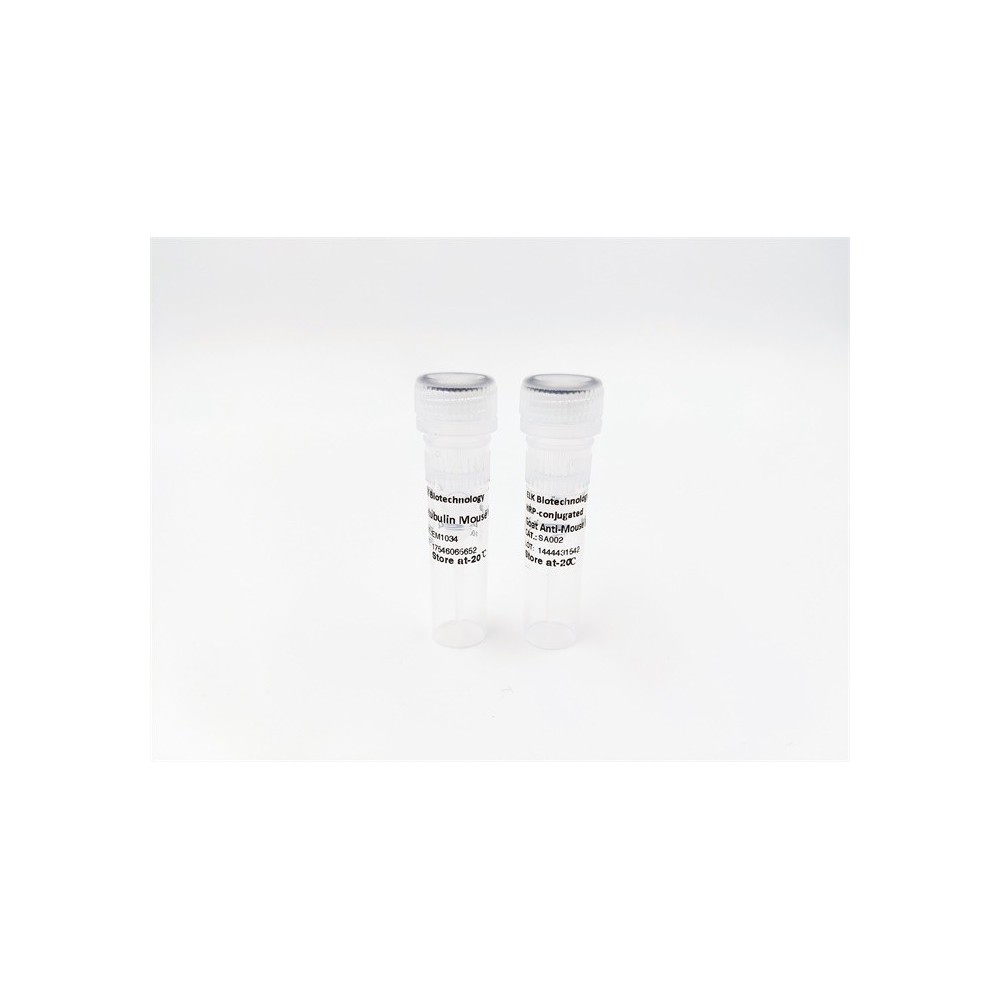

| ELK.No | ES3648 |
| Product name | Trypsin-1 rabbit pAb |
| Reactivity | Human;Rat;Mouse; |
| Applications | WB;ELISA |
| Other name | PRSS1; TRP1; TRY1; TRYP1; Trypsin-1; Beta-trypsin; Cationic trypsinogen; Serine protease 1; Trypsin I |
| Size | 50μL |
| Unit price ($) | 148 |
| Human gene ID | 5644 |
| Human Swiss-Prot | P07477 |
| Source | Rabbit |
| Isotype | IgG |
| Target | Trypsin-1 |
| Fields | >>Neuroactive ligand-receptor interaction;>>Pancreatic secretion;>>Protein digestion and absorption;>>Influenza A |
| Gene name | PRSS1 |
| Protein name | Trypsin-1 |
| Human gene link | View Human Gene |
| Human Swiss link | View Human Swiss-Prot |
| Mouse gene ID | |
| Mouse gene link | |
| Mouse Swiss-Prot | |
| Mouse Swiss link | |
| Rat gene ID | |
| Rat gene link | |
| Rat Swiss-Prot | |
| Rat Swiss link | |
| Immunogen | The antiserum was produced against synthesized peptide derived from human Trypsin-1. AA range:60-109 |
| Specificity | Trypsin-1 Polyclonal Antibody detects endogenous levels of Trypsin-1 protein. |
| Formulation | Liquid in PBS containing 50% glycerol, 0.5% BSA and 0.02% sodium azide. |
| Clonality | Polyclonal |
| Dilution | Western Blot: 1/500 - 1/2000. ELISA: 1/10000. Not yet tested in other applications. |
| Purification | The antibody was affinity-purified from rabbit antiserum by affinity-chromatography using epitope-specific immunogen. |
| Concentration | 1 mg/ml |
| Storage stability | -20°C/1 year |
| Molecular Weight (Da) | |
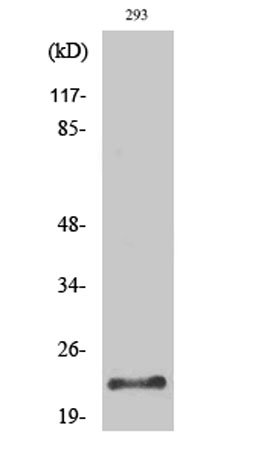
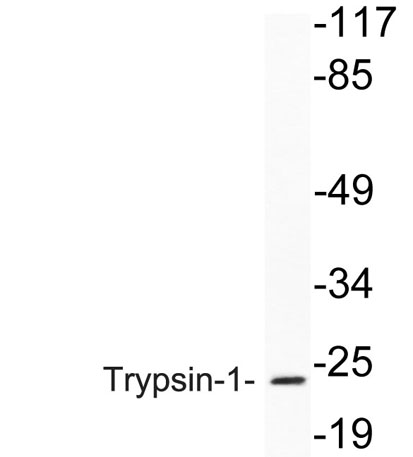
| Observed band (KD) | 23kD |
| Background | This gene encodes a trypsinogen, which is a member of the trypsin family of serine proteases. This enzyme is secreted by the pancreas and cleaved to its active form in the small intestine. It is active on peptide linkages involving the carboxyl group of lysine or arginine. Mutations in this gene are associated with hereditary pancreatitis. This gene and several other trypsinogen genes are localized to the T cell receptor beta locus on chromosome 7. [provided by RefSeq, Jul 2008], |
| Function | catalytic activity:Preferential cleavage: Arg-|-Xaa, Lys-|-Xaa.,caution:Tyr-154 was proposed to be phosphorylated (PubMed:8683601) but it has been shown (PubMed:17087724) to be sulfated instead. Phosphate and sulfate groups are similar in mass and size, and this can lead to erroneous interpretation of the results.,cofactor:Binds 1 calcium ion per subunit.,disease:Defects in PRSS1 are a cause of hereditary pancreatitis (HPC) [MIM:167800]; also known as chronic pancreatitis (CP). HPC is an autosomal dominant disease characterized by the presence of calculi in pancreatic ducts. It causes severe abdominal pain attacks.,function:Has activity against the synthetic substrates Boc-Phe-Ser-Arg-Mec, Boc-Leu-Thr-Arg-Mec, Boc-Gln-Ala-Arg-Mec and Boc-Val-Pro-Arg-Mec. The single-chain form is more active than the two-chain form against all of these substrates.,mass spectrometry: PubMed:8683601,PTM:Occ |
| Subcellular location | Secreted, extracellular space. |
| Expression | Brain,Cajal-Retzius cell,Gastric adenocarcinoma,PCR rescued clones,Prostate, |

Use collapsible tabs for more detailed information that will help customers make a purchasing decision.
Ex: Shipping and return policies, size guides, and other common questions.