 Français
 English
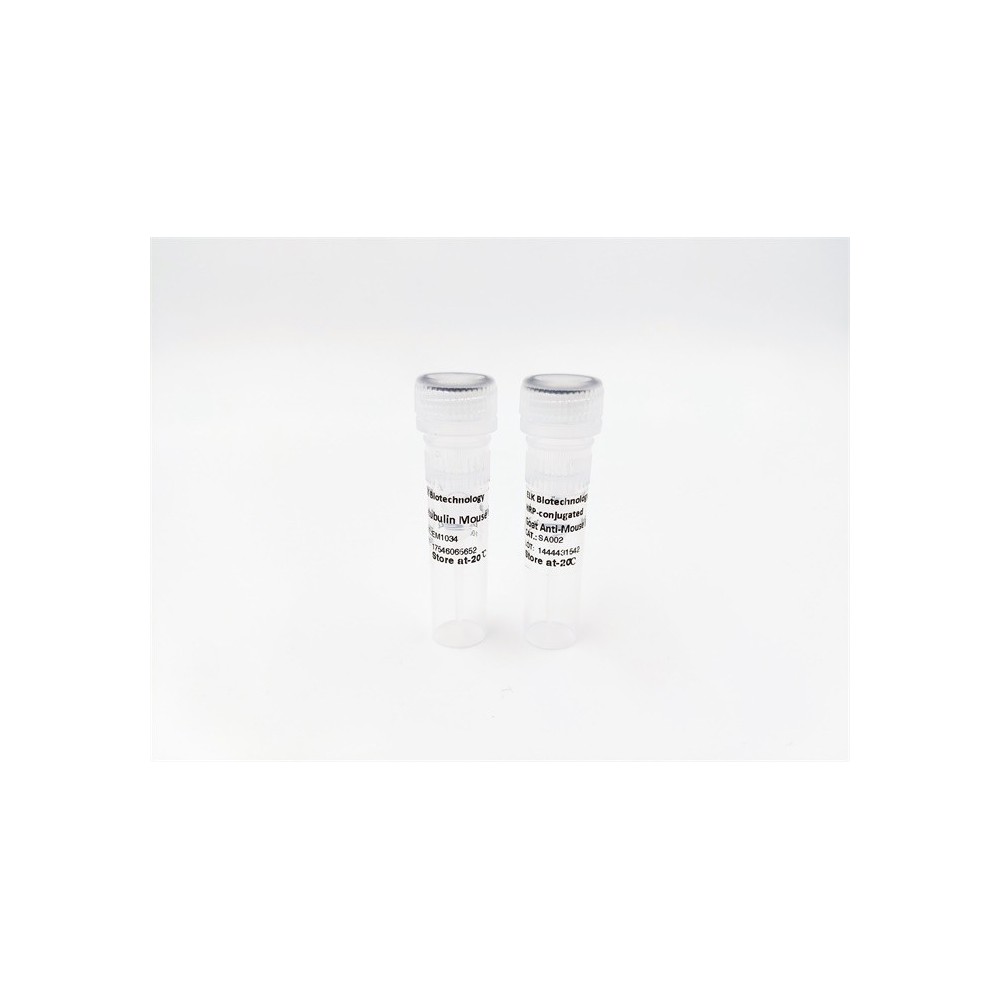

| ELK.No | ES3670 |
| Product name | UBR5 rabbit pAb |
| Reactivity | Human;Mouse |
| Applications | WB;IHC;IF;ELISA |
| Other name | UBR5; EDD; EDD1; HYD; KIAA0896; E3 ubiquitin-protein ligase UBR5; E3 ubiquitin-protein ligase; HECT domain-containing 1; Hyperplastic discs protein homolog; hHYD; Progestin-induced protein |
| Size | 50μL |
| Unit price ($) | 148 |
| Human gene ID | 51366 |
| Human Swiss-Prot | O95071 |
| Source | Rabbit |
| Isotype | IgG |
| Target | UBR5 |
| Fields | >>Ubiquitin mediated proteolysis |
| Gene name | UBR5 |
| Protein name | E3 ubiquitin-protein ligase UBR5 |
| Human gene link | View Human Gene |
| Human Swiss link | View Human Swiss-Prot |
| Mouse gene ID | 70790 |
| Mouse gene link | View Mouse Gene |
| Mouse Swiss-Prot | Q80TP3 |
| Mouse Swiss link | View Mouse Swiss-Prot |
| Rat gene ID | |
| Rat gene link | |
| Rat Swiss-Prot | |
| Rat Swiss link | |
| Immunogen | The antiserum was produced against synthesized peptide derived from human EDD. AA range:1-50 |
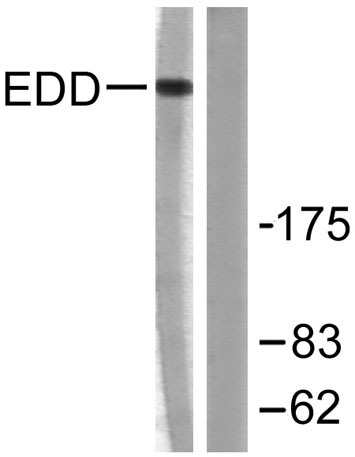
| Specificity | UBR5 Polyclonal Antibody detects endogenous levels of UBR5 protein. |
| Formulation | Liquid in PBS containing 50% glycerol, 0.5% BSA and 0.02% sodium azide. |
| Clonality | Polyclonal |
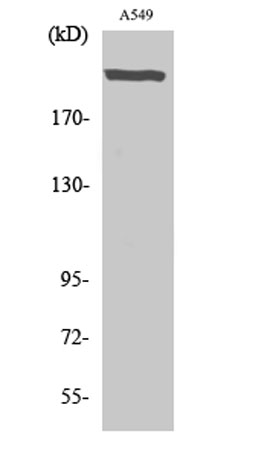
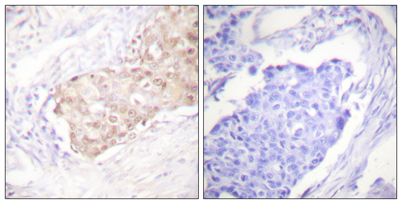
| Dilution | Western Blot: 1/500 - 1/2000. Immunohistochemistry: 1/100 - 1/300. ELISA: 1/5000. Not yet tested in other applications. |
| Purification | The antibody was affinity-purified from rabbit antiserum by affinity-chromatography using epitope-specific immunogen. |
| Concentration | 1 mg/ml |
| Storage stability | -20°C/1 year |
| Molecular Weight (Da) | |
| Observed band (KD) | 309kD |
| Background | This gene encodes a progestin-induced protein, which belongs to the HECT (homology to E6-AP carboxyl terminus) family. The HECT family proteins function as E3 ubiquitin-protein ligases, targeting specific proteins for ubiquitin-mediated proteolysis. This gene is localized to chromosome 8q22 which is disrupted in a variety of cancers. This gene potentially has a role in regulation of cell proliferation or differentiation. [provided by RefSeq, Jul 2008], |
| Function | function:E3 ubiquitin-protein ligase which is a component of the N-end rule pathway. Recognizes and binds to proteins bearing specific amino-terminal residues that are destabilizing according to the N-end rule, leading to their ubiquitination and subsequent degradation (By similarity). May be involved in maturation and/or transcriptional regulation of mRNA. May play a role in control of cell cycle progression. May have tumor suppressor function. Regulates DNA topoisomerase II binding protein (TopBP1) in the DNA damage response. Plays an essential role in extraembryonic development.,miscellaneous:A cysteine residue is required for ubiquitin-thioester formation.,pathway:Protein modification; protein ubiquitination.,PTM:Phosphorylated upon DNA damage, probably by ATM or ATR.,similarity:Contains 1 HECT (E6AP-type E3 ubiquitin-protein ligase) domain.,similarity:Contains 1 PABC domain.,similar |
| Subcellular location | Nucleus. |
| Expression | Widely expressed. Most abundant in testis and expressed at high levels in brain, pituitary and kidney. |

Use collapsible tabs for more detailed information that will help customers make a purchasing decision.
Ex: Shipping and return policies, size guides, and other common questions.