 Français
 English

| ELK.No | ES3684 |
| Product name | Vangl1 rabbit pAb |
| Reactivity | Human;Mouse |
| Applications | WB;ELISA |
| Other name | VANGL1; STB2; Vang-like protein 1; Loop-tail protein 2 homolog; LPP2; Strabismus 2; Van Gogh-like protein 1 |
| Size | 50μL |
| Unit price ($) | 148 |
| Human gene ID | 81839 |
| Human Swiss-Prot | Q8TAA9 |
| Source | Rabbit |
| Isotype | IgG |
| Target | Vangl1 |
| Fields | >>Wnt signaling pathway |
| Gene name | VANGL1 |
| Protein name | Vang-like protein 1 |
| Human gene link | View Human Gene |
| Human Swiss link | View Human Swiss-Prot |
| Mouse gene ID | 229658 |
| Mouse gene link | View Mouse Gene |
| Mouse Swiss-Prot | Q80Z96 |
| Mouse Swiss link | View Mouse Swiss-Prot |
| Rat gene ID | |
| Rat gene link | |
| Rat Swiss-Prot | |
| Rat Swiss link | |
| Immunogen | The antiserum was produced against synthesized peptide derived from human VANGL1. AA range:301-350 |
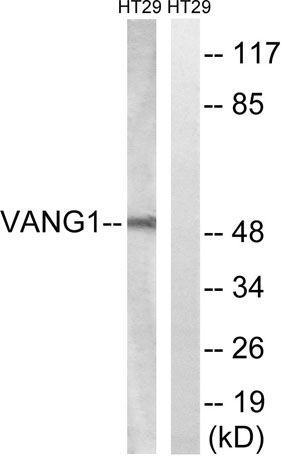
| Specificity | Vangl1 Polyclonal Antibody detects endogenous levels of Vangl1 protein. |
| Formulation | Liquid in PBS containing 50% glycerol, 0.5% BSA and 0.02% sodium azide. |
| Clonality | Polyclonal |
| Dilution | Western Blot: 1/500 - 1/2000. ELISA: 1/20000. Not yet tested in other applications. |
| Purification | The antibody was affinity-purified from rabbit antiserum by affinity-chromatography using epitope-specific immunogen. |
| Concentration | 1 mg/ml |
| Storage stability | -20°C/1 year |
| Molecular Weight (Da) | |
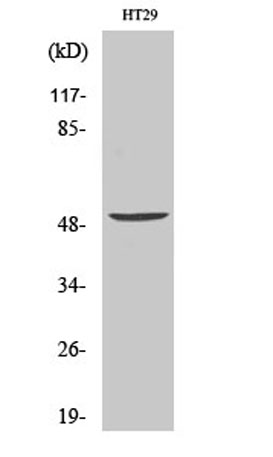
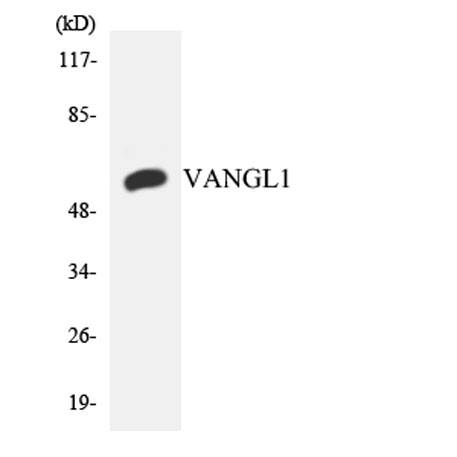
| Observed band (KD) | 50kD |
| Background | This gene encodes a member of the tretraspanin family. The encoded protein may be involved in mediating intestinal trefoil factor induced wound healing in the intestinal mucosa. Mutations in this gene are associated with neural tube defects. Alternate splicing results in multiple transcript variants. [provided by RefSeq, Feb 2010], |
| Function | disease:Defects in VANGL1 are a cause of neural tube defects (NTD) [MIM:182940]. NTD are congenital malformations. The most common forms of NTD are described as open defects (including anencephaly and myelomeningocele, or spina bifida), which result from the failure of fusion in the cranial and spinal region of the neural tube, respectively. Other open dysraphisms (including myeloschisis, hemimyelomeningocele, and hemimyelocele) are sometimes associated with a Chiari type 2 malformation. A number of skin-covered (closed) NTD are categorized clinically depending on the presence of a subcutaneous mass (lipomyeloschisis, lipomyelomeningocele, meningocele, and myelocystocele) or the absence of such a mass (complex dysraphic states, including split cord malformations, dermal sinus, caudal regression, and segmental spinal dysgenesis).,disease:Defects in VANGL1 are a cause of sacral defect with |
| Subcellular location | Cell membrane ; Multi-pass membrane protein . |
| Expression | According to PubMed:11956595, ubiquitously expressed. According to PubMed:12011995, expressed specifically in testis and ovary. |

Use collapsible tabs for more detailed information that will help customers make a purchasing decision.
Ex: Shipping and return policies, size guides, and other common questions.