 Français
 English
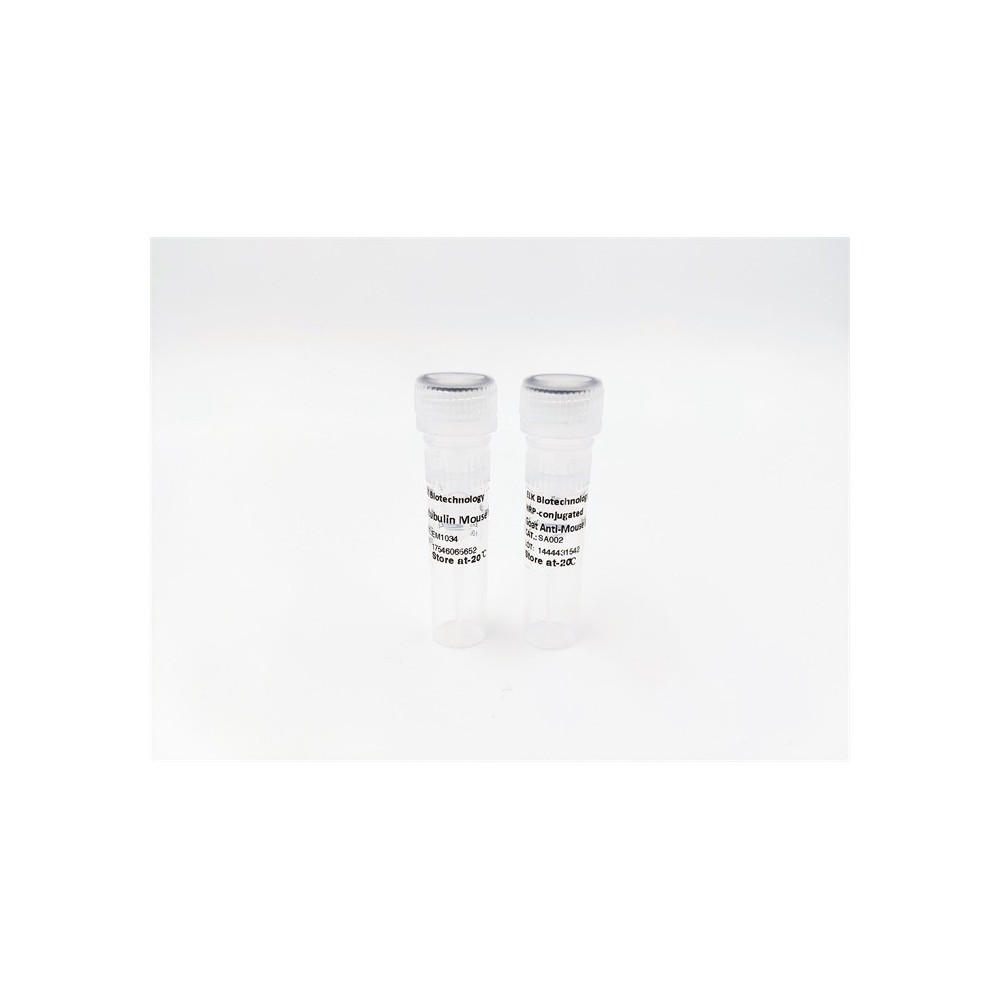

| ELK.No | ES3716 |
| Product name | XRCC4 rabbit pAb |
| Reactivity | Human;Rat;Mouse; |
| Applications | WB;ELISA |
| Other name | XRCC4; DNA repair protein XRCC4; X-ray repair cross-complementing protein 4 |
| Size | 100μL |
| Unit price ($) | 248 |
| Human gene ID | 7518 |
| Human Swiss-Prot | Q13426 |
| Source | Rabbit |
| Isotype | IgG |
| Target | XRCC4 |
| Fields | >>Non-homologous end-joining |
| Gene name | XRCC4 |
| Protein name | DNA repair protein XRCC4 |
| Human gene link | View Human Gene |
| Human Swiss link | View Human Swiss-Prot |
| Mouse gene ID | |
| Mouse gene link | |
| Mouse Swiss-Prot | Q924T3 |
| Mouse Swiss link | View Mouse Swiss-Prot |
| Rat gene ID | |
| Rat gene link | |
| Rat Swiss-Prot | |
| Rat Swiss link | |
| Immunogen | The antiserum was produced against synthesized peptide derived from human XRCC4. AA range:261-310 |
| Specificity | XRCC4 Polyclonal Antibody detects endogenous levels of XRCC4 protein. |
| Formulation | Liquid in PBS containing 50% glycerol, 0.5% BSA and 0.02% sodium azide. |
| Clonality | Polyclonal |
| Dilution | Western Blot: 1/500 - 1/2000. ELISA: 1/20000. Not yet tested in other applications. |
| Purification | The antibody was affinity-purified from rabbit antiserum by affinity-chromatography using epitope-specific immunogen. |
| Concentration | 1 mg/ml |
| Storage stability | -20°C/1 year |
| Molecular Weight (Da) | |
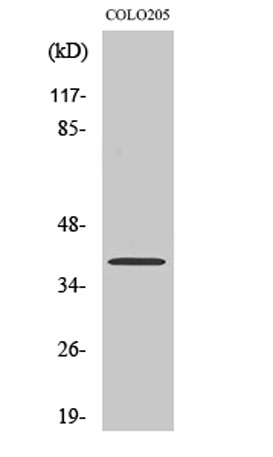
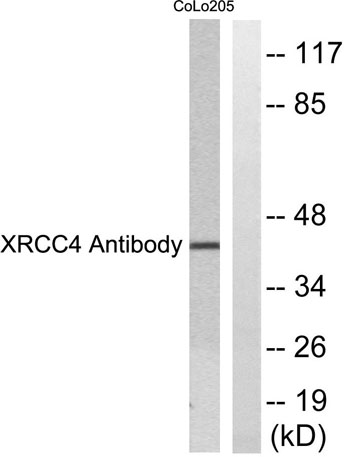
| Observed band (KD) | 40kD |
| Background | The protein encoded by this gene functions together with DNA ligase IV and the DNA-dependent protein kinase in the repair of DNA double-strand breaks. This protein plays a role in both non-homologous end joining and the completion of V(D)J recombination. Mutations in this gene can cause short stature, microcephaly, and endocrine dysfunction (SSMED). Alternative splicing generates several transcript variants. [provided by RefSeq, Dec 2015], |
| Function | function:Involved in DNA non-homologous end joining (NHEJ) required for double-strand break repair and V(D)J recombination. Binds to DNA and to DNA ligase IV (LIG4). The LIG4-XRCC4 complex is responsible for the NHEJ ligation step, and XRCC4 enhances the joining activity of LIG4. Binding of the LIG4-XRCC4 complex to DNA ends is dependent on the assembly of the DNA-dependent protein kinase complex DNA-PK to these DNA ends.,PTM:Monoubiquitinated.,PTM:Phosphorylated by PRKDC. The phosphorylation seems not to be necessary for binding to DNA. Phosphorylation by CK2 promotes interaction with APTX.,PTM:Sumoylation at Lys-210 is required for nuclear localization and recombination efficiency. Has no effect on ubiquitination.,similarity:Belongs to the XRCC4 family.,subunit:Homodimer and homotetramer in solution. The homodimer associates with LIG4, and the LIG4-XRCC4 complex associates in a DNA-dep |
| Subcellular location | Nucleus . Chromosome . Localizes to site of double-strand breaks. .; [Protein XRCC4, C-terminus]: Cytoplasm . Translocates from the nucleus to the cytoplasm following cleavage by caspase-3 (CASP3). . |
| Expression | Widely expressed. |

Use collapsible tabs for more detailed information that will help customers make a purchasing decision.
Ex: Shipping and return policies, size guides, and other common questions.