 Français
 English

| ELK.No | ES3753 |
| Product name | Ihh rabbit pAb |
| Reactivity | Human;Mouse;Rat |
| Applications | WB;ELISA |
| Other name | IHH; Indian hedgehog protein; IHH; HHG-2 |
| Size | 50μL |
| Unit price ($) | 148 |
| Human gene ID | 3549 |
| Human Swiss-Prot | Q14623 |
| Source | Rabbit |
| Isotype | IgG |
| Target | Ihh |
| Fields | >>Hedgehog signaling pathway;>>Proteoglycans in cancer |
| Gene name | IHH |
| Protein name | Indian hedgehog protein |
| Human gene link | View Human Gene |
| Human Swiss link | View Human Swiss-Prot |
| Mouse gene ID | 16147 |
| Mouse gene link | View Mouse Gene |
| Mouse Swiss-Prot | P97812 |
| Mouse Swiss link | View Mouse Swiss-Prot |
| Rat gene ID | |
| Rat gene link | |
| Rat Swiss-Prot | |
| Rat Swiss link | |
| Immunogen | The antiserum was produced against synthesized peptide derived from human Ihh. AA range:209-258 |
| Specificity | Ihh Polyclonal Antibody detects endogenous levels of Ihh protein. |
| Formulation | Liquid in PBS containing 50% glycerol, 0.5% BSA and 0.02% sodium azide. |
| Clonality | Polyclonal |
| Dilution | Western Blot: 1/500 - 1/2000. ELISA: 1/20000. Not yet tested in other applications. |
| Purification | The antibody was affinity-purified from rabbit antiserum by affinity-chromatography using epitope-specific immunogen. |
| Concentration | 1 mg/ml |
| Storage stability | -20°C/1 year |
| Molecular Weight (Da) | |
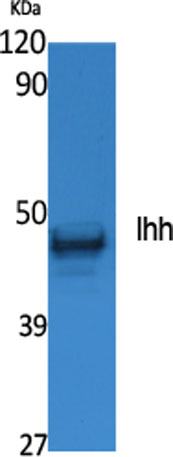
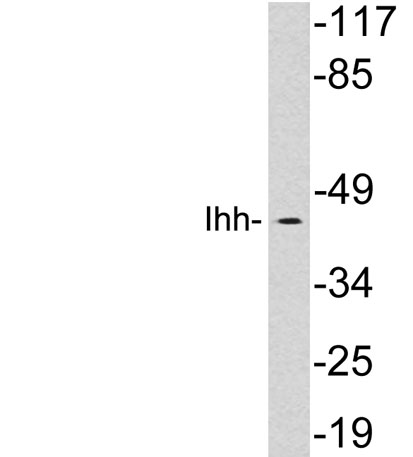
| Observed band (KD) | 45kD |
| Background | This gene encodes a member of the hedgehog family of proteins. The encoded preproprotein is proteolytically processed to generate multiple protein products, including an N-terminal fragment that is involved in signaling. Hedgehog family proteins are essential secreted signaling molecules that regulate a variety of developmental processes including growth, patterning and morphogenesis. The protein encoded by this gene specifically plays a role in bone growth and differentiation. Mutations in this gene are the cause of brachydactyly type A1, which is characterized by shortening or malformation of the fingers and toes. Mutations in this gene are also the cause of acrocapitofemoral dysplasia. [provided by RefSeq, Nov 2015], |
| Function | disease:Defects in IHH are a cause of acrocapitofemoral dysplasia (ACFD) [MIM:607778]. ACFD is a disorder characterized by short stature of variable severity with postnatal onset. The most constant radiographic abnormalities are observed in the tubular bones of the hands and in the proximal part of the femur. Cone-shaped epiphyses or a similar epiphyseal configuration with premature epimetaphyseal fusion result in shortening of the skeletal components involved. Cone-shaped epiphyses were also present to a variable extent at the shoulders, knees, and ankles.,disease:Defects in IHH are the cause of brachydactyly type A1 (BDA1) [MIM:112500]. BDA1 is an autosomal dominant disorder characterized by middle phalanges of all the digits rudimentary or fused with the terminal phalanges. The proximal phalanges of the thumbs and big toes are short.,function:Intercellular signal essential for a varie |
| Subcellular location | [Indian hedgehog protein N-product]: Cell membrane ; Lipid-anchor ; Extracellular side . The N-terminal peptide remains associated with the cell surface. .; [Indian hedgehog protein C-product]: Secreted, extracellular space . The C-terminal peptide diffuses from the cell. .; Cell membrane . |
| Expression | Expressed in embryonic lung, and in adult kidney and liver. |

Use collapsible tabs for more detailed information that will help customers make a purchasing decision.
Ex: Shipping and return policies, size guides, and other common questions.