 Français
 English

| ELK.No | ES3821 |
| Product name | IL-31Rα rabbit pAb |
| Reactivity | Human;Rat;Mouse; |
| Applications | WB;ELISA |
| Other name | IL31RA; CRL3; GPL; Interleukin-31 receptor subunit alpha; IL-31 receptor subunit alpha; IL-31R subunit alpha; IL-31R-alpha; IL-31RA; Cytokine receptor-like 3; GLM-R; hGLM-R; Gp130-like monocyte receptor; Gp130-like receptor; ZcytoR17 |
| Size | 100μL |
| Unit price ($) | 248 |
| Human gene ID | 133396 |
| Human Swiss-Prot | Q8NI17 |
| Source | Rabbit |
| Isotype | IgG |
| Target | IL-31Rα |
| Fields | >>Cytokine-cytokine receptor interaction |
| Gene name | IL31RA |
| Protein name | Interleukin-31 receptor subunit alpha |
| Human gene link | View Human Gene |
| Human Swiss link | View Human Swiss-Prot |
| Mouse gene ID | |
| Mouse gene link | |
| Mouse Swiss-Prot | Q8K5B1 |
| Mouse Swiss link | View Mouse Swiss-Prot |
| Rat gene ID | |
| Rat gene link | |
| Rat Swiss-Prot | |
| Rat Swiss link | |
| Immunogen | Synthesized peptide derived from the Internal region of human IL-31Rα. |
| Specificity | IL-31Rα Polyclonal Antibody detects endogenous levels of IL-31Rα protein. |
| Formulation | Liquid in PBS containing 50% glycerol, 0.5% BSA and 0.02% sodium azide. |
| Clonality | Polyclonal |
| Dilution | Western Blot: 1/500 - 1/2000. ELISA: 1/40000. Not yet tested in other applications. |
| Purification | The antibody was affinity-purified from rabbit antiserum by affinity-chromatography using epitope-specific immunogen. |
| Concentration | 1 mg/ml |
| Storage stability | -20°C/1 year |
| Molecular Weight (Da) | |
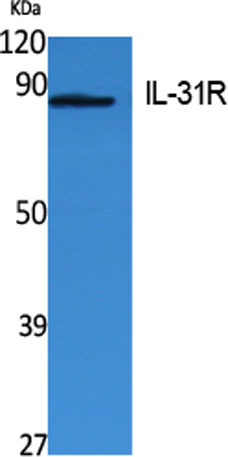
| Observed band (KD) | 82kD |
| Background | The protein encoded by this gene belongs to the type I cytokine receptor family. This receptor, with homology to gp130, is expressed on monocytes, and is involved in IL-31 signaling via activation of STAT-3 and STAT-5. It functions either as a monomer, or as part of a receptor complex with oncostatin M receptor (OSMR). Several alternatively spliced transcript variants encoding different isoforms have been noted for this gene.[provided by RefSeq, Jun 2011], |
| Function | function:Associates with OSMR to form the interleukin-31 receptor which activates STAT3 and to a lower extent STAT1 and STAT5. May function in skin immunity.,induction:Up-regulated in lesional keratinocytes of patients with atopic dermatitis. Up-regulated by IFNG and lipopolysaccharides.,PTM:N-glycosylated.,similarity:Belongs to the type I cytokine receptor family. Type 2 subfamily.,similarity:Contains 5 fibronectin type-III domains.,subunit:Heterodimer with OSMR. Interacts with JAK1 and STAT3.,tissue specificity:Expressed at low levels in testis, ovary, brain, prostate, placenta, thymus, bone marrow, trachea and skin. Detected in all of the myelomonocytic lineage. Expressed in CD14-and CD56-positive blood cells and by macrophages (at protein level)., |
| Subcellular location | Cell membrane ; Single-pass type I membrane protein . Cell junction, synapse, presynaptic cell membrane . Cell projection, axon . |
| Expression | Expressed in CD14- and CD56-positive blood cells (PubMed:11877449). Expressed in macrophages (PubMed:16461143, PubMed:18439099). Expressed in keratinocytes (PubMed:21261663). Expressed in a subset of dorsal root ganglia neurons (at protein level) (PubMed:24373353). Expressed at low levels in testis, ovary, brain, prostate, placenta, thymus, bone marrow, trachea and skin (PubMed:15184896, PubMed:11877449, PubMed:14504285). Expressed in bronchial and alveolar epithelial cells and pulmonary fibroblasts (PubMed:18439099). Detected in all of the myelomonocytic lineage (PubMed:14504285). Isoform 6: Expressed at higher levels in lesional skin compared to healthy skin of atopic dermatitis patients (PubMed:24373353). |

Use collapsible tabs for more detailed information that will help customers make a purchasing decision.
Ex: Shipping and return policies, size guides, and other common questions.