 Français
 English

| ELK.No | ES3904 |
| Product name | Angptl4 rabbit pAb |
| Reactivity | Human;Mouse;Rat |
| Applications | WB;IHC;IF;ELISA |
| Other name | ANGPTL4; ARP4; HFARP; PGAR; PP1158; PSEC0166; Angiopoietin-related protein 4; Angiopoietin-like protein 4; Hepatic fibrinogen/angiopoietin-related protein; HFARP |
| Size | 50μL |
| Unit price ($) | 148 |
| Human gene ID | 51129 |
| Human Swiss-Prot | Q9BY76 |
| Source | Rabbit |
| Isotype | IgG |
| Target | Angptl4 |
| Fields | >>PPAR signaling pathway;>>Cholesterol metabolism |
| Gene name | ANGPTL4 |
| Protein name | Angiopoietin-related protein 4 |
| Human gene link | View Human Gene |
| Human Swiss link | View Human Swiss-Prot |
| Mouse gene ID | 57875 |
| Mouse gene link | View Mouse Gene |
| Mouse Swiss-Prot | Q9Z1P8 |
| Mouse Swiss link | View Mouse Swiss-Prot |
| Rat gene ID | 362850 |
| Rat gene link | View Rat Gene |
| Rat Swiss-Prot | Q6TMA8 |
| Rat Swiss link | View Rat Swiss-Prot |
| Immunogen | The antiserum was produced against synthesized peptide derived from the Internal region of human ANGPTL4. AA range:301-350 |
| Specificity | Angptl4 Polyclonal Antibody detects endogenous levels of Angptl4 protein. |
| Formulation | Liquid in PBS containing 50% glycerol, 0.5% BSA and 0.02% sodium azide. |
| Clonality | Polyclonal |
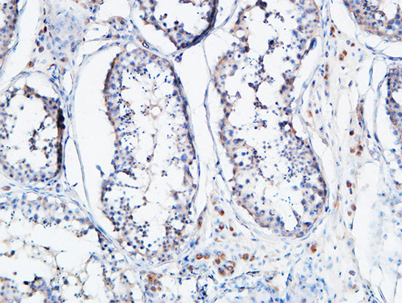
| Dilution | IHC-p: 100-300.Western Blot: 1/500 - 1/2000. ELISA: 1/20000. Not yet tested in other applications. |
| Purification | The antibody was affinity-purified from rabbit antiserum by affinity-chromatography using epitope-specific immunogen. |
| Concentration | 1 mg/ml |
| Storage stability | -20°C/1 year |
| Molecular Weight (Da) | |
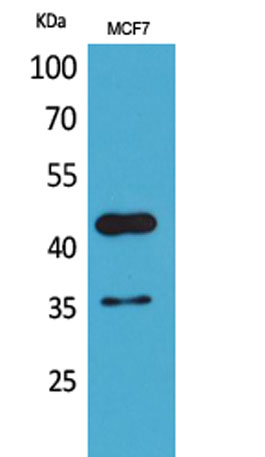
| Observed band (KD) | 45kD |
| Background | This gene encodes a glycosylated, secreted protein containing a C-terminal fibrinogen domain. The encoded protein is induced by peroxisome proliferation activators and functions as a serum hormone that regulates glucose homeostasis, lipid metabolism, and insulin sensitivity. This protein can also act as an apoptosis survival factor for vascular endothelial cells and can prevent metastasis by inhibiting vascular growth and tumor cell invasion. The C-terminal domain may be proteolytically-cleaved from the full-length secreted protein. Decreased expression of this gene has been associated with type 2 diabetes. Alternative splicing results in multiple transcript variants. This gene was previously referred to as ANGPTL2 but has been renamed ANGPTL4. [provided by RefSeq, Sep 2013], |
| Function | caution:The sequence shown here is derived from an Ensembl automatic analysis pipeline and should be considered as preliminary data.,disease:Found to be highly expressed in the early stages of collagen-induced arthritis (CIA).,disease:Produced in ischemic tissues in conditions such as critical leg ischemia. In tumors, ANGPTL4 could be produced in the hypoxic areas surrounding necrotic regions. High levels could be produced in tumor cells of conventional renal cell carcinoma. This molecule therefore seems to be a marker of conventional renal cell carcinoma.,disease:Serum levels of ANGPTL4 are significantly lower in patients with diabetes type 2 than those in healthy subjects, suggesting that decreased ANGPTL4 could be a causative factor of this disease.,function:Protein with hypoxia-induced expression in endothelial cells. May act as a regulator of angiogenesis and modulate tumorgenesis. |
| Subcellular location | Secreted . Secreted, extracellular space, extracellular matrix . The unprocessed form interacts with the extracellular matrix (PubMed:17068295, PubMed:21398697). This may constitute a dynamic reservoir, a regulatory mechanism of the bioavailability of ANGPTL4 (Probable). . |
| Expression | Detected in blood plasma (at protein level) (PubMed:29899519). Detected in liver (PubMed:10698685). Detected in white fat tissue and placenta (PubMed:10866690). Expressed at high levels in the placenta, heart, liver, muscle, pancreas and lung but expressed poorly in the brain and kidney. |

Use collapsible tabs for more detailed information that will help customers make a purchasing decision.
Ex: Shipping and return policies, size guides, and other common questions.