 Français
 English

| ELK.No | ES3999 |
| Product name | IGF-IIR rabbit pAb |
| Reactivity | Human;Rat;Mouse; |
| Applications | WB;IF;ELISA |
| Other name | IGF2R; MPRI; Cation-independent mannose-6-phosphate receptor; CI Man-6-P receptor; CI-MPR; M6PR; 300 kDa mannose 6-phosphate receptor; MPR 300;Insulin-like growth factor 2 receptor; Insulin-like growth factor II receptor; IGF-II receptor; M6P/IGF2 receptor; M6P/IGF2R; CD222 |
| Size | 100μL |
| Unit price ($) | 248 |
| Human gene ID | 3482 |
| Human Swiss-Prot | P11717 |
| Source | Rabbit |
| Isotype | IgG |
| Target | IGF2R |
| Fields | >>Lysosome;>>Endocytosis |
| Gene name | IGF2R |
| Protein name | Cation-independent mannose-6-phosphate receptor |
| Human gene link | View Human Gene |
| Human Swiss link | View Human Swiss-Prot |
| Mouse gene ID | |
| Mouse gene link | |
| Mouse Swiss-Prot | Q07113 |
| Mouse Swiss link | View Mouse Swiss-Prot |
| Rat gene ID | |
| Rat gene link | |
| Rat Swiss-Prot | |
| Rat Swiss link | |
| Immunogen | The antiserum was produced against synthesized peptide derived from the C-terminal region of human IGF2R. AA range:2251-2300 |
| Specificity | IGF-IIR Polyclonal Antibody detects endogenous levels of IGF-IIR protein. |
| Formulation | Liquid in PBS containing 50% glycerol, 0.5% BSA and 0.02% sodium azide. |
| Clonality | Polyclonal |
| Dilution | Western Blot: 1/500 - 1/2000. Immunohistochemistry: 1/200 - 1/1000. ELISA: 1/10000. Not yet tested in other applications. |
| Purification | The antibody was affinity-purified from rabbit antiserum by affinity-chromatography using epitope-specific immunogen. |
| Concentration | 1 mg/ml |
| Storage stability | -20°C/1 year |
| Molecular Weight (Da) | |
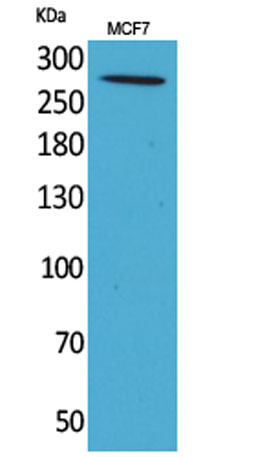
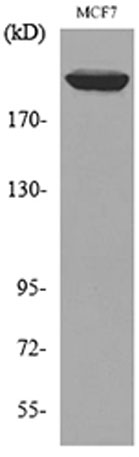
| Observed band (KD) | 250kD |
| Background | This gene encodes a receptor for both insulin-like growth factor 2 and mannose 6-phosphate. The binding sites for each ligand are located on different segments of the protein. This receptor has various functions, including in the intracellular trafficking of lysosomal enzymes, the activation of transforming growth factor beta, and the degradation of insulin-like growth factor 2. Mutation or loss of heterozygosity of this gene has been association with risk of hepatocellular carcinoma. The orthologous mouse gene is imprinted and shows exclusive expression from the maternal allele; however, imprinting of the human gene may be polymorphic, as only a minority of individuals showed biased expression from the maternal allele (PMID:8267611). [provided by RefSeq, Nov 2015], |
| Function | domain:Contains 15 repeating units of approximately 147 AA. The most highly conserved region within the repeat consists of a stretch of 13 AA that contains cysteines at both ends.,function:Transport of phosphorylated lysosomal enzymes from the Golgi complex and the cell surface to lysosomes. Lysosomal enzymes bearing phosphomannosyl residues bind specifically to mannose-6-phosphate receptors in the Golgi apparatus and the resulting receptor-ligand complex is transported to an acidic prelyosomal compartment where the low pH mediates the dissociation of the complex. This receptor also binds IGF2.,similarity:Belongs to the MRL1/IGF2R family.,similarity:Contains 1 fibronectin type-II domain.,subunit:Binds GGA1, GGA2 and GGA3., |
| Subcellular location | Golgi apparatus membrane ; Single-pass type I membrane protein . Endosome membrane ; Single-pass type I membrane protein . Mainly localized in the Golgi at steady state and not detectable in lysosome (PubMed:18817523). Colocalized with DPP4 in internalized cytoplasmic vesicles adjacent to the cell surface (PubMed:10900005). . |
| Expression | Brain,Epithelium,Liver, |

Use collapsible tabs for more detailed information that will help customers make a purchasing decision.
Ex: Shipping and return policies, size guides, and other common questions.