 Français
 English

| ELK.No | ES4006 |
| Product name | CD161 rabbit pAb |
| Reactivity | Human;Rat;Mouse; |
| Applications | WB;ELISA |
| Other name | KLRB1; CLEC5B; NKRP1A; Killer cell lectin-like receptor subfamily B member 1; C-type lectin domain family 5 member B; HNKR-P1a; NKR-P1A; Natural killer cell surface protein P1A; CD161 |
| Size | 50μL |
| Unit price ($) | 148 |
| Human gene ID | 3820 |
| Human Swiss-Prot | Q12918 |
| Source | Rabbit |
| Isotype | IgG |
| Target | CD161 |
| Fields | >>Malaria |
| Gene name | KLRB1 |
| Protein name | Killer cell lectin-like receptor subfamily B member 1 |
| Human gene link | View Human Gene |
| Human Swiss link | View Human Swiss-Prot |
| Mouse gene ID | 100043861 |
| Mouse gene link | View Mouse Gene |
| Mouse Swiss-Prot | Q0ZUP1 |
| Mouse Swiss link | View Mouse Swiss-Prot |
| Rat gene ID | 689817 |
| Rat gene link | View Rat Gene |
| Rat Swiss-Prot | Q0ZUP0 |
| Rat Swiss link | View Rat Swiss-Prot |
| Immunogen | The antiserum was produced against synthesized peptide derived from the Internal region of human KLRB1. AA range:101-150 |
| Specificity | CD161 Polyclonal Antibody detects endogenous levels of CD161 protein. |
| Formulation | Liquid in PBS containing 50% glycerol, 0.5% BSA and 0.02% sodium azide. |
| Clonality | Polyclonal |
| Dilution | Western Blot: 1/500 - 1/2000. ELISA: 1/20000. Not yet tested in other applications. |
| Purification | The antibody was affinity-purified from rabbit antiserum by affinity-chromatography using epitope-specific immunogen. |
| Concentration | 1 mg/ml |
| Storage stability | -20°C/1 year |
| Molecular Weight (Da) | |
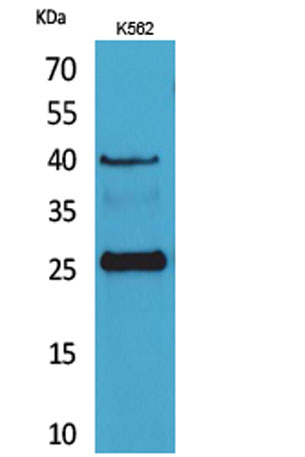
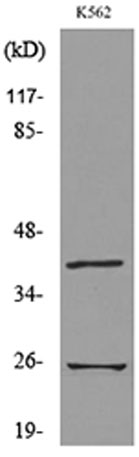
| Observed band (KD) | 25kD |
| Background | Natural killer (NK) cells are lymphocytes that mediate cytotoxicity and secrete cytokines after immune stimulation. Several genes of the C-type lectin superfamily, including the rodent NKRP1 family of glycoproteins, are expressed by NK cells and may be involved in the regulation of NK cell function. The KLRB1 protein contains an extracellular domain with several motifs characteristic of C-type lectins, a transmembrane domain, and a cytoplasmic domain. The KLRB1 protein is classified as a type II membrane protein because it has an external C terminus. [provided by RefSeq, Jul 2008], |
| Function | function:Plays an inhibitory role on natural killer (NK) cells cytotoxicity. Activation results in specific acid sphingomyelinase/SMPD1 stimulation with subsequent marked elevation of intracellular ceramide. Activation also leads to AKT1/PKB and RPS6KA1/RSK1 kinases stimulation as well as markedly enhanced T-cell proliferation induced by anti-CD3. Acts as a lectin that binds to the terminal carbohydrate Gal-alpha(1,3)Gal epitope as well as to the N-acetyllactosamine epitope. Binds also to CLEC2D/LLT1 as a ligand and inhibits NK cell-mediated cytotoxicity as well as interferon-gamma secretion in target cells.,induction:By IL12 in NK cells.,online information:NKRP1,PTM:N-glycosylated. Contains sialic acid residues.,similarity:Contains 1 C-type lectin domain.,subunit:Homodimer; disulfide-linked. Interacts with acid sphingomyelinase/SMPD1.,tissue specificity:Expressed in a subset of NK cells |
| Subcellular location | Membrane ; Single-pass type II membrane protein . |
| Expression | Expressed in a subset of NK cells predominantly in intestinal epithelium and liver. Detected in peripheral blood T-cells and preferentially in adult T-cells with a memory antigenic phenotype. |

Use collapsible tabs for more detailed information that will help customers make a purchasing decision.
Ex: Shipping and return policies, size guides, and other common questions.