 Français
 English

| ELK.No | ES4019 |
| Product name | CKR-3 rabbit pAb |
| Reactivity | Human;Rat;Mouse; |
| Applications | WB;IHC;IF;ELISA |
| Other name | CCR3; CMKBR3; C-C chemokine receptor type 3; C-C CKR-3; CC-CKR-3; CCR-3; CCR3; CKR3; Eosinophil eotaxin receptor; CD193 |
| Size | 50μL |
| Unit price ($) | 148 |
| Human gene ID | 1232 |
| Human Swiss-Prot | P51677 |
| Source | Rabbit |
| Isotype | IgG |
| Target | CKR-3 |
| Fields | >>Cytokine-cytokine receptor interaction;>>Viral protein interaction with cytokine and cytokine receptor;>>Chemokine signaling pathway;>>Human cytomegalovirus infection;>>Kaposi sarcoma-associated herpesvirus infection;>>Viral carcinogenesis |
| Gene name | CCR3 |
| Protein name | C-C chemokine receptor type 3 |
| Human gene link | View Human Gene |
| Human Swiss link | View Human Swiss-Prot |
| Mouse gene ID | 12771 |
| Mouse gene link | View Mouse Gene |
| Mouse Swiss-Prot | P51678 |
| Mouse Swiss link | View Mouse Swiss-Prot |
| Rat gene ID | 117027 |
| Rat gene link | View Rat Gene |
| Rat Swiss-Prot | O54814 |
| Rat Swiss link | View Rat Swiss-Prot |
| Immunogen | The antiserum was produced against synthesized peptide derived from the N-terminal region of human CCR3. AA range:1-50 |
| Specificity | CKR-3 Polyclonal Antibody detects endogenous levels of CKR-3 protein. |
| Formulation | Liquid in PBS containing 50% glycerol, 0.5% BSA and 0.02% sodium azide. |
| Clonality | Polyclonal |
| Dilution | Western Blot: 1/500 - 1/2000. IHC-p: 1:100-300 ELISA: 1/20000. Not yet tested in other applications. |
| Purification | The antibody was affinity-purified from rabbit antiserum by affinity-chromatography using epitope-specific immunogen. |
| Concentration | 1 mg/ml |
| Storage stability | -20°C/1 year |
| Molecular Weight (Da) | |
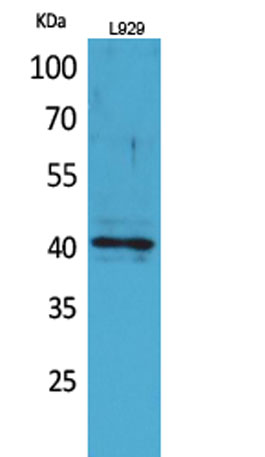
| Observed band (KD) | 41kD |
| Background | The protein encoded by this gene is a receptor for C-C type chemokines. It belongs to family 1 of the G protein-coupled receptors. This receptor binds and responds to a variety of chemokines, including eotaxin (CCL11), eotaxin-3 (CCL26), MCP-3 (CCL7), MCP-4 (CCL13), and RANTES (CCL5). It is highly expressed in eosinophils and basophils, and is also detected in TH1 and TH2 cells, as well as in airway epithelial cells. This receptor may contribute to the accumulation and activation of eosinophils and other inflammatory cells in the allergic airway. It is also known to be an entry co-receptor for HIV-1. This gene and seven other chemokine receptor genes form a chemokine receptor gene cluster on the chromosomal region 3p21. Alternatively spliced transcript variants have been described. [provided by RefSeq, Sep 2009], |
| Function | function:Receptor for a C-C type chemokine. Binds to eotaxin, eotaxin-3, MCP-3, MCP-4, RANTES and MIP-1 delta. Subsequently transduces a signal by increasing the intracellular calcium ions level. Alternative coreceptor with CD4 for HIV-1 infection.,online information:CC chemokine receptors entry,similarity:Belongs to the G-protein coupled receptor 1 family.,subunit:Binds to HIV-1 Tat.,tissue specificity:In eosinophils as well as trace amounts in neutrophils and monocytes., |
| Subcellular location | Cell membrane; Multi-pass membrane protein . |
| Expression | In eosinophils as well as trace amounts in neutrophils and monocytes. |



Use collapsible tabs for more detailed information that will help customers make a purchasing decision.
Ex: Shipping and return policies, size guides, and other common questions.