 Français
 English

| ELK.No | ES4178 |
| Product name | D3DR rabbit pAb |
| Reactivity | Human;Mouse;Rat |
| Applications | WB;ELISA |
| Other name | DRD3; D(3) dopamine receptor; Dopamine D3 receptor |
| Size | 50μL |
| Unit price ($) | 148 |
| Human gene ID | 1814 |
| Human Swiss-Prot | P35462 |
| Source | Rabbit |
| Isotype | IgG |
| Target | D3DR |
| Fields | >>Neuroactive ligand-receptor interaction;>>Dopaminergic synapse |
| Gene name | DRD3 |
| Protein name | D(3) dopamine receptor |
| Human gene link | View Human Gene |
| Human Swiss link | View Human Swiss-Prot |
| Mouse gene ID | 13490 |
| Mouse gene link | View Mouse Gene |
| Mouse Swiss-Prot | P30728 |
| Mouse Swiss link | View Mouse Swiss-Prot |
| Rat gene ID | 29238 |
| Rat gene link | View Rat Gene |
| Rat Swiss-Prot | P19020 |
| Rat Swiss link | View Rat Swiss-Prot |
| Immunogen | Synthesized peptide derived from D3DR . at AA range: 181-230 |
| Specificity | D3DR Polyclonal Antibody detects endogenous levels of D3DR protein. |
| Formulation | Liquid in PBS containing 50% glycerol, 0.5% BSA and 0.02% sodium azide. |
| Clonality | Polyclonal |
| Dilution | Western Blot: 1/500 - 1/2000. ELISA: 1/20000. Not yet tested in other applications. |
| Purification | The antibody was affinity-purified from rabbit antiserum by affinity-chromatography using epitope-specific immunogen. |
| Concentration | 1 mg/ml |
| Storage stability | -20°C/1 year |
| Molecular Weight (Da) | |
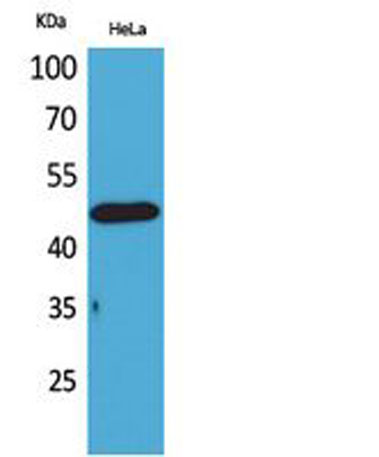
| Observed band (KD) | 44kD |
| Background | This gene encodes the D3 subtype of the five (D1-D5) dopamine receptors. The activity of the D3 subtype receptor is mediated by G proteins which inhibit adenylyl cyclase. This receptor is localized to the limbic areas of the brain, which are associated with cognitive, emotional, and endocrine functions. Genetic variation in this gene may be associated with susceptibility to hereditary essential tremor 1. Alternative splicing of this gene results in transcript variants encoding different isoforms, although some variants may be subject to nonsense-mediated decay (NMD). [provided by RefSeq, Jul 2008], |
| Function | disease:Genetic variation in DRD3 may be associated with susceptibility to hereditary essential tremor 1 (ETM1) [MIM:190300]. ETM1 is the most common movement disorder. The main feature is postural tremor of the arms. Head, legs, trunk, voice, jaw, and facial muscles also may be involved. The condition can be aggravated by emotions, hunger, fatigue and temperature extremes, and may cause a functional disability or even incapacitation. Inheritance is autosomal dominant.,function:This is one of the five types (D1 to D5) of receptors for dopamine. The activity of this receptor is mediated by G proteins which inhibit adenylyl cyclase.,online information:The Singapore human mutation and polymorphism database,similarity:Belongs to the G-protein coupled receptor 1 family.,subunit:Interacts with CLIC6.,tissue specificity:Brain., |
| Subcellular location | Cell membrane ; Multi-pass membrane protein . Both membrane-bound and scattered in the cytoplasm during basal conditions. Receptor stimulation results in the rapid internalization and sequestration of the receptors at the perinuclear area (5 and 15 minutes), followed by the dispersal of the receptors to the membrane (30 minutes). DRD3 and GRK4 co-localize in lipid rafts of renal proximal tubule cells. |
| Expression | Brain. |

Use collapsible tabs for more detailed information that will help customers make a purchasing decision.
Ex: Shipping and return policies, size guides, and other common questions.