 Français
 English

| ELK.No | ES4323 |
| Product name | P-Selectin rabbit pAb |
| Reactivity | Human;Mouse;Rat |
| Applications | WB;IHC;IF;ELISA |
| Other name | SELP; GMRP; GRMP; P-selectin; CD62 antigen-like family member P; Granule membrane protein 140; GMP-140; Leukocyte-endothelial cell adhesion molecule 3; LECAM3; Platelet activation dependent granule-external membrane protein; PADGEM; CD62P |
| Size | 100μL |
| Unit price ($) | 248 |
| Human gene ID | 6403 |
| Human Swiss-Prot | P16109 |
| Source | Rabbit |
| Isotype | IgG |
| Target | P-Selectin |
| Fields | >>Cell adhesion molecules;>>Neutrophil extracellular trap formation;>>Malaria;>>Staphylococcus aureus infection;>>Coronavirus disease - COVID-19;>>Lipid and atherosclerosis |
| Gene name | SELP |
| Protein name | P-selectin |
| Human gene link | View Human Gene |
| Human Swiss link | View Human Swiss-Prot |
| Mouse gene ID | 20344 |
| Mouse gene link | View Mouse Gene |
| Mouse Swiss-Prot | Q01102 |
| Mouse Swiss link | View Mouse Swiss-Prot |
| Rat gene ID | 25651 |
| Rat gene link | View Rat Gene |
| Rat Swiss-Prot | P98106 |
| Rat Swiss link | View Rat Swiss-Prot |
| Immunogen | The antiserum was produced against synthesized peptide derived from the N-terminal region of human SELP. AA range:81-130 |
| Specificity | P-Selectin Polyclonal Antibody detects endogenous levels of P-Selectin protein. |
| Formulation | Liquid in PBS containing 50% glycerol, 0.5% BSA and 0.02% sodium azide. |
| Clonality | Polyclonal |
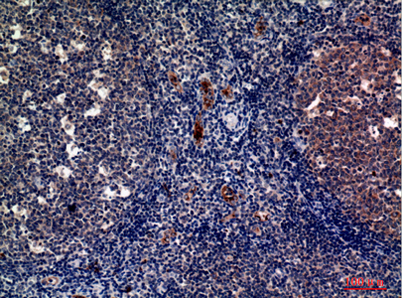
| Dilution | Western Blot: 1/500 - 1/2000. IHC-p: 1:100-1:300. ELISA: 1/10000. Not yet tested in other applications. |
| Purification | The antibody was affinity-purified from rabbit antiserum by affinity-chromatography using epitope-specific immunogen. |
| Concentration | 1 mg/ml |
| Storage stability | -20°C/1 year |
| Molecular Weight (Da) | |
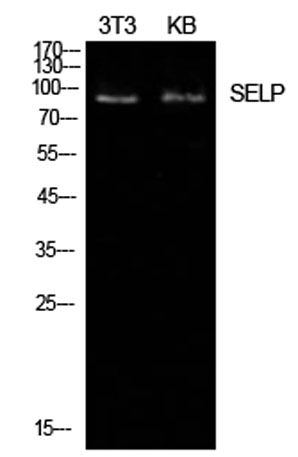
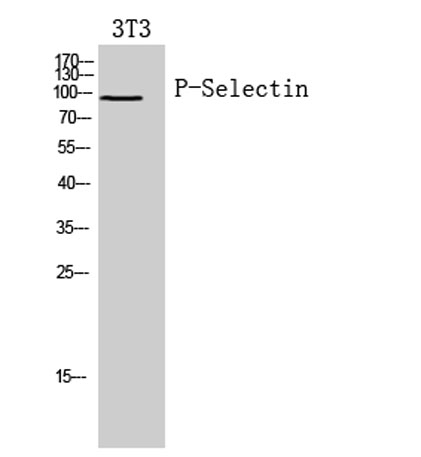
| Observed band (KD) | 91kD |
| Background | This gene encodes a 140 kDa protein that is stored in the alpha-granules of platelets and Weibel-Palade bodies of endothelial cells. This protein redistributes to the plasma membrane during platelet activation and degranulation and mediates the interaction of activated endothelial cells or platelets with leukocytes. The membrane protein is a calcium-dependent receptor that binds to sialylated forms of Lewis blood group carbohydrate antigens on neutrophils and monocytes. Alternative splice variants may occur but are not well documented. [provided by RefSeq, Jul 2008], |
| Function | disease:Defects in SELP may be a cause of susceptibility to ischemic stroke [MIM:601367]; also known as cerebrovascular accident or cerebral infarction. A stroke is an acute neurologic event leading to death of neural tissue of the brain and resulting in loss of motor, sensory and/or cognitive function. Ischemic strokes, resulting from vascular occlusion, is considered to be a highly complex disease consisting of a group of heterogeneous disorders with multiple genetic and environmental risk factors.,function:Ca(2+)-dependent receptor for myeloid cells that binds to carbohydrates on neutrophils and monocytes. Mediates the interaction of activated endothelial cells or platelets with leukocytes. The ligand recognized is sialyl-Lewis X. Mediates rapid rolling of leukocyte rolling over vascular surfaces during the initial steps in inflammation through interaction with PSGL1.,online informati |
| Subcellular location | Cell membrane ; Single-pass type I membrane protein . |
| Expression | Stored in the alpha-granules of platelets and Weibel-Palade bodies of endothelial cells. Upon cell activation by agonists, P-selectin is transported rapidly to the cell surface. |

Use collapsible tabs for more detailed information that will help customers make a purchasing decision.
Ex: Shipping and return policies, size guides, and other common questions.