 Français
 English

| ELK.No | ES4362 |
| Product name | CD267 rabbit pAb |
| Reactivity | Human;Rat;Mouse; |
| Applications | WB;ELISA |
| Other name | TNFRSF13B; TACI; Tumor necrosis factor receptor superfamily member 13B; Transmembrane activator and CAML interactor; CD267 |
| Size | 50μL |
| Unit price ($) | 148 |
| Human gene ID | 23495 |
| Human Swiss-Prot | O14836 |
| Source | Rabbit |
| Isotype | IgG |
| Target | CD267 |
| Fields | >>Cytokine-cytokine receptor interaction;>>Intestinal immune network for IgA production;>>Primary immunodeficiency |
| Gene name | TNFRSF13B |
| Protein name | Tumor necrosis factor receptor superfamily member 13B |
| Human gene link | View Human Gene |
| Human Swiss link | View Human Swiss-Prot |
| Mouse gene ID | 57916 |
| Mouse gene link | View Mouse Gene |
| Mouse Swiss-Prot | Q9ET35 |
| Mouse Swiss link | View Mouse Swiss-Prot |
| Rat gene ID | |
| Rat gene link | |
| Rat Swiss-Prot | |
| Rat Swiss link | |
| Immunogen | The antiserum was produced against synthesized peptide derived from the Internal region of human TNFRSF13B. AA range:81-130 |
| Specificity | CD267 Polyclonal Antibody detects endogenous levels of CD267 protein. |
| Formulation | Liquid in PBS containing 50% glycerol, 0.5% BSA and 0.02% sodium azide. |
| Clonality | Polyclonal |
| Dilution | Western Blot: 1/500 - 1/2000. ELISA: 1/10000. Not yet tested in other applications. |
| Purification | The antibody was affinity-purified from rabbit antiserum by affinity-chromatography using epitope-specific immunogen. |
| Concentration | 1 mg/ml |
| Storage stability | -20°C/1 year |
| Molecular Weight (Da) | |
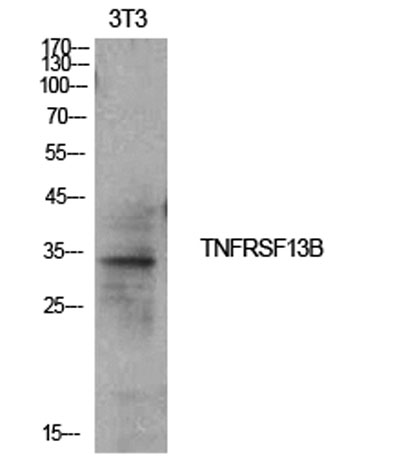
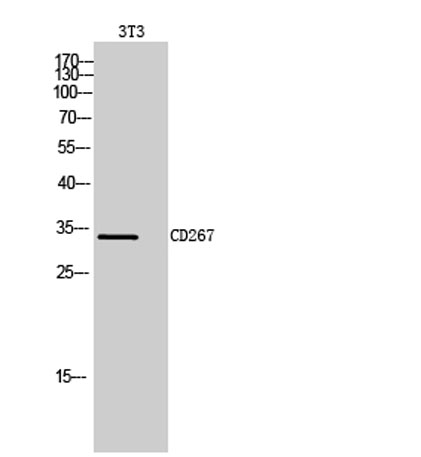
| Observed band (KD) | 32kD |
| Background | The protein encoded by this gene is a lymphocyte-specific member of the tumor necrosis factor (TNF) receptor superfamily. It interacts with calcium-modulator and cyclophilin ligand (CAML). The protein induces activation of the transcription factors NFAT, AP1, and NF-kappa-B and plays a crucial role in humoral immunity by interacting with a TNF ligand. This gene is located within the Smith-Magenis syndrome region on chromosome 17. [provided by RefSeq, Jul 2008], |
| Function | disease:Defects in TNFRSF13B are a cause of common variable immunodeficiency (CVID) [MIM:240500]. CVID is characterized by a deficiency in all immunoglobulin (Ig) isotypes. Individuals with CVID suffer from recurrent sinopulmonary and gastrointestinal infections and have an increased incidence of autoimmune disorders and of lymphoid and non-lymphoid malignancies. There is evidence for a global isotype switching defect in some individuals with CVID. But CVID is a complex and heterogeneous disease in which defects in B-cell survival, number of circulating CD27+ memory B-cells (including IgM+CD27+ B-cells), B-cell activation after antigen receptor cross-linking, T-cell signaling and cytokine expression have been observed.,disease:Defects in TNFRSF13B are a cause of immunoglobulin A deficiency 2 (IGAD2) [MIM:609529]. Selective deficiency of immunoglobulin A (IGAD) is the most common form of |
| Subcellular location | Membrane; Single-pass type III membrane protein. |
| Expression | Highly expressed in spleen, thymus, small intestine and peripheral blood leukocytes. Expressed in resting B-cells and activated T-cells, but not in resting T-cells. |

Use collapsible tabs for more detailed information that will help customers make a purchasing decision.
Ex: Shipping and return policies, size guides, and other common questions.