 Français
 English

| ELK.No | ES4368 |
| Product name | Lambda 5 rabbit pAb |
| Reactivity | Human;Rat;Mouse; |
| Applications | WB;IHC;IF;ELISA |
| Other name | IGLL1; IGL1; Immunoglobulin lambda-like polypeptide 1; CD179 antigen-like family member B; Ig lambda-5; Immunoglobulin omega polypeptide; Immunoglobulin-related protein 14.1; CD179b |
| Size | 50μL |
| Unit price ($) | 148 |
| Human gene ID | 3543 |
| Human Swiss-Prot | P15814 |
| Source | Rabbit |
| Isotype | IgG |
| Target | Lambda 5 |
| Fields | >>Primary immunodeficiency |
| Gene name | IGLL1 |
| Protein name | Immunoglobulin lambda-like polypeptide 1 |
| Human gene link | View Human Gene |
| Human Swiss link | View Human Swiss-Prot |
| Mouse gene ID | 16136 |
| Mouse gene link | View Mouse Gene |
| Mouse Swiss-Prot | P20764 |
| Mouse Swiss link | View Mouse Swiss-Prot |
| Rat gene ID | |
| Rat gene link | |
| Rat Swiss-Prot | |
| Rat Swiss link | |
| Immunogen | The antiserum was produced against synthesized peptide derived from the C-terminal region of human IGLL1. AA range:151-200 |
| Specificity | Lambda 5 Polyclonal Antibody detects endogenous levels of Lambda 5 protein. |
| Formulation | Liquid in PBS containing 50% glycerol, 0.5% BSA and 0.02% sodium azide. |
| Clonality | Polyclonal |
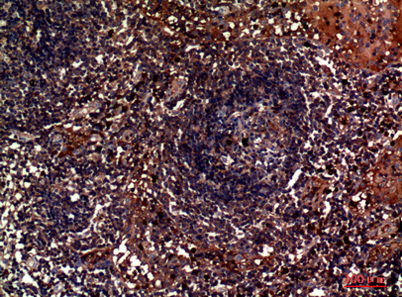
| Dilution | Western Blot: 1/500 - 1/2000. IHC-p: 1:100-1:300. ELISA: 1/10000. Not yet tested in other applications. |
| Purification | The antibody was affinity-purified from rabbit antiserum by affinity-chromatography using epitope-specific immunogen. |
| Concentration | 1 mg/ml |
| Storage stability | -20°C/1 year |
| Molecular Weight (Da) | |
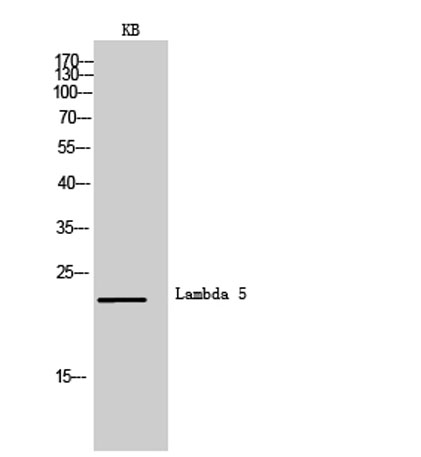
| Observed band (KD) | 23kD |
| Background | immunoglobulin lambda like polypeptide 1(IGLL1) Homo sapiens The preB cell receptor is found on the surface of proB and preB cells, where it is involved in transduction of signals for cellular proliferation, differentiation from the proB cell to the preB cell stage, allelic exclusion at the Ig heavy chain gene locus, and promotion of Ig light chain gene rearrangements. The preB cell receptor is composed of a membrane-bound Ig mu heavy chain in association with a heterodimeric surrogate light chain. This gene encodes one of the surrogate light chain subunits and is a member of the immunoglobulin gene superfamily. This gene does not undergo rearrangement. Mutations in this gene can result in B cell deficiency and agammaglobulinemia, an autosomal recessive disease in which few or no gamma globulins or antibodies are made. Two transcript variants encoding different isoforms have been found for this gene. [provided by RefSeq, Jul 2008], |
| Function | disease:Defects in IGLL1 are a cause of autosomal recessive non-Bruton type agammaglobulinemia [MIM:601495]. It is characterized by agammaglobulinemia and markedly reduced numbers of B cells.,online information:IGLL1 mutation db,similarity:Contains 1 Ig-like C1-type (immunoglobulin-like) domain.,subunit:Associates non-covalently with VPREB1.,tissue specificity:Expressed only in pre-B-cells and a special B-cell line (which is surface Ig negative)., |
| Subcellular location | Endoplasmic reticulum . Secreted . In pre-B cells, localizes predominantly to the endoplasmic reticulum. . |
| Expression | Expressed only in pre-B-cells and a special B-cell line (which is surface Ig negative). |

Use collapsible tabs for more detailed information that will help customers make a purchasing decision.
Ex: Shipping and return policies, size guides, and other common questions.