 Français
 English

| ELK.No | ES4378 |
| Product name | GDF-6 rabbit pAb |
| Reactivity | Human;Mouse;Rat |
| Applications | WB;ELISA |
| Other name | GDF6; GDF16; Growth/differentiation factor 6; GDF-6; Growth/differentiation factor 16 |
| Size | 100μL |
| Unit price ($) | 248 |
| Human gene ID | 392255 |
| Human Swiss-Prot | Q6KF10 |
| Source | Rabbit |
| Isotype | IgG |
| Target | GDF-6 |
| Fields | >>Cytokine-cytokine receptor interaction;>>TGF-beta signaling pathway;>>Hippo signaling pathway |
| Gene name | GDF6 |
| Protein name | Growth/differentiation factor 6 |
| Human gene link | View Human Gene |
| Human Swiss link | View Human Swiss-Prot |
| Mouse gene ID | 242316 |
| Mouse gene link | View Mouse Gene |
| Mouse Swiss-Prot | P43028 |
| Mouse Swiss link | View Mouse Swiss-Prot |
| Rat gene ID | 252834 |
| Rat gene link | View Rat Gene |
| Rat Swiss-Prot | Q6HA10 |
| Rat Swiss link | View Rat Swiss-Prot |
| Immunogen | The antiserum was produced against synthesized peptide derived from the Internal region of human GDF6. AA range:311-360 |
| Specificity | GDF-6 Polyclonal Antibody detects endogenous levels of GDF-6 protein. |
| Formulation | Liquid in PBS containing 50% glycerol, 0.5% BSA and 0.02% sodium azide. |
| Clonality | Polyclonal |
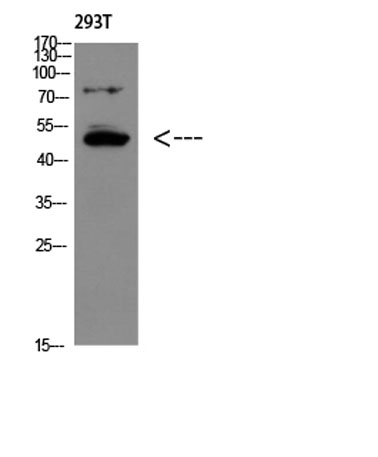
| Dilution | Western Blot: 1/500 - 1/2000. ELISA: 1/10000. Not yet tested in other applications. |
| Purification | The antibody was affinity-purified from rabbit antiserum by affinity-chromatography using epitope-specific immunogen. |
| Concentration | 1 mg/ml |
| Storage stability | -20°C/1 year |
| Molecular Weight (Da) | |
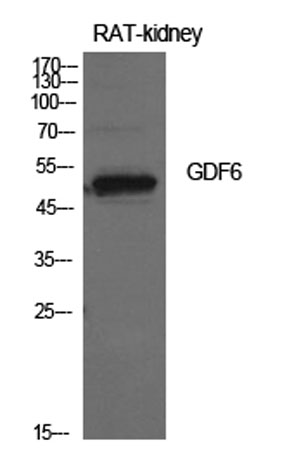
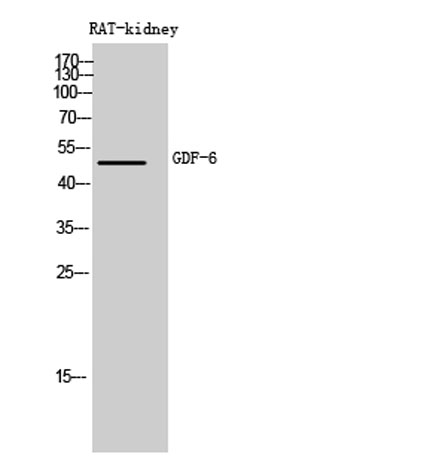
| Observed band (KD) | 50kD |
| Background | This gene encodes a secreted ligand of the TGF-beta (transforming growth factor-beta) superfamily of proteins. Ligands of this family bind various TGF-beta receptors leading to recruitment and activation of SMAD family transcription factors that regulate gene expression. The encoded preproprotein is proteolytically processed to generate each subunit of the disulfide-linked homodimer. This protein is required for normal formation of some bones and joints in the limbs, skull, and axial skeleton. Mutations in this gene are associated with Klippel-Feil syndrome, microphthalmia, and Leber congenital amaurosis. [provided by RefSeq, Sep 2016], |
| Function | disease:A chromosomal aberration involving GDF6 is associated with Klippel-Feil syndrome (KFS) [MIM:118100]. Paracentric inv(8)(q22;2q23.3).,disease:Defects in GDF6 are associated with Klippel-Feil syndrome (KFS) [MIM:118100]. Klippel-Feil syndrome is a complex skeletal disorder characterized by congenital fusion of vertebrae within the anterior/cervical spine. Vertebral fusion appears to be caused by a failure in the normal segmentation of vertebrae during the early weeks of fetal development and defective somitogenesis has been postulated as a mitigating factor. However, the etiology of KFS is still unknown and no definitive disease-causing genes have yet been identified. Although most cases are sporadic, both autosomal dominant and autosomal recessive inheritance have been reported.,function:Required for normal formation of bones and joints in the limbs, skull, and axial skeleton. Pla |
| Subcellular location | Secreted . |
| Expression | Hindbrain,Testis, |

Use collapsible tabs for more detailed information that will help customers make a purchasing decision.
Ex: Shipping and return policies, size guides, and other common questions.