 Français
 English

| ELK.No | ES4439 |
| Product name | Cdk5 rabbit pAb |
| Reactivity | Human;Mouse;Rat |
| Applications | WB;IHC;IF;ELISA |
| Other name | CDK5; CDKN5; Cyclin-dependent kinase 5; Cell division protein kinase 5; Serine/threonine-protein kinase PSSALRE; Tau protein kinase II catalytic subunit; TPKII catalytic subunit |
| Size | 50μL |
| Unit price ($) | 148 |
| Human gene ID | 1020 |
| Human Swiss-Prot | Q00535 |
| Source | Rabbit |
| Isotype | IgG |
| Target | CDK5 |
| Fields | >>Axon guidance;>>Alzheimer disease;>>Pathways of neurodegeneration - multiple diseases;>>Cocaine addiction |
| Gene name | CDK5 |
| Protein name | Cyclin-dependent kinase 5 |
| Human gene link | View Human Gene |
| Human Swiss link | View Human Swiss-Prot |
| Mouse gene ID | 12568 |
| Mouse gene link | View Mouse Gene |
| Mouse Swiss-Prot | P49615 |
| Mouse Swiss link | View Mouse Swiss-Prot |
| Rat gene ID | 140908 |
| Rat gene link | View Rat Gene |
| Rat Swiss-Prot | Q03114 |
| Rat Swiss link | View Rat Swiss-Prot |
| Immunogen | The antiserum was produced against synthesized peptide derived from human CDK5. AA range:1-50 |
| Specificity | Cdk5 Polyclonal Antibody detects endogenous levels of Cdk5 protein. |
| Formulation | Liquid in PBS containing 50% glycerol, 0.5% BSA and 0.02% sodium azide. |
| Clonality | Polyclonal |
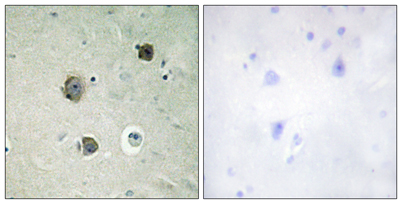
| Dilution | Western Blot: 1/500 - 1/2000. Immunohistochemistry: 1/100 - 1/300. ELISA: 1/5000. Not yet tested in other applications. |
| Purification | The antibody was affinity-purified from rabbit antiserum by affinity-chromatography using epitope-specific immunogen. |
| Concentration | 1 mg/ml |
| Storage stability | -20°C/1 year |
| Molecular Weight (Da) | |
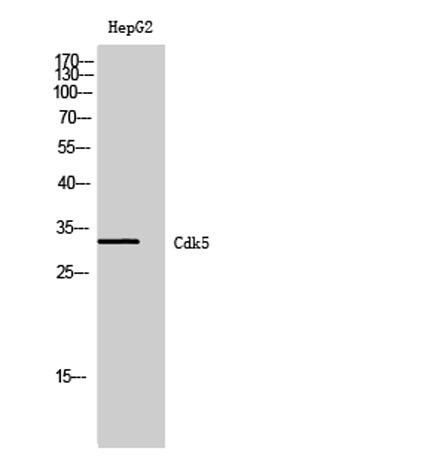
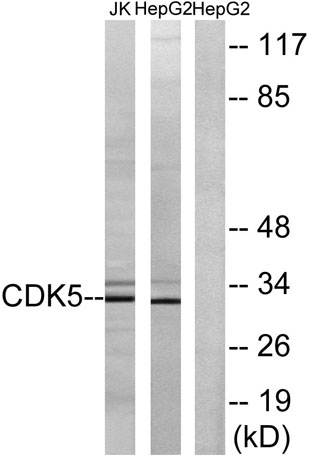
| Observed band (KD) | 33kD |
| Background | cyclin dependent kinase 5(CDK5) Homo sapiens This gene encodes a proline-directed serine/threonine kinase that is a member of the cyclin-dependent kinase family of proteins. Unlike other members of the family, the protein encoded by this gene does not directly control cell cycle regulation. Instead the protein, which is predominantly expressed at high levels in mammalian postmitotic central nervous system neurons, functions in diverse processes such as synaptic plasticity and neuronal migration through phosphorylation of proteins required for cytoskeletal organization, endocytosis and exocytosis, and apoptosis. In humans, an allelic variant of the gene that results in undetectable levels of the protein has been associated with lethal autosomal recessive lissencephaly-7. Alternative splicing results in multiple transcript variants. [provided by RefSeq, May 2015], |
| Function | catalytic activity:ATP + a protein = ADP + a phosphoprotein.,function:Probably involved in the control of the cell cycle. Interacts with D1 and D3-type G1 cyclins. Can phosphorylate histone H1, tau, MAP2 and NF-H and NF-M. Also interacts with p35 which activates the kinase.,similarity:Belongs to the protein kinase superfamily. CMGC Ser/Thr protein kinase family. CDC2/CDKX subfamily.,similarity:Contains 1 protein kinase domain.,subcellular location:In axonal growth cone with extension to the peripheral lamellipodia.,subunit:Heterodimer of a catalytic subunit and a regulatory subunit (p35). Found in a trimolecular complex with CABLES1 and ABL1. Interacts with CABLES1 (By similarity). Interacts with AATK., |
| Subcellular location | [Isoform 1]: Cytoplasm . Nucleus . Cell membrane ; Peripheral membrane protein. Perikaryon. Cell projection, lamellipodium . Cell projection, growth cone . Cell junction, synapse, postsynaptic density . Cell junction, synapse . In axonal growth cone with extension to the peripheral lamellipodia (By similarity). Under neurotoxic stress and neuronal injury conditions, CDK5R (p35) is cleaved by calpain to generate CDK5R1 (p25) in response to increased intracellular calcium. The elevated level of p25, when in complex with CDK5, leads to its subcellular misallocation as well as its hyperactivation. Colocalizes with CTNND2 in the cell body of neuronal cells, and with CTNNB1 in the cell-cell contacts and plasma membrane of undifferentiated and differentiated neuroblastoma cells. Reversibly attach |
| Expression | [Isoform 1]: Ubiquitously expressed (PubMed:17009320, PubMed:19693690). Accumulates in cortical neurons (at protein level) (PubMed:17009320). ; [Isoform 2]: Expressed in the testis, skeletal muscle, colon, bone marrow and ovary. |

Use collapsible tabs for more detailed information that will help customers make a purchasing decision.
Ex: Shipping and return policies, size guides, and other common questions.