 Français
 English
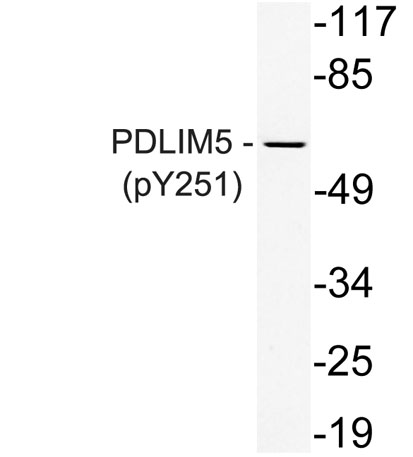
PDLIM5 (phospho Tyr251) rabbit pAb
AO-06-ES4519-100

| ELK.No | ES4519 |
| Product name | PDLIM5 (phospho Tyr251) rabbit pAb |
| Reactivity | Human;Rat;Mouse; |
| Applications | WB;ELISA;IHC |
| Other name | PDLIM5; ENH; L9; PDZ and LIM domain protein 5; Enigma homolog; Enigma-like PDZ and LIM domains protein |
| Size | 100μL |
| Unit price ($) | 248 |
| Human gene ID | 10611 |
| Human Swiss-Prot | Q96HC4 |
| Source | Rabbit |
| Isotype | IgG |
| Target | PDLIM5 |
| Fields | |
| Gene name | PDLIM5 |
| Protein name | PDZ and LIM domain protein 5 |
| Human gene link | View Human Gene |
| Human Swiss link | View Human Swiss-Prot |
| Mouse gene ID | |
| Mouse gene link | |
| Mouse Swiss-Prot | Q8CI51 |
| Mouse Swiss link | View Mouse Swiss-Prot |
| Rat gene ID | |
| Rat gene link | |
| Rat Swiss-Prot | |
| Rat Swiss link | |
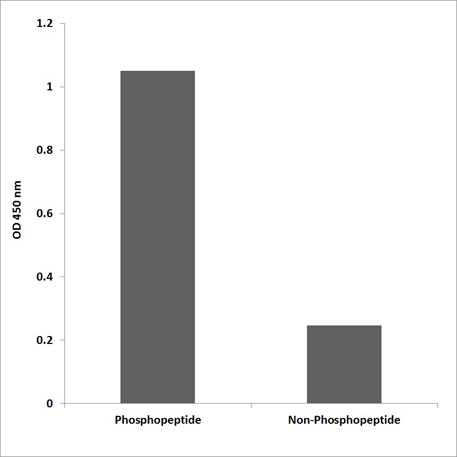
| Immunogen | Synthesized phospho-peptide around the phosphorylation site of human PDLIM5 (phospho Tyr251) |
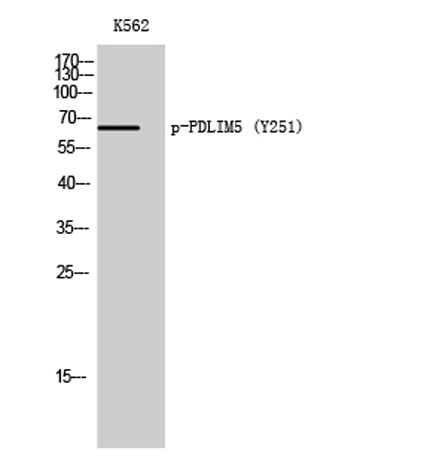
| Specificity | Phospho-PDLIM5 (Y251) Polyclonal Antibody detects endogenous levels of PDLIM5 protein only when phosphorylated at Y251. |
| Formulation | Liquid in PBS containing 50% glycerol, 0.5% BSA and 0.02% sodium azide. |
| Clonality | Polyclonal |
| Dilution | WB 1:500-2000;IHC-p 1:50-300; ELISA 2000-20000 |
| Purification | The antibody was affinity-purified from rabbit antiserum by affinity-chromatography using epitope-specific immunogen. |
| Concentration | 1 mg/ml |
| Storage stability | -20°C/1 year |
| Molecular Weight (Da) | |
| Observed band (KD) | 64kD |
| Background | This gene encodes a member of a family of proteins that possess a 100-amino acid PDZ domain at the N terminus and one to three LIM domains at the C-terminus. This family member functions as a scaffold protein that tethers protein kinases to the Z-disk in striated muscles. It is thought to function in cardiomyocyte expansion and in restraining postsynaptic growth of excitatory synapses. Alternative splicing of this gene results in multiple transcript variants. [provided by RefSeq, Jan 2012], |
| Function | caution:The sequence shown here is derived from an Ensembl automatic analysis pipeline and should be considered as preliminary data.,disease:May play a role in genetic susceptibility to schizophrenia. PDLIM5 is commonly increased in the brain of patients with bipolar disorder, schizophrenia, and major depression.,function:May play an important role in the heart development by scaffolding PKC to the Z-disk region.,similarity:Contains 1 PDZ (DHR) domain.,similarity:Contains 3 LIM zinc-binding domains.,subunit:Interacts with various PKC isoforms through the LIM domains. Interacts with actin and alpha-actinin through the PDZ domain.,tissue specificity:Heart and skeletal muscle specific., |
| Subcellular location | Cell junction, synapse, postsynaptic density . Cell junction, synapse, presynapse . Cell junction, synapse, postsynapse . Cytoplasm, cytosol . Detected both at presynaptic and postsynaptic sites, exclusively at excitatory synapses, but not inhibitory synapses, in hippocampal neurons. . |
| Expression | Heart and skeletal muscle specific. Expression is commonly increased in the brain of patients with bipolar disorder, schizophrenia, and major depression. |

Use collapsible tabs for more detailed information that will help customers make a purchasing decision.
Ex: Shipping and return policies, size guides, and other common questions.