 Français
 English

| ELK.No | ES4614 |
| Product name | DNA pol ι rabbit pAb |
| Reactivity | Human;Rat;Mouse; |
| Applications | WB;ELISA |
| Other name | POLI; RAD30B; DNA polymerase iota; Eta2; RAD30 homolog B |
| Size | 50μL |
| Unit price ($) | 148 |
| Human gene ID | 11201 |
| Human Swiss-Prot | Q9UNA4 |
| Source | Rabbit |
| Isotype | IgG |
| Target | DNA pol ι |
| Fields | >>Fanconi anemia pathway |
| Gene name | POLI |
| Protein name | DNA polymerase iota |
| Human gene link | View Human Gene |
| Human Swiss link | View Human Swiss-Prot |
| Mouse gene ID | |
| Mouse gene link | |
| Mouse Swiss-Prot | Q6R3M4 |
| Mouse Swiss link | View Mouse Swiss-Prot |
| Rat gene ID | |
| Rat gene link | |
| Rat Swiss-Prot | |
| Rat Swiss link | |
| Immunogen | The antiserum was produced against synthesized peptide derived from human POLI. AA range:641-690 |
| Specificity | DNA pol ι Polyclonal Antibody detects endogenous levels of DNA pol ι protein. |
| Formulation | Liquid in PBS containing 50% glycerol, 0.5% BSA and 0.02% sodium azide. |
| Clonality | Polyclonal |
| Dilution | Western Blot: 1/500 - 1/2000. ELISA: 1/40000. Not yet tested in other applications. |
| Purification | The antibody was affinity-purified from rabbit antiserum by affinity-chromatography using epitope-specific immunogen. |
| Concentration | 1 mg/ml |
| Storage stability | -20°C/1 year |
| Molecular Weight (Da) | |
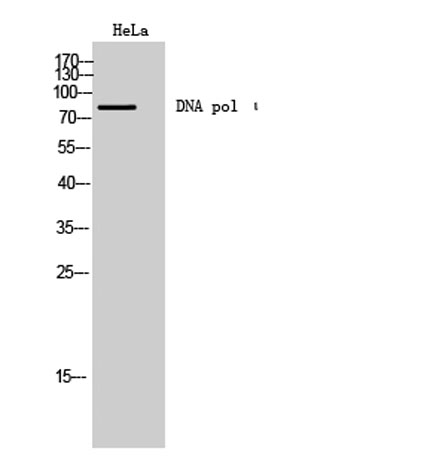
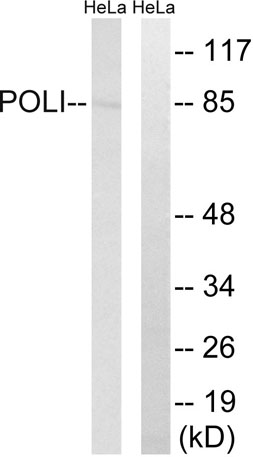
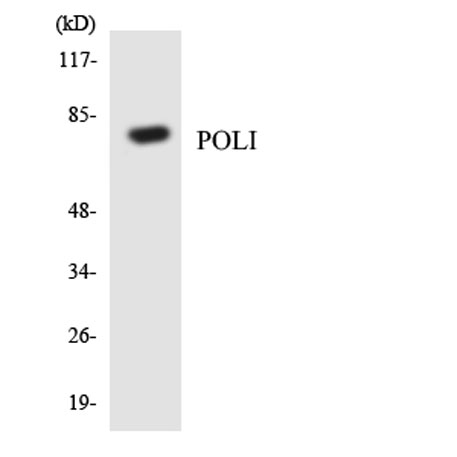
| Observed band (KD) | 85kD |
| Background | catalytic activity:Deoxynucleoside triphosphate + DNA(n) = diphosphate + DNA(n+1).,cofactor:Magnesium.,domain:The catalytic core consists of fingers, palm and thumb subdomains, but the fingers and thumb subdomains are much smaller than in high-fidelity polymerases; residues from five sequence motifs of the Y-family cluster around an active site cleft that can accommodate DNA and nucleotide substrates with relaxed geometric constraints, with consequently higher rates of misincorporation and low processivity.,function:Error-prone DNA polymerase specifically involved in DNA repair. Plays an important role in translesion synthesis, where the normal high-fidelity DNA polymerases cannot proceed and DNA synthesis stalls. Favors Hoogsteen base-pairing in the active site. Inserts the correct base with high-fidelity opposite an adenosine template. Exhibits low fidelity and efficiency opposite a thymidine template, where it will preferentially insert guanosine. May play a role in hypermutation of immunogobulin genes. Forms a Schiff base with 5'-deoxyribose phosphate at abasic sites, but may not have lyase activity.,similarity:Belongs to the DNA polymerase type-Y family.,similarity:Contains 1 umuC domain.,subcellular location:Accumulates at replication forks after DNA damage.,subunit:Binds REV1L (By similarity). Binds POLH.,tissue specificity:Ubiquitous. Highly expressed in testis., |
| Function | catalytic activity:Deoxynucleoside triphosphate + DNA(n) = diphosphate + DNA(n+1).,cofactor:Magnesium.,domain:The catalytic core consists of fingers, palm and thumb subdomains, but the fingers and thumb subdomains are much smaller than in high-fidelity polymerases; residues from five sequence motifs of the Y-family cluster around an active site cleft that can accommodate DNA and nucleotide substrates with relaxed geometric constraints, with consequently higher rates of misincorporation and low processivity.,function:Error-prone DNA polymerase specifically involved in DNA repair. Plays an important role in translesion synthesis, where the normal high-fidelity DNA polymerases cannot proceed and DNA synthesis stalls. Favors Hoogsteen base-pairing in the active site. Inserts the correct base with high-fidelity opposite an adenosine template. Exhibits low fidelity and efficiency opposite a th |
| Subcellular location | Nucleus . Binding to ubiquitin mediates localization to replication forks after UV-induced DNA damage. . |
| Expression | Ubiquitous. Highly expressed in testis. |

Use collapsible tabs for more detailed information that will help customers make a purchasing decision.
Ex: Shipping and return policies, size guides, and other common questions.