 Français
 English

| ELK.No | ES4715 |
| Product name | MRP2 rabbit pAb |
| Reactivity | Human;Rat;Mouse; |
| Applications | WB;ELISA |
| Other name | ABCC2; CMOAT; CMOAT1; CMRP; MRP2; Canalicular multispecific organic anion transporter 1; ATP-binding cassette sub-family C member 2; Canalicular multidrug resistance protein; Multidrug resistance-associated protein 2 |
| Size | 50μL |
| Unit price ($) | 148 |
| Human gene ID | 1244 |
| Human Swiss-Prot | Q92887 |
| Source | Rabbit |
| Isotype | IgG |
| Target | MRP2 |
| Fields | >>Antifolate resistance;>>Platinum drug resistance;>>ABC transporters;>>Bile secretion |
| Gene name | ABCC2 |
| Protein name | Canalicular multispecific organic anion transporter 1 |
| Human gene link | View Human Gene |
| Human Swiss link | View Human Swiss-Prot |
| Mouse gene ID | |
| Mouse gene link | |
| Mouse Swiss-Prot | Q8VI47 |
| Mouse Swiss link | View Mouse Swiss-Prot |
| Rat gene ID | |
| Rat gene link | |
| Rat Swiss-Prot | |
| Rat Swiss link | |
| Immunogen | The antiserum was produced against synthesized peptide derived from human ABCC2. AA range:991-1040 |
| Specificity | MRP2 Polyclonal Antibody detects endogenous levels of MRP2 protein. |
| Formulation | Liquid in PBS containing 50% glycerol, 0.5% BSA and 0.02% sodium azide. |
| Clonality | Polyclonal |
| Dilution | Western Blot: 1/500 - 1/2000. ELISA: 1/10000. Not yet tested in other applications. |
| Purification | The antibody was affinity-purified from rabbit antiserum by affinity-chromatography using epitope-specific immunogen. |
| Concentration | 1 mg/ml |
| Storage stability | -20°C/1 year |
| Molecular Weight (Da) | |
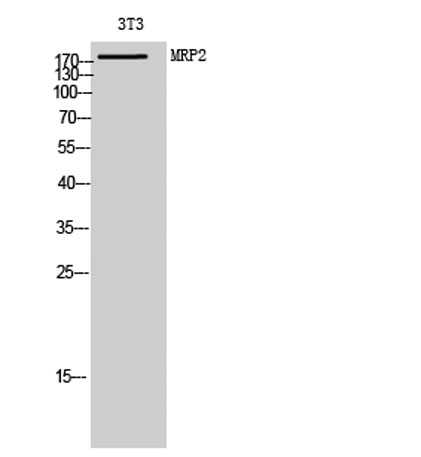
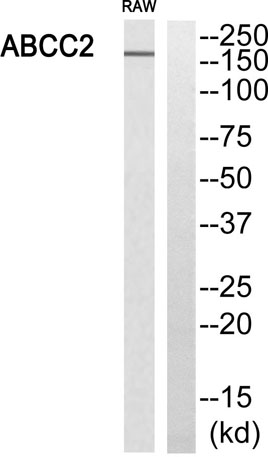
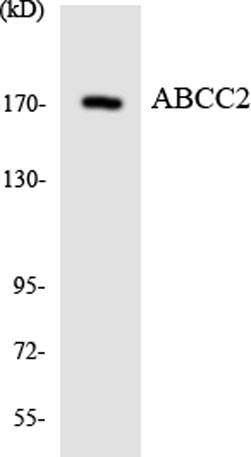
| Observed band (KD) | 175kD |
| Background | The protein encoded by this gene is a member of the superfamily of ATP-binding cassette (ABC) transporters. ABC proteins transport various molecules across extra- and intra-cellular membranes. ABC genes are divided into seven distinct subfamilies (ABC1, MDR/TAP, MRP, ALD, OABP, GCN20, White). This protein is a member of the MRP subfamily which is involved in multi-drug resistance. This protein is expressed in the canalicular (apical) part of the hepatocyte and functions in biliary transport. Substrates include anticancer drugs such as vinblastine; therefore, this protein appears to contribute to drug resistance in mammalian cells. Several different mutations in this gene have been observed in patients with Dubin-Johnson syndrome (DJS), an autosomal recessive disorder characterized by conjugated hyperbilirubinemia. [provided by RefSeq, Jul 2008], |
| Function | disease:Defects in ABCC2 are the cause of Dubin-Johnson syndrome (DJS) [MIM:237500]. DJS is an autosomal recessive disorder characterized by conjugated hyperbilirubinemia, an increase in the urinary excretion of coproporphyrin isomer I, deposition of melanin-like pigment in hepatocytes, and prolonged retention of sulfobromophthalein, but otherwise normal liver function.,function:Mediates hepatobiliary excretion of numerous organic anions. May function as a cellular cisplatin transporter.,similarity:Belongs to the ABC transporter family. Conjugate transporter (TC 3.A.1.208) subfamily.,similarity:Contains 2 ABC transmembrane type-1 domains.,similarity:Contains 2 ABC transporter domains.,tissue specificity:Found on the apical membrane of polarized cells in liver, kidney and intestine. The highest expression is found in liver., |
| Subcellular location | Apical cell membrane ; Multi-pass membrane protein . |
| Expression | Expressed by polarized cells in liver, kidney and intestine. The highest expression is found in liver. |

Use collapsible tabs for more detailed information that will help customers make a purchasing decision.
Ex: Shipping and return policies, size guides, and other common questions.