 Français
 English
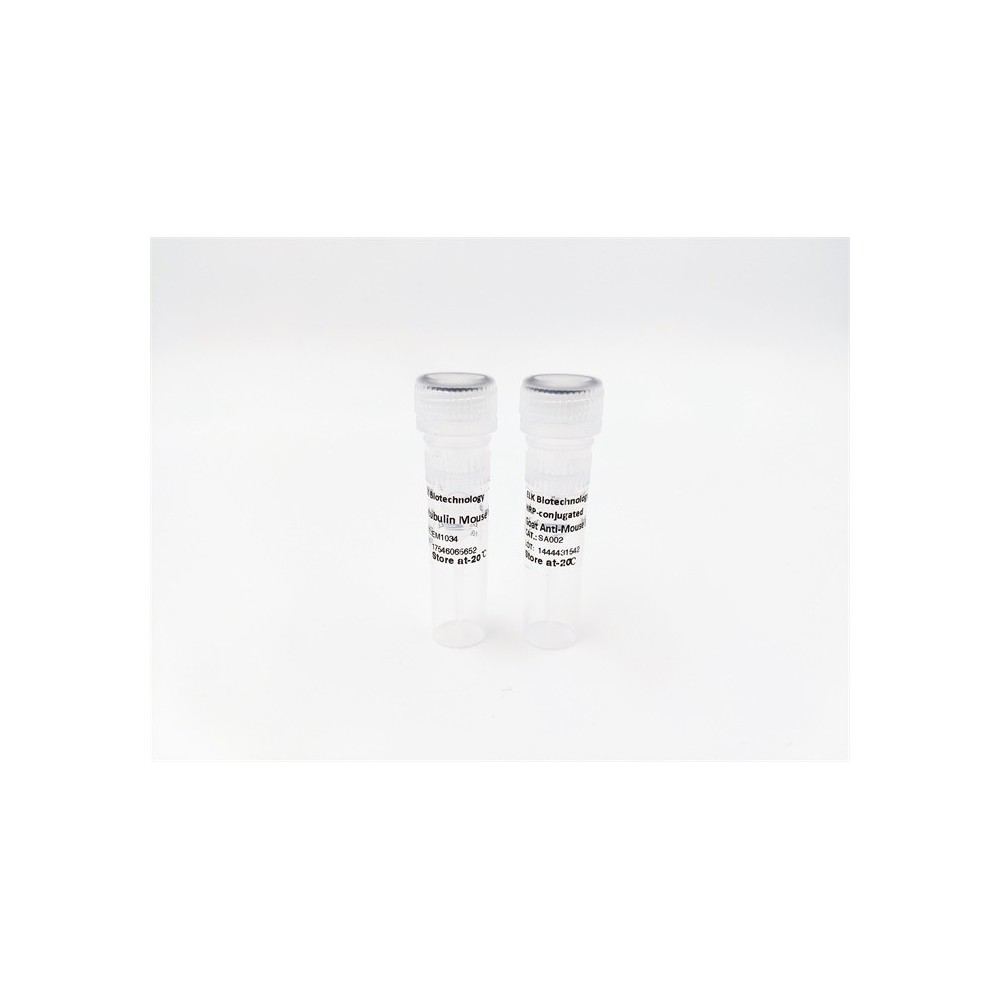

| ELK.No | ES4879 |
| Product name | AR-α1A rabbit pAb |
| Reactivity | Human;Mouse;Rat |
| Applications | WB;IF;ELISA |
| Other name | ADRA1A; ADRA1C; Alpha-1A adrenergic receptor; Alpha-1A adrenoreceptor; Alpha-1A adrenoceptor; Alpha-1C adrenergic receptor; Alpha-adrenergic receptor 1c |
| Size | 100μL |
| Unit price ($) | 248 |
| Human gene ID | 148 |
| Human Swiss-Prot | P35348 |
| Source | Rabbit |
| Isotype | IgG |
| Target | AR-α1A |
| Fields | >>Calcium signaling pathway;>>cGMP-PKG signaling pathway;>>Neuroactive ligand-receptor interaction;>>AMPK signaling pathway;>>Adrenergic signaling in cardiomyocytes;>>Vascular smooth muscle contraction;>>Salivary secretion |
| Gene name | ADRA1A |
| Protein name | Alpha-1A adrenergic receptor |
| Human gene link | View Human Gene |
| Human Swiss link | View Human Swiss-Prot |
| Mouse gene ID | 11549 |
| Mouse gene link | View Mouse Gene |
| Mouse Swiss-Prot | P97718 |
| Mouse Swiss link | View Mouse Swiss-Prot |
| Rat gene ID | 29412 |
| Rat gene link | View Rat Gene |
| Rat Swiss-Prot | P43140 |
| Rat Swiss link | View Rat Swiss-Prot |
| Immunogen | The antiserum was produced against synthesized peptide derived from human ADRA1A. AA range:136-185 |
| Specificity | AR-α1A Polyclonal Antibody detects endogenous levels of AR-α1A protein. |
| Formulation | Liquid in PBS containing 50% glycerol, 0.5% BSA and 0.02% sodium azide. |
| Clonality | Polyclonal |
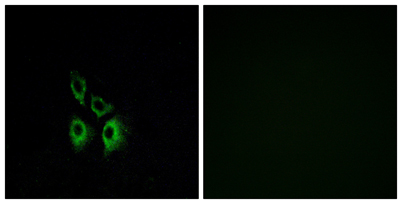
| Dilution | Western Blot: 1/500 - 1/2000. Immunofluorescence: 1/200 - 1/1000. ELISA: 1/10000. Not yet tested in other applications. |
| Purification | The antibody was affinity-purified from rabbit antiserum by affinity-chromatography using epitope-specific immunogen. |
| Concentration | 1 mg/ml |
| Storage stability | -20°C/1 year |
| Molecular Weight (Da) | |
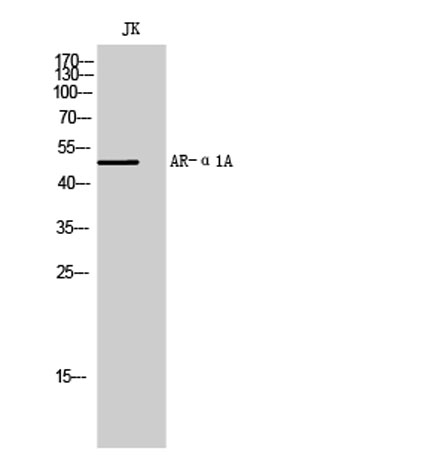
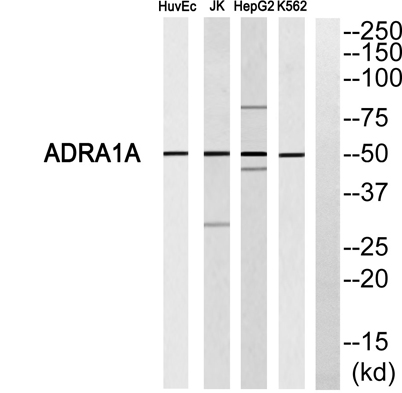
| Observed band (KD) | 51kD |
| Background | Alpha-1-adrenergic receptors (alpha-1-ARs) are members of the G protein-coupled receptor superfamily. They activate mitogenic responses and regulate growth and proliferation of many cells. There are 3 alpha-1-AR subtypes: alpha-1A, -1B and -1D, all of which signal through the Gq/11 family of G-proteins and different subtypes show different patterns of activation. This gene encodes alpha-1A-adrenergic receptor. Alternative splicing of this gene generates four transcript variants, which encode four different isoforms with distinct C-termini but having similar ligand binding properties. [provided by RefSeq, Jul 2008], |
| Function | function:This alpha-adrenergic receptor mediates its action by association with G proteins that activate a phosphatidylinositol-calcium second messenger system. Its effect is mediated by G(q) and G(11) proteins.,PTM:Carboxyl-terminal Ser or Thr residues may be phosphorylated.,similarity:Belongs to the G-protein coupled receptor 1 family.,tissue specificity:Heart, brain, liver and prostate, but not in kidney, lung, adrenal, aorta and pituitary. Isoform 4 is the most abundant isoform expressed in the prostate with high levels also detected in liver and heart., |
| Subcellular location | Nucleus membrane; Multi-pass membrane protein. Cell membrane ; Multi-pass membrane protein . Cytoplasm . Membrane, caveola . Location at the nuclear membrane facilitates heterooligomerization and regulates ERK-mediated signaling in cardiac myocytes. Colocalizes with GNAQ, PLCB1 as well as LAP2 at the nuclear membrane of cardiac myocytes. |
| Expression | Expressed in heart, brain, liver and prostate, but not in kidney, lung, adrenal, aorta and pituitary. Within the prostate, expressed in the apex, base, periurethral and lateral lobe. Isoform 4 is the most abundant isoform expressed in the prostate with high levels also detected in liver and heart. |

Use collapsible tabs for more detailed information that will help customers make a purchasing decision.
Ex: Shipping and return policies, size guides, and other common questions.