 Français
 English

| ELK.No | ES4949 |
| Product name | AKAP 14 rabbit pAb |
| Reactivity | Human;Rat;Mouse; |
| Applications | WB;IHC;IF;ELISA |
| Other name | AKAP14; AKAP28; A-kinase anchor protein 14; AKAP-14; A-kinase anchor protein 28 kDa; AKAP 28; Protein kinase A-anchoring protein 14; PRKA14 |
| Size | 100μL |
| Unit price ($) | 248 |
| Human gene ID | 158798 |
| Human Swiss-Prot | Q86UN6 |
| Source | Rabbit |
| Isotype | IgG |
| Target | AKAP 14 |
| Fields | |
| Gene name | AKAP14 |
| Protein name | A-kinase anchor protein 14 |
| Human gene link | View Human Gene |
| Human Swiss link | View Human Swiss-Prot |
| Mouse gene ID | |
| Mouse gene link | |
| Mouse Swiss-Prot | |
| Mouse Swiss link | |
| Rat gene ID | |
| Rat gene link | |
| Rat Swiss-Prot | |
| Rat Swiss link | |
| Immunogen | The antiserum was produced against synthesized peptide derived from human AKAP14. AA range:1-50 |
| Specificity | AKAP 14 Polyclonal Antibody detects endogenous levels of AKAP 14 protein. |
| Formulation | Liquid in PBS containing 50% glycerol, 0.5% BSA and 0.02% sodium azide. |
| Clonality | Polyclonal |
| Dilution | Western Blot: 1/500 - 1/2000. Immunohistochemistry: 1/100 - 1/300. Immunofluorescence: 1/200 - 1/1000. ELISA: 1/5000. Not yet tested in other applications. |
| Purification | The antibody was affinity-purified from rabbit antiserum by affinity-chromatography using epitope-specific immunogen. |
| Concentration | 1 mg/ml |
| Storage stability | -20°C/1 year |
| Molecular Weight (Da) | |
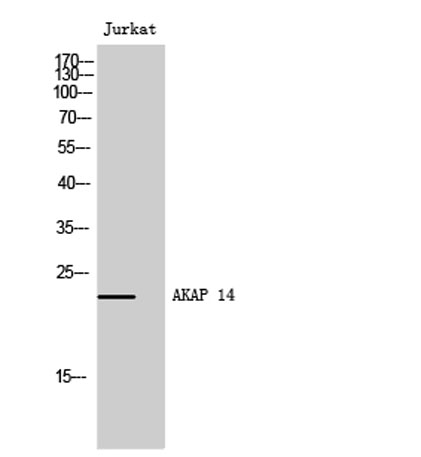
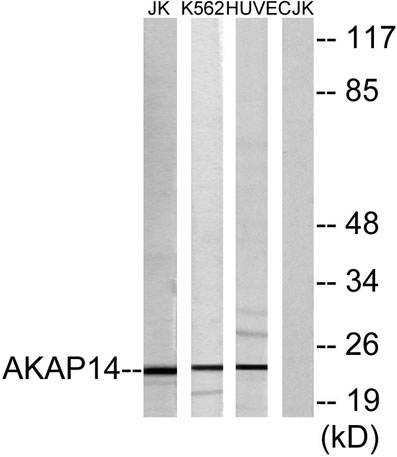
| Observed band (KD) | 23kD |
| Background | The A-kinase anchor proteins (AKAPs) are a group of structurally diverse proteins, which have the common function of binding to the regulatory subunit of protein kinase A (PKA) and confining the holoenzyme to discrete locations within the cell. This gene encodes a member of the AKAP family. The protein anchors PKA in ciliary axonemes and, in this way, may play a role in regulating ciliary beat frequency. Alternate transcriptional splice variants, encoding different isoforms, have been characterized. [provided by RefSeq, Jul 2008], |
| Function | caution:The sequence shown here is derived from an Ensembl automatic analysis pipeline and should be considered as preliminary data.,function:Binds to type II regulatory subunits of protein kinase A and anchors/targets them.,subunit:Binds to type II regulatory subunits (RII).,tissue specificity:Present in cilia (at protein level). Expressed in tissues containing axoneme-based organelles (cilia and/or flagella): trachea and testis. Highly expressed in airway cilia., |
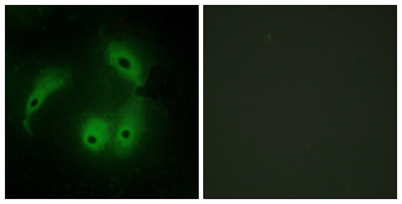
| Subcellular location | Cytoplasm . |
| Expression | Present in cilia (at protein level). Expressed in tissues containing axoneme-based organelles (cilia and/or flagella): trachea and testis. Highly expressed in airway cilia. |

Use collapsible tabs for more detailed information that will help customers make a purchasing decision.
Ex: Shipping and return policies, size guides, and other common questions.