 Français
 English
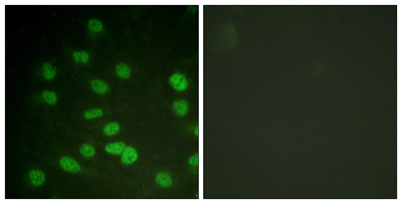
DDX3 (phospho Thr322) rabbit pAb
AO-06-ES4984-50

| ELK.No | ES4984 |
| Product name | DDX3 (phospho Thr322) rabbit pAb |
| Reactivity | Human;Mouse;Rat |
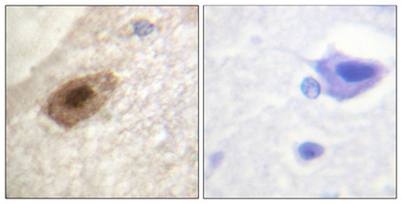
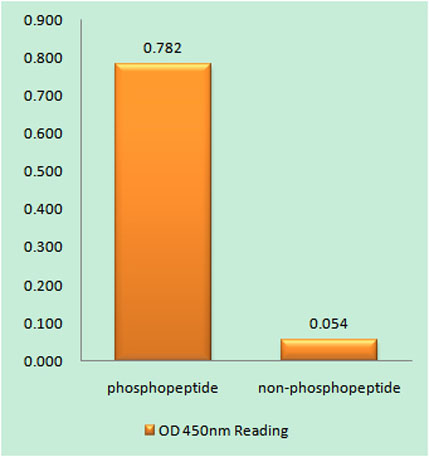
| Applications | IHC;IF;ELISA |
| Other name | DDX3X; DBX; DDX3; ATP-dependent RNA helicase DDX3X; DEAD box protein 3; X-chromosomal; DEAD box, X isoform; Helicase-like protein 2; HLP2 |
| Size | 50μL |
| Unit price ($) | 148 |
| Human gene ID | 1654 |
| Human Swiss-Prot | O00571 |
| Source | Rabbit |
| Isotype | IgG |
| Target | DDX3 |
| Fields | >>RIG-I-like receptor signaling pathway;>>Hepatitis B;>>Viral carcinogenesis |
| Gene name | DDX3X |
| Protein name | ATP-dependent RNA helicase DDX3X |
| Human gene link | View Human Gene |
| Human Swiss link | View Human Swiss-Prot |
| Mouse gene ID | 13205 |
| Mouse gene link | View Mouse Gene |
| Mouse Swiss-Prot | Q62167 |
| Mouse Swiss link | View Mouse Swiss-Prot |
| Rat gene ID | |
| Rat gene link | |
| Rat Swiss-Prot | |
| Rat Swiss link | |
| Immunogen | The antiserum was produced against synthesized peptide derived from human DDX3/DEAD-box Protein 3 around the phosphorylation site of Thr322. AA range:466-515 |
| Specificity | Phospho-DDX3 (T322) Polyclonal Antibody detects endogenous levels of DDX3 protein only when phosphorylated at T322. |
| Formulation | Liquid in PBS containing 50% glycerol, 0.5% BSA and 0.02% sodium azide. |
| Clonality | Polyclonal |
| Dilution | Immunohistochemistry: 1/100 - 1/300. Immunofluorescence: 1/200 - 1/1000. ELISA: 1/10000. Not yet tested in other applications. |
| Purification | The antibody was affinity-purified from rabbit antiserum by affinity-chromatography using epitope-specific immunogen. |
| Concentration | 1 mg/ml |
| Storage stability | -20°C/1 year |
| Molecular Weight (Da) | 73kD |
| Observed band (KD) | |
| Background | The protein encoded by this gene is a member of the large DEAD-box protein family, that is defined by the presence of the conserved Asp-Glu-Ala-Asp (DEAD) motif, and has ATP-dependent RNA helicase activity. This protein has been reported to display a high level of RNA-independent ATPase activity, and unlike most DEAD-box helicases, the ATPase activity is thought to be stimulated by both RNA and DNA. This protein has multiple conserved domains and is thought to play roles in both the nucleus and cytoplasm. Nuclear roles include transcriptional regulation, mRNP assembly, pre-mRNA splicing, and mRNA export. In the cytoplasm, this protein is thought to be involved in translation, cellular signaling, and viral replication. Misregulation of this gene has been implicated in tumorigenesis. This gene has a paralog located in the nonrecombining region of the Y chromosome. Pseudogenes sharing similarit |
| Function | function:ATP-dependent RNA helicase. Acts as a cofactor for XPO1-mediated nuclear export of incompletely spliced HIV-1 Rev RNAs. Also involved in HIV-1 replication. Interacts specifically with hepatitis C virus core protein resulting in a change in intracellular location.,similarity:Belongs to the DEAD box helicase family.,similarity:Belongs to the DEAD box helicase family. DDX3/DED1 subfamily.,similarity:Contains 1 helicase ATP-binding domain.,similarity:Contains 1 helicase C-terminal domain.,subcellular location:Located predominantly in nuclear speckles and, at low levels, throughout the cytoplasm. Located to the outer side of nuclear pore complexes (NPC). Shuttles between the nucleus and the cytoplasm in a XPO1-dependent manner.,subunit:Found in a complex with Rev and XPO1. Interacts with XPO1 and TDRD3. Interacts with HCV core protein., |
| Subcellular location | Cell membrane . Nucleus . Cytoplasm . Cytoplasm, Stress granule . Inflammasome . Cell projection, lamellipodium . Cytoplasm, cytoskeleton, microtubule organizing center, centrosome . Shuttles between the nucleus and the cytosol (PubMed:15507209, PubMed:18636090, PubMed:29899501, PubMed:31575075, PubMed:30131165). Exported from the nucleus partly through the XPO1/CRM1 system and partly through NXF1/TAP (PubMed:15507209, PubMed:18636090, PubMed:18596238, PubMed:31575075, PubMed:30131165). Localizes to nuclear pores on the outer side of the nuclear membrane (PubMed:15507209). In the cytosol, partly colocalizes with mitochondria (PubMed:20127681). At G0, predominantly located in nucleus. In G1/S phase, predominantly cytoplasmic (PubMed:22034099). During prophase/prometaphase, localizes in clos |
| Expression | Widely expressed (PubMed:15294876). In testis, expressed in spermatids (PubMed:15294876). Expressed in epidermis and liver (at protein level) (PubMed:16818630, PubMed:16301996). |

Use collapsible tabs for more detailed information that will help customers make a purchasing decision.
Ex: Shipping and return policies, size guides, and other common questions.