 Français
 English
Ah Receptor (phospho Ser36) rabbit pAb
AO-06-ES5068-100

| ELK.No | ES5068 |
| Product name | Ah Receptor (phospho Ser36) rabbit pAb |
| Reactivity | Human;Mouse;Rat |
| Applications | WB;IHC;IF;ELISA |
| Other name | AHR; BHLHE76; Aryl hydrocarbon receptor; Ah receptor; AhR; Class E basic helix-loop-helix protein 76; bHLHe76; AHRR; BHLHE77; KIAA1234; Aryl hydrocarbon receptor repressor; AhR repressor; AhRR; Class E basic helix-loop-helix protein 77; bHL |
| Size | 100μL |
| Unit price ($) | 248 |
| Human gene ID | 196/57491 |
| Human Swiss-Prot | P35869/A9YTQ3 |
| Source | Rabbit |
| Isotype | IgG |
| Target | Ah Receptor |
| Fields | >>Th17 cell differentiation;>>Cushing syndrome;>>Chemical carcinogenesis - receptor activation;>>Chemical carcinogenesis - reactive oxygen species |
| Gene name | AHR |
| Protein name | Aryl hydrocarbon receptor |
| Human gene link | View Human Gene |
| Human Swiss link | View Human Swiss-Prot |
| Mouse gene ID | 11622/11624 |
| Mouse gene link | View Mouse Gene |
| Mouse Swiss-Prot | |
| Mouse Swiss link | |
| Rat gene ID | 25690/498999 |
| Rat gene link | View Rat Gene |
| Rat Swiss-Prot | P41738/Q75NT5 |
| Rat Swiss link | View Rat Swiss-Prot |
| Immunogen | The antiserum was produced against synthesized peptide derived from human AhR around the phosphorylation site of Ser36. AA range:2-51 |
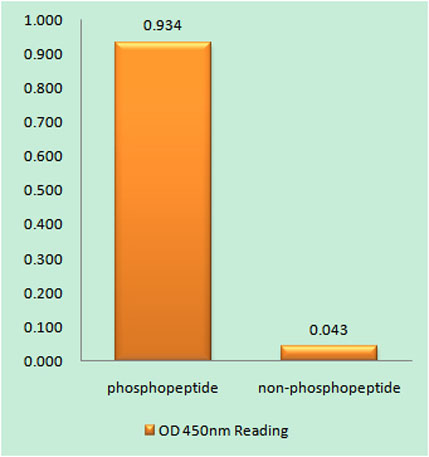
| Specificity | Phospho-Ah Receptor (S36) Polyclonal Antibody detects endogenous levels of Ah Receptor protein only when phosphorylated at S36. |
| Formulation | Liquid in PBS containing 50% glycerol, 0.5% BSA and 0.02% sodium azide. |
| Clonality | Polyclonal |
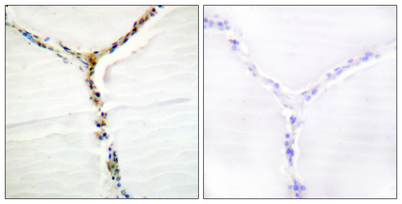
| Dilution | Western Blot: 1/500 - 1/2000. Immunohistochemistry: 1/100 - 1/300. ELISA: 1/5000. Not yet tested in other applications. |
| Purification | The antibody was affinity-purified from rabbit antiserum by affinity-chromatography using epitope-specific immunogen. |
| Concentration | 1 mg/ml |
| Storage stability | -20°C/1 year |
| Molecular Weight (Da) | |
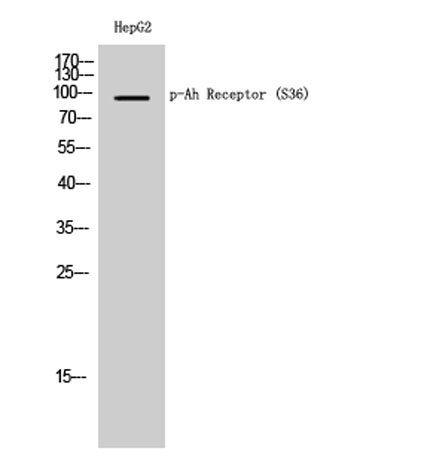
| Observed band (KD) | 90kD |
| Background | The protein encoded by this gene is a ligand-activated helix-loop-helix transcription factor involved in the regulation of biological responses to planar aromatic hydrocarbons. This receptor has been shown to regulate xenobiotic-metabolizing enzymes such as cytochrome P450. Before ligand binding, the encoded protein is sequestered in the cytoplasm; upon ligand binding, this protein moves to the nucleus and stimulates transcription of target genes. [provided by RefSeq, Sep 2015], |
| Function | function:Ligand-activated transcriptional activator. Binds to the XRE promoter region of genes it activates. Activates the expression of multiple phase I and II xenobiotic chemical metabolizing enzyme genes (such as the CYP1A1 gene). Mediates biochemical and toxic effects of halogenated aromatic hydrocarbons. Involved in cell-cycle regulation. Likely to play an important role in the development and maturation of many tissues.,induction:Induced or repressed by TGF-beta and dioxin in a cell-type specific fashion. Repressed by cAMP, retinoic acid, and TPA.,similarity:Contains 1 basic helix-loop-helix (bHLH) domain.,similarity:Contains 1 PAC (PAS-associated C-terminal) domain.,similarity:Contains 2 PAS (PER-ARNT-SIM) domains.,subcellular location:Initially cytoplasmic; upon binding with ligand and interaction with a HSP90, it translocates to the nucleus.,subunit:Binds MYBBP1A (By similarity) |
| Subcellular location | Cytoplasm . Nucleus . Initially cytoplasmic; upon binding with ligand and interaction with a HSP90, it translocates to the nucleus. . |
| Expression | Expressed in all tissues tested including blood, brain, heart, kidney, liver, lung, pancreas and skeletal muscle. Expressed in retinal photoreceptors (PubMed:29726989). |

Use collapsible tabs for more detailed information that will help customers make a purchasing decision.
Ex: Shipping and return policies, size guides, and other common questions.