 Français
 English

| ELK.No | ES5186 |
| Product name | ABCD1 rabbit pAb |
| Reactivity | Human;Rat;Mouse; |
| Applications | WB;ELISA |
| Other name | ABCD1; ALD; ATP-binding cassette sub-family D member 1; Adrenoleukodystrophy protein; ALDP |
| Size | 50μL |
| Unit price ($) | 148 |
| Human gene ID | 215 |
| Human Swiss-Prot | P33897 |
| Source | Rabbit |
| Isotype | IgG |
| Target | ABCD1 |
| Fields | >>ABC transporters;>>Peroxisome |
| Gene name | ABCD1 |
| Protein name | ATP-binding cassette sub-family D member 1 |
| Human gene link | View Human Gene |
| Human Swiss link | View Human Swiss-Prot |
| Mouse gene ID | |
| Mouse gene link | |
| Mouse Swiss-Prot | P48410 |
| Mouse Swiss link | View Mouse Swiss-Prot |
| Rat gene ID | |
| Rat gene link | |
| Rat Swiss-Prot | |
| Rat Swiss link | |
| Immunogen | The antiserum was produced against synthesized peptide derived from human ABCD1. AA range:531-580 |
| Specificity | ABCD1 Polyclonal Antibody detects endogenous levels of ABCD1 protein. |
| Formulation | Liquid in PBS containing 50% glycerol, 0.5% BSA and 0.02% sodium azide. |
| Clonality | Polyclonal |
| Dilution | Western Blot: 1/500 - 1/2000. ELISA: 1/40000. Not yet tested in other applications. |
| Purification | The antibody was affinity-purified from rabbit antiserum by affinity-chromatography using epitope-specific immunogen. |
| Concentration | 1 mg/ml |
| Storage stability | -20°C/1 year |
| Molecular Weight (Da) | |
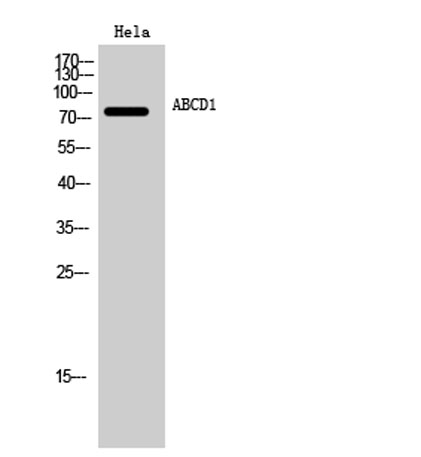
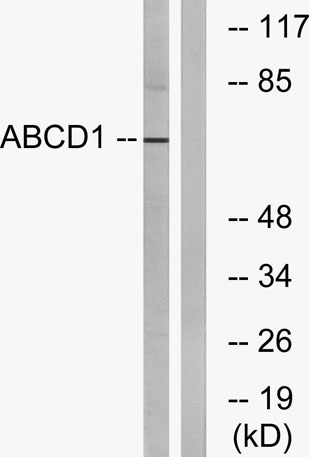
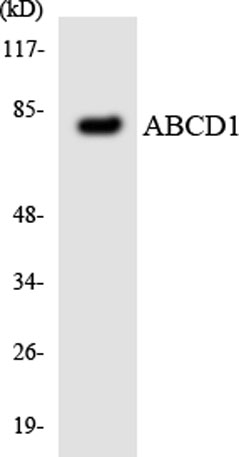
| Observed band (KD) | 75kD |
| Background | The protein encoded by this gene is a member of the superfamily of ATP-binding cassette (ABC) transporters. ABC proteins transport various molecules across extra- and intra-cellular membranes. ABC genes are divided into seven distinct subfamilies (ABC1, MDR/TAP, MRP, ALD, OABP, GCN20, White). This protein is a member of the ALD subfamily, which is involved in peroxisomal import of fatty acids and/or fatty acyl-CoAs in the organelle. All known peroxisomal ABC transporters are half transporters which require a partner half transporter molecule to form a functional homodimeric or heterodimeric transporter. This peroxisomal membrane protein is likely involved in the peroxisomal transport or catabolism of very long chain fatty acids. Defects in this gene have been identified as the underlying cause of adrenoleukodystrophy, an X-chromosome recessively inherited demyelinating disord |
| Function | disease:Defects in ABCD1 are the cause of adrenoleukodystrophy X-linked (X-ALD) [MIM:300100]. X-ALD is a peroxisomal metabolic disorder characterized by progressive multifocal demyelination of the central nervous system and by peripheral adrenal insufficiency (Addison disease). It results in mental deterioration, corticospinal tract dysfunction, and cortical blindness. Different clinical manifestations exist like: cerebral childhood ALD (CALD), adult cerebral ALD (ACALD), adrenomyeloneuropathy (AMN) and "Addison disease only" (ADO) phenotype.,disease:Microdeletions in ABCD1 are involved in the contiguous ABCD1/DXS1375E deletion syndrome (CADDS) [MIM:300475]. Patients manifest profound neonatal hypotonia, subsequent failure to thrive, and cholestatic liver disease.,function:Probable transporter. The nucleotide-binding fold acts as an ATP-binding subunit with ATPase activity.,similarity:Be |
| Subcellular location | Peroxisome membrane ; Multi-pass membrane protein . Mitochondrion membrane ; Multi-pass membrane protein. Lysosome membrane ; Multi-pass membrane protein. Endoplasmic reticulum membrane ; Multi-pass membrane protein. |
| Expression | Brain,Pancreas, |

Use collapsible tabs for more detailed information that will help customers make a purchasing decision.
Ex: Shipping and return policies, size guides, and other common questions.