 Français
 English
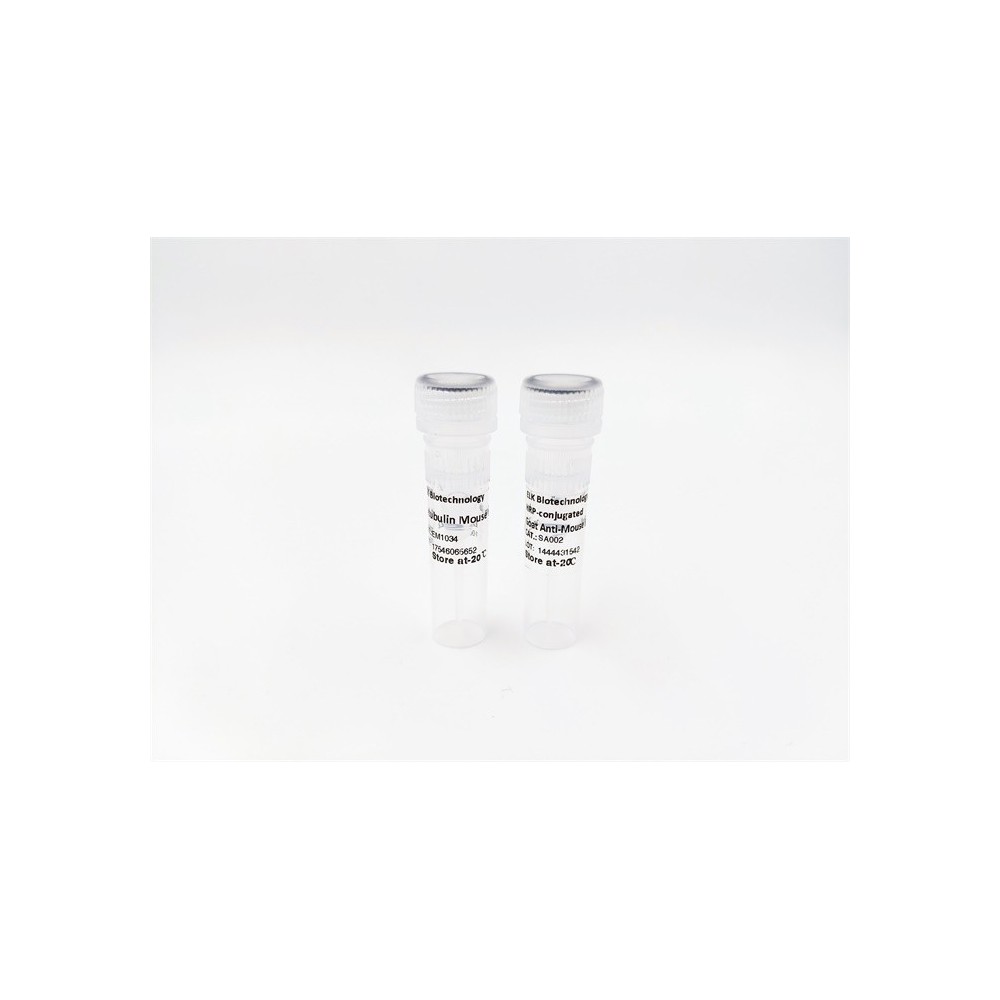

| ELK.No | ES5236 |
| Product name | GPRC6A rabbit pAb |
| Reactivity | Human;Rat;Mouse; |
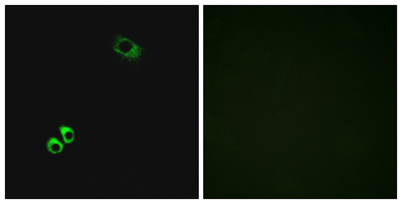
| Applications | WB;IF;ELISA |
| Other name | GPRC6A; G-protein coupled receptor family C group 6 member A; hGPRC6A; G-protein coupled receptor GPCR33; hGPCR33 |
| Size | 100μL |
| Unit price ($) | 248 |
| Human gene ID | 222545 |
| Human Swiss-Prot | Q5T6X5 |
| Source | Rabbit |
| Isotype | IgG |
| Target | GPRC6A |
| Fields | >>NOD-like receptor signaling pathway |
| Gene name | GPRC6A |
| Protein name | G-protein coupled receptor family C group 6 member A |
| Human gene link | View Human Gene |
| Human Swiss link | View Human Swiss-Prot |
| Mouse gene ID | |
| Mouse gene link | |
| Mouse Swiss-Prot | Q8K4Z6 |
| Mouse Swiss link | View Mouse Swiss-Prot |
| Rat gene ID | |
| Rat gene link | |
| Rat Swiss-Prot | |
| Rat Swiss link | |
| Immunogen | The antiserum was produced against synthesized peptide derived from human GPRC6A. AA range:471-520 |
| Specificity | GPRC6A Polyclonal Antibody detects endogenous levels of GPRC6A protein. |
| Formulation | Liquid in PBS containing 50% glycerol, 0.5% BSA and 0.02% sodium azide. |
| Clonality | Polyclonal |
| Dilution | Western Blot: 1/500 - 1/2000. Immunofluorescence: 1/200 - 1/1000. ELISA: 1/5000. Not yet tested in other applications. |
| Purification | The antibody was affinity-purified from rabbit antiserum by affinity-chromatography using epitope-specific immunogen. |
| Concentration | 1 mg/ml |
| Storage stability | -20°C/1 year |
| Molecular Weight (Da) | |
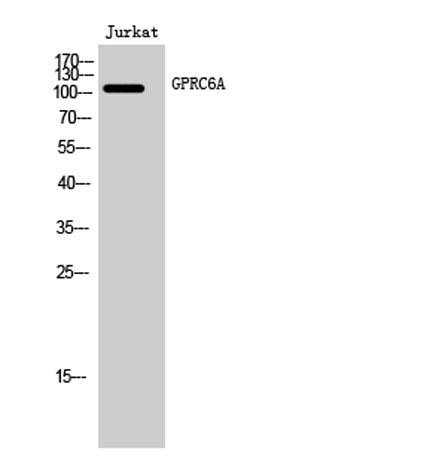
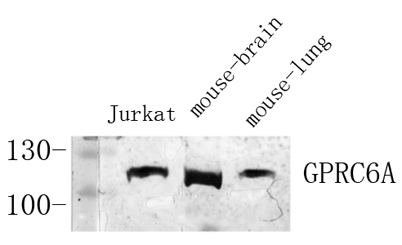
| Observed band (KD) | 105kD |
| Background | Members of family C of the G protein-coupled receptor (GPCR) superfamily, such as GPRC6A, are characterized by an evolutionarily conserved amino acid-sensing motif linked to an intramembranous 7-transmembrane loop region. Several members of GPCR family C, including GPRC6A, also have a long N-terminal domain (summary by Pi et al., 2005 [PubMed 16199532]).[supplied by OMIM, Nov 2010], |
| Function | function:Receptor that is activated by both amino acids and extracellular concentration of calcium ions. The activity of this receptor is mediated by a G-protein that activates a phosphatidylinositol-calcium second messenger system. Senses changes in the extracellular concentration of calcium ions, suggesting that it may mediate extracellular calcium-sensing responses in osteoblasts. Osteocalin, stimulates its activity in presence of calcium. Has a lower affinity for calcium than CASR. Also acts as a receptor for amino acids, with a preference for basic amino acids such as L-Lys, L-Arg and L-ornithine. Its affinity for amino acids suggests that it may act as a regulatory component of the urea cycle.,PTM:N-glycosylated.,similarity:Belongs to the G-protein coupled receptor 3 family.,subunit:Homodimer; disulfide-linked.,tissue specificity:Widely expressed. Expressed at high level in brain, |
| Subcellular location | Cell membrane ; Multi-pass membrane protein . |
| Expression | Isoform 1 is expressed at high level in brain, skeletal muscle, testis, bone, calvaria, osteoblasts and leukocytes. Expressed at intermediate level in liver, heart, kidney and spleen. Expressed at low level in lung, pancreas, placenta and ovary. Not detected in thymus, prostate, small intestine, tongue and colon. Isoform 1 and isoform 2 are expressed in kidney at the same level. Isoform 2 is expressed at lower level than isoform 1 in the other tissues. |

Use collapsible tabs for more detailed information that will help customers make a purchasing decision.
Ex: Shipping and return policies, size guides, and other common questions.