 Français
 English
Flg/Bek (phospho Tyr463/466) rabbit pAb
AO-06-ES5247-100

| ELK.No | ES5247 |
| Product name | Flg/Bek (phospho Tyr463/466) rabbit pAb |
| Reactivity | Human;Mouse;Rat |
| Applications | WB;ELISA |
| Other name | FGFR1; BFGFR; CEK; FGFBR; FLG; FLT2; HBGFR; Fibroblast growth factor receptor 1; FGFR-1; Basic fibroblast growth factor receptor 1; BFGFR; bFGF-R-1; Fms-like tyrosine kinase 2; FLT-2; N-sam; Proto-oncogene c-Fgr; CD antigen CD331; FGFR2; BE |
| Size | 100μL |
| Unit price ($) | 248 |
| Human gene ID | 2260/2263 |
| Human Swiss-Prot | P11362/P21802 |
| Source | Rabbit |
| Isotype | IgG |
| Target | Flg/Bek |
| Fields | >>MAPK signaling pathway;>>Ras signaling pathway;>>Rap1 signaling pathway;>>Calcium signaling pathway;>>PI3K-Akt signaling pathway;>>Adherens junction;>>Signaling pathways regulating pluripotency of stem cells;>>Thermogenesis;>>Regulation of actin cytoskeleton;>>Parathyroid hormone synthesis, secretion and action;>>Pathways in cancer;>>Proteoglycans in cancer;>>Prostate cancer;>>Melanoma;>>Breast cancer;>>Central carbon metabolism in cancer |
| Gene name | FGFR1/FGFR2 |
| Protein name | Basic fibroblast growth factor receptor 1/2 |
| Human gene link | View Human Gene |
| Human Swiss link | View Human Swiss-Prot |
| Mouse gene ID | 14182/14183 |
| Mouse gene link | View Mouse Gene |
| Mouse Swiss-Prot | |
| Mouse Swiss link | |
| Rat gene ID | 79114 |
| Rat gene link | View Rat Gene |
| Rat Swiss-Prot | Q04589 |
| Rat Swiss link | View Rat Swiss-Prot |
| Immunogen | Synthesized phospho-peptide around the phosphorylation site of human Flg/Bek (phospho Tyr463/466) |
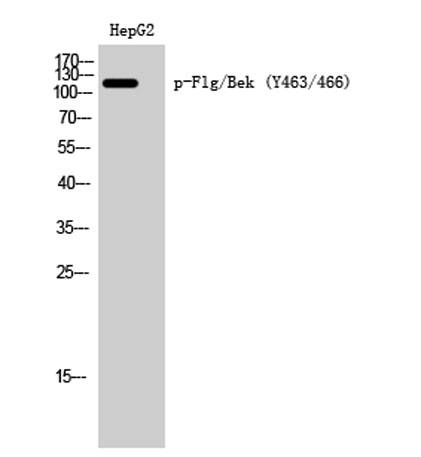
| Specificity | Phospho-Flg/Bek (Y463/466) Polyclonal Antibody detects endogenous levels of Flg/Bek protein only when phosphorylated at Y463/466. |
| Formulation | Liquid in PBS containing 50% glycerol, 0.5% BSA and 0.02% sodium azide. |
| Clonality | Polyclonal |
| Dilution | Western Blot: 1/500 - 1/2000. ELISA: 1/10000. Not yet tested in other applications. |
| Purification | The antibody was affinity-purified from rabbit antiserum by affinity-chromatography using epitope-specific immunogen. |
| Concentration | 1 mg/ml |
| Storage stability | -20°C/1 year |
| Molecular Weight (Da) | |
| Observed band (KD) | 120kD |
| Background | The protein encoded by this gene is a member of the fibroblast growth factor receptor (FGFR) family, where amino acid sequence is highly conserved between members and throughout evolution. FGFR family members differ from one another in their ligand affinities and tissue distribution. A full-length representative protein consists of an extracellular region, composed of three immunoglobulin-like domains, a single hydrophobic membrane-spanning segment and a cytoplasmic tyrosine kinase domain. The extracellular portion of the protein interacts with fibroblast growth factors, setting in motion a cascade of downstream signals, ultimately influencing mitogenesis and differentiation. This particular family member binds both acidic and basic fibroblast growth factors and is involved in limb induction. Mutations in this gene have been associated with Pfeiffer syndrome, Jackson-Weiss syndrome, |
| Function | catalytic activity:ATP + a [protein]-L-tyrosine = ADP + a [protein]-L-tyrosine phosphate.,disease:A chromosomal aberration involving FGFR1 may be a cause of stem cell leukemia lymphoma syndrome (SCLL). Translocation t(8;13)(p11;q12) with ZMYM2. SCLL usually presents as lymphoblastic lymphoma in association with a myeloproliferative disorder, often accompanied by pronounced peripheral eosinophilia and/or prominent eosinophilic infiltrates in the affected bone marrow.,disease:A chromosomal aberration involving FGFR1 may be a cause of stem cell myeloproliferative disorder (MPD). Translocation t(6;8)(q27;p11) with FGFR1OP. Insertion ins(12;8)(p11;p11p22) with FGFR1OP2. MPD is characterized by myeloid hyperplasia, eosinophilia and T-cell or B-cell lymphoblastic lymphoma. In general it progresses to acute myeloid leukemia. The fusion proteins FGFR1OP2-FGFR1, FGFR1OP-FGFR1 or FGFR1-FGFR1OP may |
| Subcellular location | Cell membrane; Single-pass type I membrane protein. Nucleus. Cytoplasm, cytosol. Cytoplasmic vesicle. After ligand binding, both receptor and ligand are rapidly internalized. Can translocate to the nucleus after internalization, or by translocation from the endoplasmic reticulum or Golgi apparatus to the cytosol, and from there to the nucleus. |
| Expression | Detected in astrocytoma, neuroblastoma and adrenal cortex cell lines. Some isoforms are detected in foreskin fibroblast cell lines, however isoform 17, isoform 18 and isoform 19 are not detected in these cells. |

Use collapsible tabs for more detailed information that will help customers make a purchasing decision.
Ex: Shipping and return policies, size guides, and other common questions.