 Français
 English
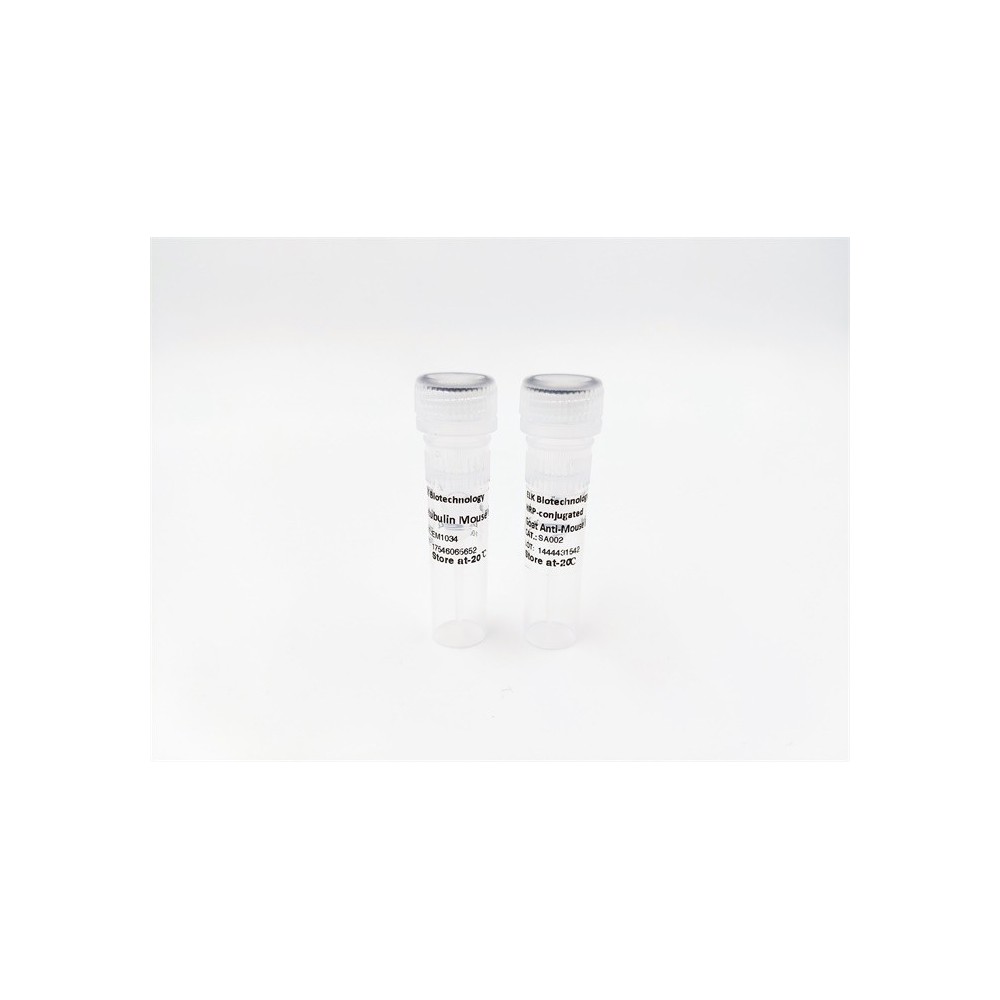

| ELK.No | ES5361 |
| Product name | FPR1 rabbit pAb |
| Reactivity | Human;Rat;Mouse; |
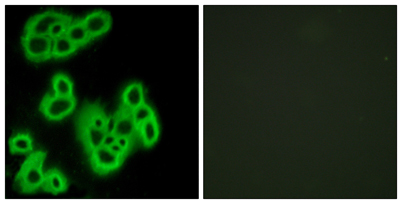
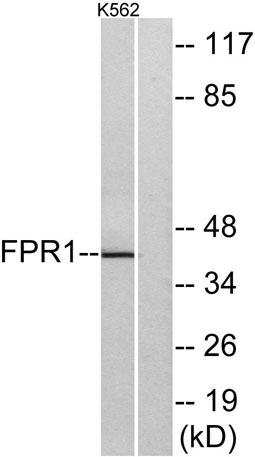
| Applications | WB;IHC;IF;ELISA |
| Other name | FPR1; fMet-Leu-Phe receptor; fMLP receptor; N-formyl peptide receptor; FPR; N-formylpeptide chemoattractant receptor |
| Size | 100μL |
| Unit price ($) | 248 |
| Human gene ID | 2357 |
| Human Swiss-Prot | P21462 |
| Source | Rabbit |
| Isotype | IgG |
| Target | FPR1 |
| Fields | >>Rap1 signaling pathway;>>Neuroactive ligand-receptor interaction;>>Neutrophil extracellular trap formation;>>Staphylococcus aureus infection |
| Gene name | FPR1 |
| Protein name | fMet-Leu-Phe receptor |
| Human gene link | View Human Gene |
| Human Swiss link | View Human Swiss-Prot |
| Mouse gene ID | |
| Mouse gene link | |
| Mouse Swiss-Prot | P33766 |
| Mouse Swiss link | View Mouse Swiss-Prot |
| Rat gene ID | |
| Rat gene link | |
| Rat Swiss-Prot | |
| Rat Swiss link | |
| Immunogen | The antiserum was produced against synthesized peptide derived from human FPR1. AA range:155-204 |
| Specificity | FPR1 Polyclonal Antibody detects endogenous levels of FPR1 protein. |
| Formulation | Liquid in PBS containing 50% glycerol, 0.5% BSA and 0.02% sodium azide. |
| Clonality | Polyclonal |
| Dilution | Western Blot: 1/500 - 1/2000. Immunohistochemistry: 1/100 - 1/300. Immunofluorescence: 1/200 - 1/1000. ELISA: 1/5000. Not yet tested in other applications. |
| Purification | The antibody was affinity-purified from rabbit antiserum by affinity-chromatography using epitope-specific immunogen. |
| Concentration | 1 mg/ml |
| Storage stability | -20°C/1 year |
| Molecular Weight (Da) | |
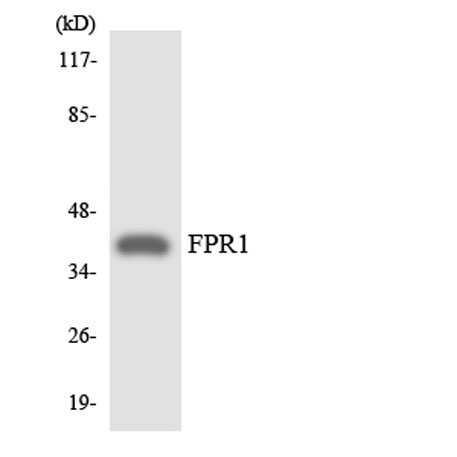
| Observed band (KD) | 40kD |
| Background | formyl peptide receptor 1(FPR1) Homo sapiens This gene encodes a G protein-coupled receptor of mammalian phagocytic cells that is a member of the G-protein coupled receptor 1 family. The protein mediates the response of phagocytic cells to invasion of the host by microorganisms and is important in host defense and inflammation.[provided by RefSeq, Jul 2010], |
| Function | function:High affinity receptor for N-formyl-methionyl peptides, which are powerful neutrophils chemotactic factors. Binding of FMLP to the receptor causes activation of neutrophils. This response is mediated via a G-protein that activates a phosphatidylinositol-calcium second messenger system.,PTM:Phosphorylated; which is necessary for desensitization.,similarity:Belongs to the G-protein coupled receptor 1 family.,tissue specificity:Neutrophils., |
| Subcellular location | Cell membrane ; Multi-pass membrane protein . Internalizes in presence of its ligands, fMLP, TAFA4 and CTSG. . |
| Expression | Neutrophils. |

Use collapsible tabs for more detailed information that will help customers make a purchasing decision.
Ex: Shipping and return policies, size guides, and other common questions.