 Français
 English
hnRNP D0 (phospho Ser83) rabbit pAb
AO-06-ES5756-50

| ELK.No | ES5756 |
| Product name | hnRNP D0 (phospho Ser83) rabbit pAb |
| Reactivity | Human;Mouse;Rat |
| Applications | WB;IHC;IF;ELISA |
| Other name | HNRNPD; AUF1; HNRPD; Heterogeneous nuclear ribonucleoprotein D0; hnRNP D0; AU-rich element RNA-binding protein 1 |
| Size | 50μL |
| Unit price ($) | 148 |
| Human gene ID | 3184 |
| Human Swiss-Prot | Q14103 |
| Source | Rabbit |
| Isotype | IgG |
| Target | hnRNP D0 |
| Fields | |
| Gene name | HNRNPD |
| Protein name | Heterogeneous nuclear ribonucleoprotein D0 |
| Human gene link | View Human Gene |
| Human Swiss link | View Human Swiss-Prot |
| Mouse gene ID | 11991 |
| Mouse gene link | View Mouse Gene |
| Mouse Swiss-Prot | Q60668 |
| Mouse Swiss link | View Mouse Swiss-Prot |
| Rat gene ID | 79256 |
| Rat gene link | View Rat Gene |
| Rat Swiss-Prot | Q9JJ54 |
| Rat Swiss link | View Rat Swiss-Prot |
| Immunogen | The antiserum was produced against synthesized peptide derived from human hnRPD around the phosphorylation site of Ser83. AA range:49-98 |
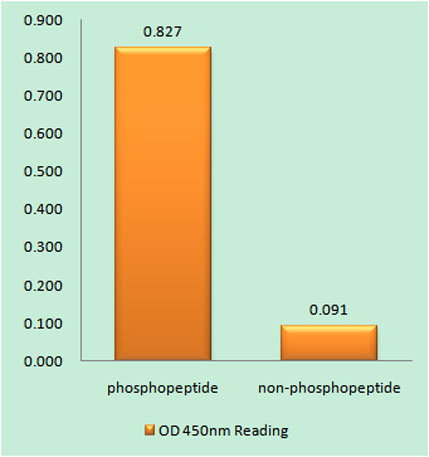
| Specificity | Phospho-hnRNP D0 (S83) Polyclonal Antibody detects endogenous levels of hnRNP D0 protein only when phosphorylated at S83. |
| Formulation | Liquid in PBS containing 50% glycerol, 0.5% BSA and 0.02% sodium azide. |
| Clonality | Polyclonal |
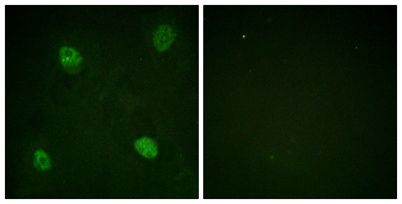
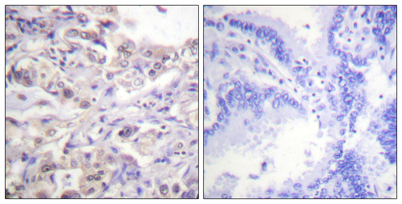
| Dilution | Western Blot: 1/500 - 1/2000. Immunohistochemistry: 1/100 - 1/300. Immunofluorescence: 1/200 - 1/1000. ELISA: 1/20000. Not yet tested in other applications. |
| Purification | The antibody was affinity-purified from rabbit antiserum by affinity-chromatography using epitope-specific immunogen. |
| Concentration | 1 mg/ml |
| Storage stability | -20°C/1 year |
| Molecular Weight (Da) | |
| Observed band (KD) | 38kD |
| Background | This gene belongs to the subfamily of ubiquitously expressed heterogeneous nuclear ribonucleoproteins (hnRNPs). The hnRNPs are nucleic acid binding proteins and they complex with heterogeneous nuclear RNA (hnRNA). These proteins are associated with pre-mRNAs in the nucleus and appear to influence pre-mRNA processing and other aspects of mRNA metabolism and transport. While all of the hnRNPs are present in the nucleus, some seem to shuttle between the nucleus and the cytoplasm. The hnRNP proteins have distinct nucleic acid binding properties. The protein encoded by this gene has two repeats of quasi-RRM domains that bind to RNAs. It localizes to both the nucleus and the cytoplasm. This protein is implicated in the regulation of mRNA stability. Alternative splicing of this gene results in four transcript variants. [provided by RefSeq, Jul 2008], |
| Function | function:Binds with high affinity to RNA molecules that contain AU-rich elements (AREs) found within the 3'-UTR of many proto-oncogenes and cytokine mRNAs. Also binds to double- and single-stranded DNA sequences in a specific manner and functions a transcription factor. Each of the RNA-binding domains specifically can bind solely to a single-stranded non-monotonous 5'-UUAG-3' sequence and also weaker to the single-stranded 5'-TTAGGG-3' telomeric DNA repeat. Binds RNA oligonucleotides with 5'-UUAGGG-3' repeats more tightly than the telomeric single-stranded DNA 5'-TTAGGG-3' repeats. Binding of RRM1 to DNA inhibits the formation of DNA quadruplex structure which may play a role in telomere elongation. May be involved in translationally coupled mRNA turnover. Implicated with other RNA-binding proteins in the cytoplasmic deadenylation/translational and decay interplay of the FOS mRNA mediate |
| Subcellular location | Nucleus. Cytoplasm. Localized in cytoplasmic mRNP granules containing untranslated mRNAs. Component of ribonucleosomes. Cytoplasmic localization oscillates diurnally. |
| Expression | Blood,Cervix carcinoma,Epithelium,Liver,Lung,Ovarian carcin |

Use collapsible tabs for more detailed information that will help customers make a purchasing decision.
Ex: Shipping and return policies, size guides, and other common questions.