 Français
 English
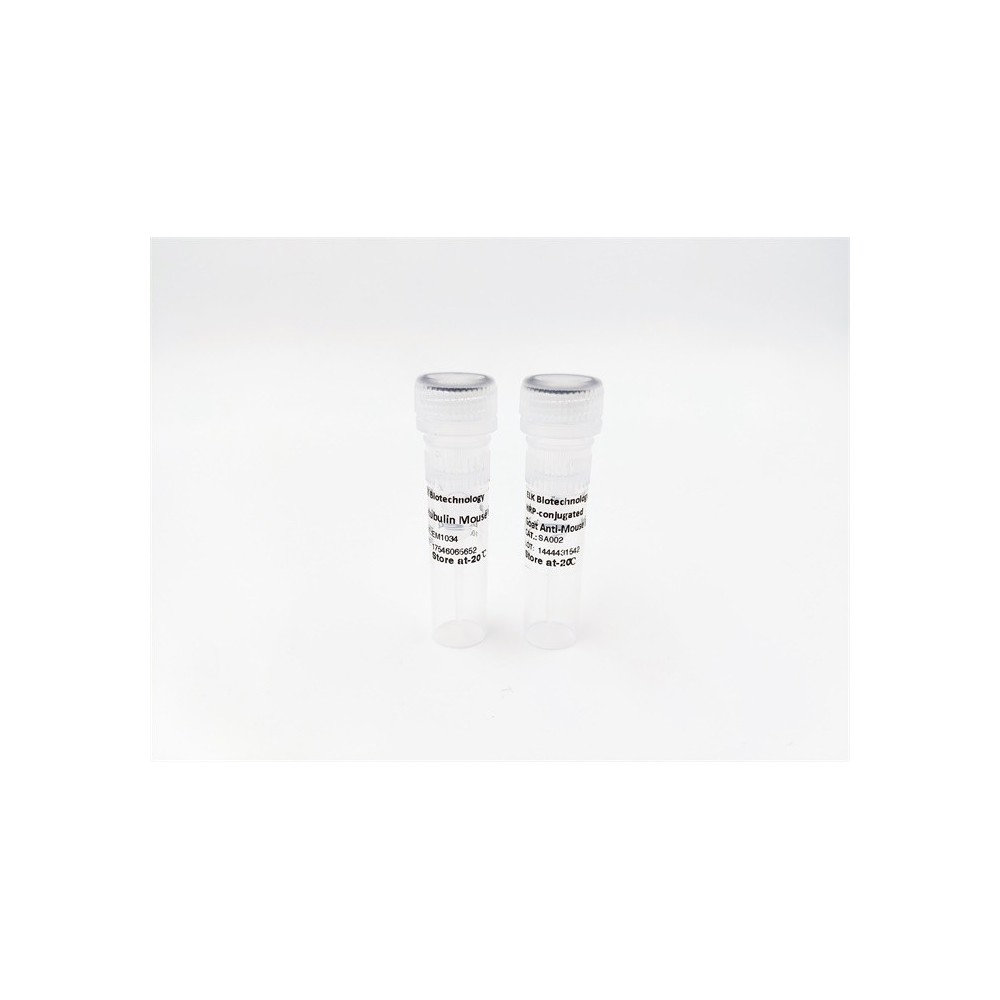

| ELK.No | ES5772 |
| Product name | AIRE-1 rabbit pAb |
| Reactivity | Human;Rat;Mouse; |
| Applications | WB;ELISA |
| Other name | AIRE; APECED; Autoimmune regulator; Autoimmune polyendocrinopathy candidiasis ectodermal dystrophy protein; APECED protein |
| Size | 50μL |
| Unit price ($) | 148 |
| Human gene ID | 326 |
| Human Swiss-Prot | O43918 |
| Source | Rabbit |
| Isotype | IgG |
| Target | AIRE-1 |
| Fields | >>Ubiquitin mediated proteolysis;>>Primary immunodeficiency |
| Gene name | AIRE |
| Protein name | Autoimmune regulator |
| Human gene link | View Human Gene |
| Human Swiss link | View Human Swiss-Prot |
| Mouse gene ID | |
| Mouse gene link | |
| Mouse Swiss-Prot | Q9Z0E3 |
| Mouse Swiss link | View Mouse Swiss-Prot |
| Rat gene ID | |
| Rat gene link | |
| Rat Swiss-Prot | |
| Rat Swiss link | |
| Immunogen | The antiserum was produced against synthesized peptide derived from human AIRE. AA range:126-175 |
| Specificity | AIRE-1 Polyclonal Antibody detects endogenous levels of AIRE-1 protein. |
| Formulation | Liquid in PBS containing 50% glycerol, 0.5% BSA and 0.02% sodium azide. |
| Clonality | Polyclonal |
| Dilution | Western Blot: 1/500 - 1/2000. ELISA: 1/5000. Not yet tested in other applications. |
| Purification | The antibody was affinity-purified from rabbit antiserum by affinity-chromatography using epitope-specific immunogen. |
| Concentration | 1 mg/ml |
| Storage stability | -20°C/1 year |
| Molecular Weight (Da) | |
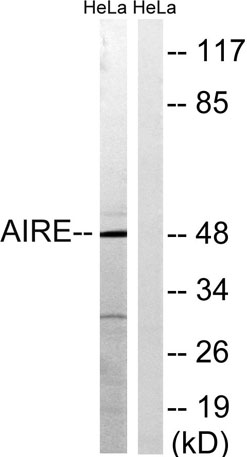
| Observed band (KD) | 50kD |
| Background | This gene encodes a transcriptional regulator that forms nuclear bodies and interacts with the transcriptional coactivator CREB binding protein. The encoded protein plays an important role in immunity by regulating the expression of autoantigens and negative selection of autoreactive T-cells in the thymus. Mutations in this gene cause the rare autosomal-recessive systemic autoimmune disease termed autoimmune polyendocrinopathy with candidiasis and ectodermal dystrophy (APECED). [provided by RefSeq, Jun 2012], |
| Function | alternative products:Additional isoforms seem to exist. Experimental confirmation may be lacking for some isoforms,disease:Defects in AIRE are a cause of autoimmune poly-endocrinopathy candidiasis ectodermal dystrophy (APECED) [MIM:240300]; also known as autoimmune polyglandular syndrome type I (APS-1). APECED is an autosomal recessive disease characterized by: (1) autoimmune polyendocrinopathies: hypoparathyroidism, adrenocortical failure, IDDM, gonadal failure, hypothyroidism, pernicious anemia, and hepatitis; (2) chronic mucocutaneous candidiasis; (3) ectodermal dystrophies: vitiligo, alopecia, keratopathy, dystrophy of dental enamel, nails and tympanic membranes. In addition, a high proportion of patients develop squamous cell carcinoma of the oral mucosa. The disease is reported worldwide but is exceptionally prevalent among the Finnish population (incidence 1:25000) and the Iranian |
| Subcellular location | Nucleus . Cytoplasm . Predominantly nuclear but also cytoplasmic (PubMed:11274163, PubMed:14974083). Found in nuclear body-like structures (dots) and in a filamentous vimentin-like pattern (PubMed:11274163, PubMed:14974083, PubMed:26084028). Associated with tubular structures (PubMed:11274163, PubMed:14974083). . |
| Expression | Widely expressed. Expressed at higher level in thymus (medullary epithelial cells and monocyte-dendritic cells), pancreas, adrenal cortex and testis. Expressed at lower level in the spleen, fetal liver and lymph nodes. In secondary lymphoid organs, expressed in a discrete population of bone marrow-derived toleregenic antigen presenting cells (APCs) called extrathymic AIRE expressing cells (eTAC)(at protein level) (PubMed:23993652). Isoform 2 and isoform 3 seem to be less frequently expressed than isoform 1, if at all. |

Use collapsible tabs for more detailed information that will help customers make a purchasing decision.
Ex: Shipping and return policies, size guides, and other common questions.