 Français
 English

| ELK.No | ES5802 |
| Product name | SR-2C rabbit pAb |
| Reactivity | Human;Mouse;Rat |
| Applications | WB;IHC;IF;ELISA |
| Other name | HTR2C; HTR1C; 5-hydroxytryptamine receptor 2C; 5-HT-2C; 5-HT2C; 5-HTR2C; 5-hydroxytryptamine receptor 1C; 5-HT-1C; 5-HT1C; Serotonin receptor 2C |
| Size | 50μL |
| Unit price ($) | 148 |
| Human gene ID | 3358 |
| Human Swiss-Prot | P28335 |
| Source | Rabbit |
| Isotype | IgG |
| Target | SR-2C |
| Fields | >>Calcium signaling pathway;>>Neuroactive ligand-receptor interaction;>>Gap junction;>>Serotonergic synapse;>>Inflammatory mediator regulation of TRP channels |
| Gene name | HTR2C |
| Protein name | 5-hydroxytryptamine receptor 2C |
| Human gene link | View Human Gene |
| Human Swiss link | View Human Swiss-Prot |
| Mouse gene ID | 15560 |
| Mouse gene link | View Mouse Gene |
| Mouse Swiss-Prot | P34968 |
| Mouse Swiss link | View Mouse Swiss-Prot |
| Rat gene ID | 25187 |
| Rat gene link | View Rat Gene |
| Rat Swiss-Prot | P08909 |
| Rat Swiss link | View Rat Swiss-Prot |
| Immunogen | The antiserum was produced against synthesized peptide derived from human 5-HT-2C. AA range:161-210 |
| Specificity | SR-2C Polyclonal Antibody detects endogenous levels of SR-2C protein. |
| Formulation | Liquid in PBS containing 50% glycerol, 0.5% BSA and 0.02% sodium azide. |
| Clonality | Polyclonal |
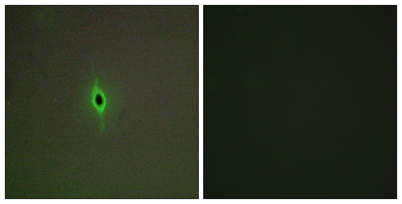
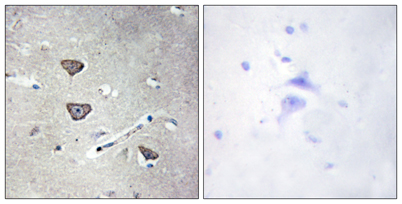
| Dilution | Western Blot: 1/500 - 1/2000. Immunohistochemistry: 1/100 - 1/300. Immunofluorescence: 1/200 - 1/1000. ELISA: 1/5000. Not yet tested in other applications. |
| Purification | The antibody was affinity-purified from rabbit antiserum by affinity-chromatography using epitope-specific immunogen. |
| Concentration | 1 mg/ml |
| Storage stability | -20°C/1 year |
| Molecular Weight (Da) | |
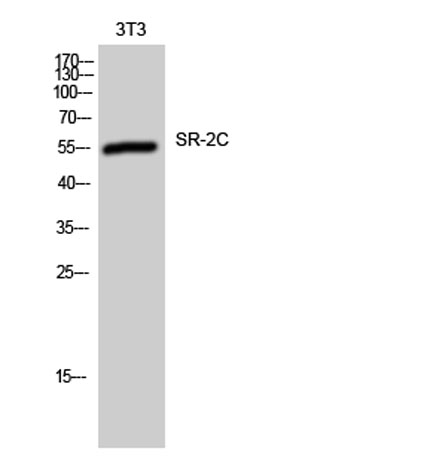
| Observed band (KD) | 55kD |
| Background | This gene encodes a seven-transmembrane G-protein-coupled receptor. The encoded protein responds to signaling through the neurotransmitter serotonin. The mRNA of this gene is subject to multiple RNA editing events, where adenosine residues encoded by the genome are converted to inosines. RNA editing is predicted to alter the structure of the second intracellular loop, thereby generating alternate protein forms with decreased ability to interact with G proteins. Abnormalities in RNA editing of this gene have been detected in victims of suicide that suffer from depression. In addition, naturally-occuring variation in the promoter and 5' non-coding and coding regions of this gene may show statistically-significant association with mental illness and behavioral disorders. Alternative splicing results in multiple different transcript variants. [provided by RefSeq, Jan 2015], |
| Function | domain:The PDZ domain-binding motif is involved in the interaction with MPDZ.,function:This is one of the several different receptors for 5-hydroxytryptamine (serotonin), a biogenic hormone that functions as a neurotransmitter, a hormone, and a mitogen. This receptor mediates its action by association with G proteins that activate a phosphatidylinositol-calcium second messenger system.,polymorphism:Position 23 is polymorphic; the frequencies in unrelated Caucasians are 0.87 for Cys and 0.13 for Ser.,PTM:N-glycosylated.,RNA editing:Partially edited. RNA editing generates receptor isoforms that differ in their ability to interact with the phospholipase C signaling cascade in a transfected cell line, suggesting that this RNA processing event may contribute to the modulation of serotonergic neurotransmission in the central nervous system.,similarity:Belongs to the G-protein coupled receptor |
| Subcellular location | Cell membrane ; Multi-pass membrane protein . |
| Expression | Detected in brain. |

Use collapsible tabs for more detailed information that will help customers make a purchasing decision.
Ex: Shipping and return policies, size guides, and other common questions.