 Français
 English
Cleaved-Integrin α5 HC (F42) rabbit pAb
AO-06-ES5944-100

| ELK.No | ES5944 |
| Product name | Cleaved-Integrin α5 HC (F42) rabbit pAb |
| Reactivity | Human;Mouse |
| Applications | WB;ELISA |
| Other name | ITGA5; FNRA; Integrin alpha-5; CD49 antigen-like family member E; Fibronectin receptor subunit alpha; Integrin alpha-F; VLA-5; CD antigen CD49e |
| Size | 100μL |
| Unit price ($) | 248 |
| Human gene ID | 3678 |
| Human Swiss-Prot | P08648 |
| Source | Rabbit |
| Isotype | IgG |
| Target | Integrin α5 |
| Fields | >>Phagosome;>>PI3K-Akt signaling pathway;>>Focal adhesion;>>ECM-receptor interaction;>>Hematopoietic cell lineage;>>Regulation of actin cytoskeleton;>>Bacterial invasion of epithelial cells;>>Shigellosis;>>Pertussis;>>Yersinia infection;>>Human papillomavirus infection;>>Herpes simplex virus 1 infection;>>Proteoglycans in cancer;>>MicroRNAs in cancer;>>Hypertrophic cardiomyopathy;>>Arrhythmogenic right ventricular cardiomyopathy;>>Dilated cardiomyopathy |
| Gene name | ITGA5 |
| Protein name | Integrin alpha-5 |
| Human gene link | View Human Gene |
| Human Swiss link | View Human Swiss-Prot |
| Mouse gene ID | 16402 |
| Mouse gene link | View Mouse Gene |
| Mouse Swiss-Prot | P11688 |
| Mouse Swiss link | View Mouse Swiss-Prot |
| Rat gene ID | |
| Rat gene link | |
| Rat Swiss-Prot | |
| Rat Swiss link | |
| Immunogen | The antiserum was produced against synthesized peptide derived from human ITGA5. AA range:23-72 |
| Specificity | Cleaved-Integrin α5 HC (F42) Polyclonal Antibody detects endogenous levels of fragment of activated Integrin α5 HC protein resulting from cleavage adjacent to F42. |
| Formulation | Liquid in PBS containing 50% glycerol, 0.5% BSA and 0.02% sodium azide. |
| Clonality | Polyclonal |
| Dilution | Western Blot: 1/500 - 1/2000. ELISA: 1/10000. Not yet tested in other applications. |
| Purification | The antibody was affinity-purified from rabbit antiserum by affinity-chromatography using epitope-specific immunogen. |
| Concentration | 1 mg/ml |
| Storage stability | -20°C/1 year |
| Molecular Weight (Da) | |
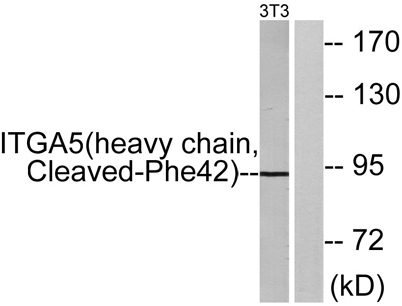
| Observed band (KD) | 92kD |
| Background | integrin subunit alpha 5(ITGA5) Homo sapiens The product of this gene belongs to the integrin alpha chain family. Integrins are heterodimeric integral membrane proteins composed of an alpha subunit and a beta subunit that function in cell surface adhesion and signaling. The encoded preproprotein is proteolytically processed to generate light and heavy chains that comprise the alpha 5 subunit. This subunit associates with the beta 1 subunit to form a fibronectin receptor. This integrin may promote tumor invasion, and higher expression of this gene may be correlated with shorter survival time in lung cancer patients. Note that the integrin alpha 5 and integrin alpha V subunits are encoded by distinct genes. [provided by RefSeq, Oct 2015], |
| Function | function:Integrin alpha-5/beta-1 is a receptor for fibronectin and fibrinogen. It recognizes the sequence R-G-D in its ligands. In case of HIV-1 infection, the interaction with extracellular viral Tat protein seems to enhance angiogenesis in Kaposi's sarcoma lesions.,similarity:Belongs to the integrin alpha chain family.,similarity:Contains 7 FG-GAP repeats.,subunit:Heterodimer of an alpha and a beta subunit. The alpha subunit is composed of an heavy and a light chain linked by a disulfide bond. Alpha-5 associates with beta-1. Interacts with HPS5 and NISCH. Interacts with HIV-1 Tat. Interacts with RAB21., |
| Subcellular location | Membrane; Single-pass type I membrane protein. Cell junction, focal adhesion . Cell surface . |
| Expression | Liver,Placenta, |

Use collapsible tabs for more detailed information that will help customers make a purchasing decision.
Ex: Shipping and return policies, size guides, and other common questions.